Compare commits
172 Commits
| Author | SHA1 | Date | |
|---|---|---|---|
 Sidharth Mohanty Sidharth Mohanty
|
b4f3bbbbc9 | ||
|
Deshraj Yadav
|
3cd50c4cd9 | ||
|
Sidharth Mohanty
|
cd2c40a9c4 | ||
|
Sidharth Mohanty
|
33dcfe42b5 | ||
|
Deven Patel
|
db37b2ac15 | ||
|
Sidharth Mohanty
|
bee4e834b1 | ||
|
Sidharth Mohanty
|
0272459435 | ||
|
Deven Patel
|
c0b5e93967 | ||
|
Sidharth Mohanty
|
6983ebba49 | ||
|
Sidharth Mohanty
|
9943d1e015 | ||
|
Sidharth Mohanty
|
b348251484 | ||
|
xuxiang
|
e719b5bac3 | ||
|
Sidharth Mohanty
|
54f43215cd | ||
|
Deven Patel
|
b246d9823e | ||
|
Deven Patel
|
65c8dd445b | ||
|
Deven Patel
|
0efbc80ac9 | ||
|
Deven Patel
|
151746beec | ||
|
Deven Patel
|
c0ee680546 | ||
|
Sidharth Mohanty
|
9303a1bf81 | ||
|
Deshraj Yadav
|
d54cdc5b00 | ||
|
Sidharth Mohanty
|
b7a44ef472 | ||
|
Deven Patel
|
ae6f866901 | ||
|
Sidharth Mohanty
|
7910cee259 | ||
|
Deshraj Yadav
|
d66e647f99 | ||
|
Deven Patel
|
ff4a333be7 | ||
|
Deshraj Yadav
|
111749a95d | ||
|
Deshraj Yadav
|
adde398b65 | ||
|
Sidharth Mohanty
|
d8897ce356 | ||
|
Deven Patel
|
0ea8ab228c | ||
|
Sidharth Mohanty
|
d62a23edf6 | ||
|
Sidharth Mohanty
|
51ebf3439b | ||
|
Deven Patel
|
4a5ed1dd8d | ||
|
Deven Patel
|
e84b5034ea | ||
|
Deven Patel
|
a4831d6ed9 | ||
|
Deven Patel
|
51b4966801 | ||
|
atkinsh
|
1d4e00ccef | ||
|
Deven Patel
|
c9fbc2e7d6 | ||
|
Deshraj Yadav
|
fa34788df6 | ||
|
Deven Patel
|
0f4f220119 | ||
|
Deven Patel
|
512cfc9466 | ||
|
Deshraj Yadav
|
541b1cb7c7 | ||
|
Deven Patel
|
36af1a7615 | ||
|
Deshraj Yadav
|
b02e8feeda | ||
|
Deven Patel
|
406c46e7f4 | ||
|
Sidharth Mohanty
|
e35eaf1bfc | ||
|
Sidharth Mohanty
|
38426a7af1 | ||
|
Deshraj Yadav
|
141a23fb1e | ||
|
Sidharth Mohanty
|
bb28569abf | ||
|
Deshraj Yadav
|
1df46b2bb3 | ||
|
Deshraj Yadav
|
58f72e1ffe | ||
|
Deshraj Yadav
|
33409140b4 | ||
|
Deshraj Yadav
|
f6b80e01a1 | ||
|
Sidharth Mohanty
|
798d3fcc5a | ||
|
Sidharth Mohanty
|
85f3ac428b | ||
|
Deshraj Yadav
|
9fcf2130b5 | ||
|
Taranjeet Singh
|
51df00729e | ||
|
Deven Patel
|
023a61446f | ||
|
Deshraj Yadav
|
e0b73e6a5a | ||
|
Deven Patel
|
28460f725c | ||
|
Deshraj Yadav
|
c93e49d2b8 | ||
|
Deven Patel
|
07fb6bee54 | ||
|
Deshraj Yadav
|
3fa7db8420 | ||
|
Deven Patel
|
c14bd7b73b | ||
|
Sidharth Mohanty
|
5201beaab0 | ||
|
Sidharth Mohanty
|
122313d8a5 | ||
|
Deven Patel
|
82fd595306 | ||
|
Deven Patel
|
95c0d47236 | ||
|
Deven Patel
|
919cc74e94 | ||
|
Deshraj Yadav
|
d839991acb | ||
|
Deven Patel
|
539286aafd | ||
|
Sidharth Mohanty
|
23522b7b55 | ||
|
UnMonsieur
|
bf3fac56e4 | ||
|
Deshraj Yadav
|
a5bf8e9075 | ||
|
Deshraj Yadav
|
1d31b8f7e4 | ||
|
Deshraj Yadav
|
b144c7dccc | ||
|
Deshraj Yadav
|
1364975396 | ||
|
Deven Patel
|
deaa7f50f8 | ||
|
Sidharth Mohanty
|
744ab5156f | ||
|
Sidharth Mohanty
|
c45413969a | ||
|
Deshraj Yadav
|
b314e5e080 | ||
|
Deshraj Yadav
|
17129e2eaa | ||
|
Deven Patel
|
654fd8d74c | ||
|
Sidharth Mohanty
|
9d3568ef75 | ||
|
Sidharth Mohanty
|
14712cac88 | ||
|
Deshraj Yadav
|
0d568c758b | ||
|
Deshraj Yadav
|
7c6b88c7c5 | ||
|
Deshraj Yadav
|
32c93be46e | ||
|
Deven Patel
|
7de8d85199 | ||
|
Deshraj Yadav
|
f7dd65a3de | ||
|
Sidharth Mohanty
|
d8cdbe0041 | ||
|
Sidharth Mohanty
|
2b8b6d3ea9 | ||
|
Sidharth Mohanty
|
936c7e389f | ||
|
Sidharth Mohanty
|
6864b4207b | ||
|
Deshraj Yadav
|
98eb5b54be | ||
|
Deshraj Yadav
|
3332e6e236 | ||
|
Deven Patel
|
0533da72d7 | ||
|
Sidharth Mohanty
|
a1de238716 | ||
|
Deshraj Yadav
|
f0d112254b | ||
|
Sidharth Mohanty
|
830a7397ef | ||
|
Deven Patel
|
5428765329 | ||
|
Sidharth Mohanty
|
23c912f2b7 | ||
|
Sidharth Mohanty
|
9c4b023297 | ||
|
Deven Patel
|
53037b5ed8 | ||
|
Sidharth Mohanty
|
e2546a653d | ||
|
Deshraj Yadav
|
4b8cada873 | ||
|
Deshraj Yadav
|
fa3ca1d08a | ||
|
Sidharth Mohanty
|
8dd5cb9602 | ||
|
Deven Patel
|
a054f7be9c | ||
|
Deven Patel
|
df314dc6d1 | ||
|
Deven Patel
|
930280f4ce | ||
|
Deshraj Yadav
|
5022c1ae29 | ||
|
Deshraj Yadav
|
6ced756a6b | ||
|
Deshraj Yadav
|
b17268db50 | ||
|
Deshraj Yadav
|
476da37009 | ||
|
Deshraj Yadav
|
455f059c6f | ||
|
Deven Patel
|
5255a37c93 | ||
|
Deven Patel
|
68dc274f72 | ||
|
Deshraj Yadav
|
30228f7f8e | ||
|
Sidharth Mohanty
|
e15ef79ca9 | ||
|
Deshraj Yadav
|
bc012a7518 | ||
|
Sidharth Mohanty
|
3b4409cfad | ||
|
Deshraj Yadav
|
d3726134b2 | ||
|
anujshandillya
|
5acb7f1c55 | ||
|
Deshraj Yadav
|
81336668b3 | ||
|
Deshraj Yadav
|
35c2b83015 | ||
|
Deshraj Yadav
|
cc1ee1deaa | ||
|
Deshraj Yadav
|
29bd038579 | ||
|
Deshraj Yadav
|
f6c4f86986 | ||
|
Deven Patel
|
68183e9dce | ||
|
Deshraj Yadav
|
78ec91a3a9 | ||
|
Deven Patel
|
c95d458e52 | ||
|
Deshraj Yadav
|
191ae3ec1e | ||
|
Deshraj Yadav
|
ab9598d00a | ||
|
Deven Patel
|
0f8a2e624a | ||
|
Deven Patel
|
d77e8da3f3 | ||
|
Sidharth Mohanty
|
a27eeb3255 | ||
|
Deshraj Yadav
|
413ccb83e6 | ||
|
Deven Patel
|
797bb567c6 | ||
|
Deshraj Yadav
|
f2a5dc40ee | ||
|
Deshraj Yadav
|
3979480532 | ||
|
Abhinesh
|
76f1993e7a | ||
|
Deshraj Yadav
|
d783fa2b89 | ||
|
Sidharth Mohanty
|
bbce18caac | ||
|
Deshraj Yadav
|
3ce2d8a656 | ||
|
Deshraj Yadav
|
a5c86a2f5c | ||
|
Deshraj Yadav
|
d18e533adf | ||
|
Sidharth Mohanty
|
2b881aaad0 | ||
|
Sidharth Mohanty
|
39cc07608f | ||
|
Sidharth Mohanty
|
9894cfcced | ||
|
Sidharth Mohanty
|
b5d80be037 | ||
|
Sidharth Mohanty
|
b7870fbd9b | ||
|
Sidharth Mohanty
|
36e6d486fc | ||
|
Sidharth Mohanty
|
2d5dc84f1a | ||
|
Deshraj Yadav
|
b47405e1bd | ||
|
Muhammad Muzammil
|
8b64deab40 | ||
|
Rupesh Bansal
|
c8846e0e93 | ||
|
Deven Patel
|
7641cba01d | ||
|
Sidharth Mohanty
|
4dc1785ef1 | ||
|
Sidharth Mohanty
|
b2286f3e34 | ||
|
Sidharth Mohanty
|
65a20aa457 | ||
|
Rupesh Bansal
|
d8a7d71344 | ||
|
Deshraj Yadav
|
bb490df9a6 | ||
|
Rupesh Bansal
|
cdfd6519c8 | ||
|
Sidharth Mohanty
|
e8a2846449 | ||
|
Sidharth Mohanty
|
d065cbf934 | ||
|
Sidharth Mohanty
|
413b107b9a | ||
|
Deshraj Yadav
|
c336292346 | ||
|
Deshraj Yadav
|
adf50f1e81 | ||
|
Deshraj Yadav
|
636bc0a99d | ||
|
Rupesh Bansal
|
a7a61fae1d | ||
|
Sidharth Mohanty
|
5ec12212e4 | ||
|
Deshraj Yadav
|
77c90a308e |
@@ -3,7 +3,15 @@ name: ci
|
||||
on:
|
||||
push:
|
||||
branches: [main]
|
||||
paths:
|
||||
- 'embedchain/**'
|
||||
- 'tests/**'
|
||||
- 'examples/**'
|
||||
pull_request:
|
||||
paths:
|
||||
- 'embedchain/**'
|
||||
- 'tests/**'
|
||||
- 'examples/**'
|
||||
|
||||
jobs:
|
||||
build:
|
||||
@@ -19,14 +27,23 @@ jobs:
|
||||
with:
|
||||
python-version: ${{ matrix.python-version }}
|
||||
- name: Install poetry
|
||||
run: pip install poetry==1.4.2
|
||||
uses: snok/install-poetry@v1
|
||||
with:
|
||||
version: 1.4.2
|
||||
virtualenvs-create: true
|
||||
virtualenvs-in-project: true
|
||||
- name: Load cached venv
|
||||
id: cached-poetry-dependencies
|
||||
uses: actions/cache@v2
|
||||
with:
|
||||
path: .venv
|
||||
key: venv-${{ runner.os }}-${{ hashFiles('**/poetry.lock') }}
|
||||
- name: Install dependencies
|
||||
run: poetry install --all-extras
|
||||
if: steps.cached-poetry-dependencies.outputs.cache-hit != 'true'
|
||||
- name: Lint with ruff
|
||||
run: make lint
|
||||
- name: Test with pytest
|
||||
run: make test
|
||||
- name: Generate coverage report
|
||||
- name: Run tests and generate coverage report
|
||||
run: make coverage
|
||||
- name: Upload coverage reports to Codecov
|
||||
uses: codecov/codecov-action@v3
|
||||
@@ -34,4 +51,3 @@ jobs:
|
||||
file: coverage.xml
|
||||
env:
|
||||
CODECOV_TOKEN: ${{ secrets.CODECOV_TOKEN }}
|
||||
|
||||
|
||||
+6
-2
@@ -76,7 +76,6 @@ docs/_build/
|
||||
target/
|
||||
|
||||
# Jupyter Notebook
|
||||
.ipynb_checkpoints
|
||||
|
||||
# IPython
|
||||
profile_default/
|
||||
@@ -165,9 +164,14 @@ cython_debug/
|
||||
|
||||
# Database
|
||||
db
|
||||
test-db
|
||||
|
||||
.vscode
|
||||
/poetry.lock
|
||||
.idea/
|
||||
|
||||
.DS_Store
|
||||
|
||||
notebooks/*.yaml
|
||||
.ipynb_checkpoints/
|
||||
|
||||
!configs/*.yaml
|
||||
|
||||
+4
-4
@@ -1,10 +1,10 @@
|
||||
# Contributing to embedchain
|
||||
|
||||
Let us make contributing easy, collaborative and fun.
|
||||
Let us make contribution easy, collaborative and fun.
|
||||
|
||||
## Submit your Contribution through PR
|
||||
|
||||
To make a contribution, follow the following steps:
|
||||
To make a contribution, follow these steps:
|
||||
|
||||
1. Fork and clone this repository
|
||||
2. Do the changes on your fork with dedicated feature branch `feature/f1`
|
||||
@@ -35,7 +35,7 @@ poetry shell
|
||||
|
||||
### 📌 Pre-commit
|
||||
|
||||
To ensure our standards, make sure to install pre-commit before star to contribute.
|
||||
To ensure our standards, make sure to install pre-commit before starting to contribute.
|
||||
|
||||
```bash
|
||||
pre-commit install
|
||||
@@ -51,7 +51,7 @@ make lint
|
||||
|
||||
Make sure that the linter does not report any errors or warnings before submitting a pull request.
|
||||
|
||||
### Code Format with `black`
|
||||
### Code Formatting with `black`
|
||||
|
||||
We use `black` to reformat the code by running the following command:
|
||||
|
||||
|
||||
@@ -38,7 +38,7 @@ lint:
|
||||
poetry run ruff .
|
||||
|
||||
test:
|
||||
poetry run pytest
|
||||
poetry run pytest $(file)
|
||||
|
||||
coverage:
|
||||
poetry run pytest --cov=$(PROJECT_NAME) --cov-report=xml
|
||||
|
||||
@@ -1,62 +1,71 @@
|
||||
# embedchain
|
||||
<p align="center">
|
||||
<img src="docs/logo/dark.svg" width="400px" alt="Embedchain Logo">
|
||||
</p>
|
||||
|
||||
[](https://pypi.org/project/embedchain/)
|
||||
[](https://join.slack.com/t/embedchain/shared_invite/zt-22uwz3c46-Zg7cIh5rOBteT_xe1jwLDw)
|
||||
[](https://discord.gg/CUU9FPhRNt)
|
||||
[](https://twitter.com/embedchain)
|
||||
[](https://embedchain.substack.com/)
|
||||
[](https://colab.research.google.com/drive/138lMWhENGeEu7Q1-6lNbNTHGLZXBBz_B?usp=sharing)
|
||||
[](https://codecov.io/gh/embedchain/embedchain)
|
||||
<p align="center">
|
||||
<a href="https://runacap.com/ross-index/q3-2023/" target="_blank" rel="noopener"><img style="width: 260px; height: 56px" src="https://runacap.com/wp-content/uploads/2023/10/ROSS_badge_black_Q3_2023.svg" alt="ROSS Index - Fastest Growing Open-Source Startups in Q3 2023 | Runa Capital" width="260" height="56"/></a>
|
||||
</p>
|
||||
|
||||
Embedchain is a framework to easily create LLM powered bots over any dataset. If you want a javascript version, check out [embedchain-js](https://github.com/embedchain/embedchain/tree/main/embedchain-js)
|
||||
<p align="center">
|
||||
<a href="https://pypi.org/project/embedchain/">
|
||||
<img src="https://img.shields.io/pypi/v/embedchain" alt="PyPI">
|
||||
</a>
|
||||
<a href="https://join.slack.com/t/embedchain/shared_invite/zt-22uwz3c46-Zg7cIh5rOBteT_xe1jwLDw">
|
||||
<img src="https://img.shields.io/badge/slack-embedchain-brightgreen.svg?logo=slack" alt="Slack">
|
||||
</a>
|
||||
<a href="https://discord.gg/CUU9FPhRNt">
|
||||
<img src="https://dcbadge.vercel.app/api/server/6PzXDgEjG5?style=flat" alt="Discord">
|
||||
</a>
|
||||
<a href="https://twitter.com/embedchain">
|
||||
<img src="https://img.shields.io/twitter/follow/embedchain" alt="Twitter">
|
||||
</a>
|
||||
<a href="https://embedchain.substack.com/">
|
||||
<img src="https://img.shields.io/badge/Substack-%23006f5c.svg?logo=substack" alt="Substack">
|
||||
</a>
|
||||
<a href="https://colab.research.google.com/drive/138lMWhENGeEu7Q1-6lNbNTHGLZXBBz_B?usp=sharing">
|
||||
<img src="https://camo.githubusercontent.com/84f0493939e0c4de4e6dbe113251b4bfb5353e57134ffd9fcab6b8714514d4d1/68747470733a2f2f636f6c61622e72657365617263682e676f6f676c652e636f6d2f6173736574732f636f6c61622d62616467652e737667" alt="Open in Colab">
|
||||
</a>
|
||||
<a href="https://codecov.io/gh/embedchain/embedchain">
|
||||
<img src="https://codecov.io/gh/embedchain/embedchain/graph/badge.svg?token=EMRRHZXW1Q" alt="codecov">
|
||||
</a>
|
||||
<a href="https://pepy.tech/project/embedchain">
|
||||
<img src="https://static.pepy.tech/badge/embedchain" alt="Downloads">
|
||||
</a>
|
||||
</p>
|
||||
|
||||
## Community
|
||||
<hr />
|
||||
|
||||
* Join embedchain community on slack by accepting [this invite](https://join.slack.com/t/embedchain/shared_invite/zt-22uwz3c46-Zg7cIh5rOBteT_xe1jwLDw)
|
||||
|
||||
## 🤝 Schedule a 1-on-1 Session
|
||||
|
||||
Book a [1-on-1 Session](https://cal.com/taranjeetio/ec) with Taranjeet, the founder, to discuss any issues, provide feedback, or explore how we can improve Embedchain for you.
|
||||
## What is Embedchain?
|
||||
Embedchain is a Data Platform for Large Language Models (LLMs). Seamlessly load, index, retrieve, and sync unstructured data to build dynamic, LLM-powered applications. Check out [embedchain-js](https://github.com/embedchain/embedchain/tree/main/embedchain-js) for a JavaScript implementation.
|
||||
|
||||
## 🔧 Quick install
|
||||
|
||||
### Python API
|
||||
```bash
|
||||
pip install --upgrade embedchain
|
||||
```
|
||||
|
||||
## 🔍 Demo
|
||||
### REST API
|
||||
You can also run Embedchain as a REST API server using the following command:
|
||||
|
||||
Try out embedchain in your browser:
|
||||
```bash
|
||||
docker run --name embedchain -p 8080:8080 embedchain/rest-api:latest
|
||||
```
|
||||
|
||||
[](https://colab.research.google.com/drive/17ON1LPonnXAtLaZEebnOktstB_1cJJmh?usp=sharing)
|
||||
Then, navigate to http://0.0.0.0:8080/docs to interact with the API.
|
||||
|
||||
## 📖 Documentation
|
||||
## 🔍 Usage and Demo
|
||||
|
||||
The documentation for embedchain can be found at [docs.embedchain.ai](https://docs.embedchain.ai).
|
||||
<!-- Demo GIF or Image -->
|
||||
<p align="center">
|
||||
<img src="docs/images/cover.gif" width="900px" alt="Embedchain Demo">
|
||||
</p>
|
||||
|
||||
## 💻 Usage
|
||||
|
||||
Embedchain empowers you to create ChatGPT like apps, on your own dynamic dataset.
|
||||
|
||||
### Data Types Supported
|
||||
|
||||
* Youtube video
|
||||
* PDF file
|
||||
* Web page
|
||||
* Sitemap
|
||||
* Doc file
|
||||
* Code documentation website loader
|
||||
* Notion and many more.
|
||||
|
||||
You can find the full list of data types on [our documentation](https://docs.embedchain.ai/data-sources/csv).
|
||||
|
||||
### Queries
|
||||
|
||||
For example, you can use Embedchain to create an Elon Musk bot using the following code:
|
||||
For example, you can create an Elon Musk bot using the following code:
|
||||
|
||||
```python
|
||||
import os
|
||||
from embedchain import App
|
||||
from embedchain import Pipeline as App
|
||||
|
||||
# Create a bot instance
|
||||
os.environ["OPENAI_API_KEY"] = "YOUR API KEY"
|
||||
@@ -65,14 +74,44 @@ elon_bot = App()
|
||||
# Embed online resources
|
||||
elon_bot.add("https://en.wikipedia.org/wiki/Elon_Musk")
|
||||
elon_bot.add("https://www.forbes.com/profile/elon-musk")
|
||||
elon_bot.add("https://www.youtube.com/watch?v=RcYjXbSJBN8")
|
||||
|
||||
# Query the bot
|
||||
elon_bot.query("How many companies does Elon Musk run and name those?")
|
||||
# Answer: Elon Musk currently runs several companies. As of my knowledge, he is the CEO and lead designer of SpaceX, the CEO and product architect of Tesla, Inc., the CEO and founder of Neuralink, and the CEO and founder of The Boring Company. However, please note that this information may change over time, so it's always good to verify the latest updates.
|
||||
|
||||
# (Optional): Deploy app to Embedchain Platform
|
||||
app.deploy()
|
||||
# 🔑 Enter your Embedchain API key. You can find the API key at https://app.embedchain.ai/settings/keys/
|
||||
# ec-xxxxxx
|
||||
|
||||
# 🛠️ Creating pipeline on the platform...
|
||||
# 🎉🎉🎉 Pipeline created successfully! View your pipeline: https://app.embedchain.ai/pipelines/xxxxx
|
||||
|
||||
# 🛠️ Adding data to your pipeline...
|
||||
# ✅ Data of type: web_page, value: https://www.forbes.com/profile/elon-musk added successfully.
|
||||
```
|
||||
|
||||
## 🤝 Contributing
|
||||
You can also try it in your browser with Google Colab:
|
||||
|
||||
[](https://colab.research.google.com/drive/17ON1LPonnXAtLaZEebnOktstB_1cJJmh?usp=sharing)
|
||||
|
||||
## 📖 Documentation
|
||||
Comprehensive guides and API documentation are available to help you get the most out of Embedchain:
|
||||
|
||||
- [Getting Started](https://docs.embedchain.ai/get-started/quickstart)
|
||||
- [Introduction](https://docs.embedchain.ai/get-started/introduction#what-is-embedchain)
|
||||
- [Examples](https://docs.embedchain.ai/examples)
|
||||
- [Supported data types](https://docs.embedchain.ai/components/data-sources/overview)
|
||||
|
||||
## 🔗 Join the Community
|
||||
|
||||
Connect with fellow developers and users by joining our [Slack Workspace](https://join.slack.com/t/embedchain/shared_invite/zt-22uwz3c46-Zg7cIh5rOBteT_xe1jwLDw). Dive into discussions, ask questions, and share your experiences.
|
||||
|
||||
## 🤝 Schedule a 1-on-1 Session
|
||||
|
||||
Book a [1-on-1 Session](https://cal.com/taranjeetio/ec) with Taranjeet, the founder, to discuss any issues, provide feedback, or explore how we can improve Embedchain for you.
|
||||
|
||||
## 🌐 Contributing
|
||||
|
||||
Contributions are welcome! Please check out the issues on the repository, and feel free to open a pull request.
|
||||
For more information, please see the [contributing guidelines](CONTRIBUTING.md).
|
||||
@@ -94,7 +133,7 @@ If you utilize this repository, please consider citing it with:
|
||||
```
|
||||
@misc{embedchain,
|
||||
author = {Taranjeet Singh, Deshraj Yadav},
|
||||
title = {Embedchain: Framework to easily create LLM powered bots over any dataset},
|
||||
title = {Embedchain: Data platform for LLMs - load, index, retrieve, and sync any unstructured data},
|
||||
year = {2023},
|
||||
publisher = {GitHub},
|
||||
journal = {GitHub repository},
|
||||
|
||||
@@ -1,7 +1,7 @@
|
||||
llm:
|
||||
provider: anthropic
|
||||
model: 'claude-instant-1'
|
||||
config:
|
||||
model: 'claude-instant-1'
|
||||
temperature: 0.5
|
||||
max_tokens: 1000
|
||||
top_p: 1
|
||||
|
||||
@@ -0,0 +1,19 @@
|
||||
app:
|
||||
config:
|
||||
id: azure-openai-app
|
||||
|
||||
llm:
|
||||
provider: azure_openai
|
||||
config:
|
||||
model: gpt-35-turbo
|
||||
deployment_name: your_llm_deployment_name
|
||||
temperature: 0.5
|
||||
max_tokens: 1000
|
||||
top_p: 1
|
||||
stream: false
|
||||
|
||||
embedder:
|
||||
provider: azure_openai
|
||||
config:
|
||||
model: text-embedding-ada-002
|
||||
deployment_name: you_embedding_model_deployment_name
|
||||
+1
-2
@@ -5,8 +5,8 @@ app:
|
||||
|
||||
llm:
|
||||
provider: openai
|
||||
model: 'gpt-3.5-turbo'
|
||||
config:
|
||||
model: 'gpt-3.5-turbo'
|
||||
temperature: 0.5
|
||||
max_tokens: 1000
|
||||
top_p: 1
|
||||
@@ -23,4 +23,3 @@ embedder:
|
||||
provider: openai
|
||||
config:
|
||||
model: 'text-embedding-ada-002'
|
||||
deployment_name: null
|
||||
|
||||
@@ -0,0 +1,4 @@
|
||||
chunker:
|
||||
chunk_size: 100
|
||||
chunk_overlap: 20
|
||||
length_function: 'len'
|
||||
+1
-1
@@ -1,7 +1,7 @@
|
||||
llm:
|
||||
provider: cohere
|
||||
model: large
|
||||
config:
|
||||
model: large
|
||||
temperature: 0.5
|
||||
max_tokens: 1000
|
||||
top_p: 1
|
||||
|
||||
@@ -2,10 +2,15 @@ app:
|
||||
config:
|
||||
id: 'full-stack-app'
|
||||
|
||||
chunker:
|
||||
chunk_size: 100
|
||||
chunk_overlap: 20
|
||||
length_function: 'len'
|
||||
|
||||
llm:
|
||||
provider: openai
|
||||
model: 'gpt-3.5-turbo'
|
||||
config:
|
||||
model: 'gpt-3.5-turbo'
|
||||
temperature: 0.5
|
||||
max_tokens: 1000
|
||||
top_p: 1
|
||||
@@ -25,7 +30,7 @@ llm:
|
||||
vectordb:
|
||||
provider: chroma
|
||||
config:
|
||||
collection_name: 'full-stack-app'
|
||||
collection_name: 'my-collection-name'
|
||||
dir: db
|
||||
allow_reset: true
|
||||
|
||||
|
||||
@@ -0,0 +1,13 @@
|
||||
llm:
|
||||
provider: google
|
||||
config:
|
||||
model: gemini-pro
|
||||
max_tokens: 1000
|
||||
temperature: 0.9
|
||||
top_p: 1.0
|
||||
stream: false
|
||||
|
||||
embedder:
|
||||
provider: google
|
||||
config:
|
||||
model: models/embedding-001
|
||||
@@ -0,0 +1,8 @@
|
||||
llm:
|
||||
provider: openai
|
||||
config:
|
||||
model: 'gpt-4'
|
||||
temperature: 0.5
|
||||
max_tokens: 1000
|
||||
top_p: 1
|
||||
stream: false
|
||||
@@ -1,7 +1,7 @@
|
||||
llm:
|
||||
provider: gpt4all
|
||||
model: 'orca-mini-3b.ggmlv3.q4_0.bin'
|
||||
config:
|
||||
model: 'orca-mini-3b-gguf2-q4_0.gguf'
|
||||
temperature: 0.5
|
||||
max_tokens: 1000
|
||||
top_p: 1
|
||||
@@ -9,5 +9,3 @@ llm:
|
||||
|
||||
embedder:
|
||||
provider: gpt4all
|
||||
config:
|
||||
model: 'all-MiniLM-L6-v2'
|
||||
|
||||
@@ -1,7 +1,7 @@
|
||||
llm:
|
||||
provider: huggingface
|
||||
model: 'google/flan-t5-xxl'
|
||||
config:
|
||||
model: 'google/flan-t5-xxl'
|
||||
temperature: 0.5
|
||||
max_tokens: 1000
|
||||
top_p: 0.5
|
||||
|
||||
+1
-1
@@ -1,7 +1,7 @@
|
||||
llm:
|
||||
provider: llama2
|
||||
model: 'a16z-infra/llama13b-v2-chat:df7690f1994d94e96ad9d568eac121aecf50684a0b0963b25a41cc40061269e5'
|
||||
config:
|
||||
model: 'a16z-infra/llama13b-v2-chat:df7690f1994d94e96ad9d568eac121aecf50684a0b0963b25a41cc40061269e5'
|
||||
temperature: 0.5
|
||||
max_tokens: 1000
|
||||
top_p: 0.5
|
||||
|
||||
@@ -1,14 +1,14 @@
|
||||
app:
|
||||
config:
|
||||
id: 'my-app'
|
||||
log_level: 'WARN'
|
||||
log_level: 'WARNING'
|
||||
collect_metrics: true
|
||||
collection_name: 'my-app'
|
||||
|
||||
llm:
|
||||
provider: openai
|
||||
model: 'gpt-3.5-turbo'
|
||||
config:
|
||||
model: 'gpt-3.5-turbo'
|
||||
temperature: 0.5
|
||||
max_tokens: 1000
|
||||
top_p: 1
|
||||
@@ -30,4 +30,4 @@ embedder:
|
||||
provider: openai
|
||||
config:
|
||||
model: 'text-embedding-ada-002'
|
||||
deployment_name: null
|
||||
deployment_name: 'my-app'
|
||||
|
||||
@@ -6,8 +6,8 @@ app:
|
||||
|
||||
llm:
|
||||
provider: gpt4all
|
||||
model: 'orca-mini-3b.ggmlv3.q4_0.bin'
|
||||
config:
|
||||
model: 'orca-mini-3b-gguf2-q4_0.gguf'
|
||||
temperature: 0.5
|
||||
max_tokens: 1000
|
||||
top_p: 1
|
||||
@@ -23,5 +23,4 @@ vectordb:
|
||||
embedder:
|
||||
provider: gpt4all
|
||||
config:
|
||||
model: 'all-MiniLM-L6-v2'
|
||||
deployment_name: null
|
||||
deployment_name: 'test-deployment'
|
||||
|
||||
@@ -0,0 +1,6 @@
|
||||
vectordb:
|
||||
provider: pinecone
|
||||
config:
|
||||
metric: cosine
|
||||
vector_dimension: 1536
|
||||
collection_name: my-pinecone-index
|
||||
@@ -0,0 +1,26 @@
|
||||
pipeline:
|
||||
config:
|
||||
name: Example pipeline
|
||||
id: pipeline-1 # Make sure that id is different every time you create a new pipeline
|
||||
|
||||
vectordb:
|
||||
provider: chroma
|
||||
config:
|
||||
collection_name: pipeline-1
|
||||
dir: db
|
||||
allow_reset: true
|
||||
|
||||
llm:
|
||||
provider: gpt4all
|
||||
config:
|
||||
model: 'orca-mini-3b-gguf2-q4_0.gguf'
|
||||
temperature: 0.5
|
||||
max_tokens: 1000
|
||||
top_p: 1
|
||||
stream: false
|
||||
|
||||
embedding_model:
|
||||
provider: gpt4all
|
||||
config:
|
||||
model: 'all-MiniLM-L6-v2'
|
||||
deployment_name: null
|
||||
@@ -1,6 +1,6 @@
|
||||
llm:
|
||||
provider: vertexai
|
||||
model: 'chat-bison'
|
||||
config:
|
||||
model: 'chat-bison'
|
||||
temperature: 0.5
|
||||
top_p: 0.5
|
||||
|
||||
@@ -0,0 +1,4 @@
|
||||
vectordb:
|
||||
provider: weaviate
|
||||
config:
|
||||
collection_name: my_weaviate_index
|
||||
@@ -1,11 +1,11 @@
|
||||
<CardGroup cols={3}>
|
||||
<Card title="Talk to founders" icon="calendar" href="https://cal.com/taranjeetio/ec">
|
||||
Schedule a call
|
||||
</Card>
|
||||
<Card title="Slack" icon="slack" href="https://join.slack.com/t/embedchain/shared_invite/zt-22uwz3c46-Zg7cIh5rOBteT_xe1jwLDw" color="#4A154B">
|
||||
Join our slack community
|
||||
</Card>
|
||||
<Card title="Discord" icon="discord" href="https://discord.gg/6PzXDgEjG5" color="#7289DA">
|
||||
Join our discord community
|
||||
</Card>
|
||||
<Card title="Schedule a call" icon="calendar" href="https://cal.com/taranjeetio/ec">
|
||||
Schedule a call with Embedchain founder
|
||||
</Card>
|
||||
</CardGroup>
|
||||
|
||||
@@ -1,7 +1,9 @@
|
||||
<Tip>
|
||||
If you can't find the specific data source, please feel free to request through one of the following channels and help us prioritize.
|
||||
<p>If you can't find the specific data source, please feel free to request through one of the following channels and help us prioritize.</p>
|
||||
|
||||
<CardGroup cols={2}>
|
||||
<Card title="Google Form" icon="file" href="https://forms.gle/NDRCKsRpUHsz2Wcm8" color="#7387d0">
|
||||
Fill out this form
|
||||
</Card>
|
||||
<Card title="Slack" icon="slack" href="https://join.slack.com/t/embedchain/shared_invite/zt-22uwz3c46-Zg7cIh5rOBteT_xe1jwLDw" color="#4A154B">
|
||||
Let us know on our slack community
|
||||
</Card>
|
||||
@@ -15,4 +17,3 @@ If you can't find the specific data source, please feel free to request through
|
||||
Schedule a call with Embedchain founder
|
||||
</Card>
|
||||
</CardGroup>
|
||||
</Tip>
|
||||
|
||||
@@ -1,5 +1,4 @@
|
||||
<Tip>
|
||||
If you can't find the specific LLM you need, no need to fret. We're continuously expanding our support for additional LLMs, and you can help us prioritize by opening an issue on our GitHub or simply reaching out to us on our Slack or Discord community.
|
||||
<p>If you can't find the specific LLM you need, no need to fret. We're continuously expanding our support for additional LLMs, and you can help us prioritize by opening an issue on our GitHub or simply reaching out to us on our Slack or Discord community.</p>
|
||||
|
||||
<CardGroup cols={2}>
|
||||
<Card title="Slack" icon="slack" href="https://join.slack.com/t/embedchain/shared_invite/zt-22uwz3c46-Zg7cIh5rOBteT_xe1jwLDw" color="#4A154B">
|
||||
@@ -15,4 +14,3 @@ If you can't find the specific LLM you need, no need to fret. We're continuously
|
||||
Schedule a call with Embedchain founder
|
||||
</Card>
|
||||
</CardGroup>
|
||||
</Tip>
|
||||
|
||||
@@ -1,5 +1,6 @@
|
||||
<Tip>
|
||||
If you can't find the specific vector database, please feel free to request through one of the following channels and help us prioritize.
|
||||
|
||||
|
||||
<p>If you can't find the specific vector database, please feel free to request through one of the following channels and help us prioritize.</p>
|
||||
|
||||
<CardGroup cols={2}>
|
||||
<Card title="Slack" icon="slack" href="https://join.slack.com/t/embedchain/shared_invite/zt-22uwz3c46-Zg7cIh5rOBteT_xe1jwLDw" color="#4A154B">
|
||||
@@ -15,4 +16,3 @@ If you can't find the specific vector database, please feel free to request thro
|
||||
Schedule a call with Embedchain founder
|
||||
</Card>
|
||||
</CardGroup>
|
||||
</Tip>
|
||||
|
||||
@@ -1,75 +0,0 @@
|
||||
---
|
||||
title: '⚙️ Custom configurations'
|
||||
---
|
||||
|
||||
Embedchain is made to work out of the box. However, for advanced users we're also offering configuration options. All of these configuration options are optional and have sane defaults.
|
||||
|
||||
You can configure different components of your app (`llm`, `embedding model`, or `vector database`) through a simple yaml configuration that Embedchain offers. Here is a generic full-stack example of the yaml config:
|
||||
|
||||
```yaml
|
||||
app:
|
||||
config:
|
||||
id: 'full-stack-app'
|
||||
|
||||
llm:
|
||||
provider: openai
|
||||
model: 'gpt-3.5-turbo'
|
||||
config:
|
||||
temperature: 0.5
|
||||
max_tokens: 1000
|
||||
top_p: 1
|
||||
stream: false
|
||||
template: |
|
||||
Use the following pieces of context to answer the query at the end.
|
||||
If you don't know the answer, just say that you don't know, don't try to make up an answer.
|
||||
|
||||
$context
|
||||
|
||||
Query: $query
|
||||
|
||||
Helpful Answer:
|
||||
system_prompt: |
|
||||
Act as William Shakespeare. Answer the following questions in the style of William Shakespeare.
|
||||
|
||||
vectordb:
|
||||
provider: chroma
|
||||
config:
|
||||
collection_name: 'full-stack-app'
|
||||
dir: db
|
||||
allow_reset: true
|
||||
|
||||
embedder:
|
||||
provider: openai
|
||||
config:
|
||||
model: 'text-embedding-ada-002'
|
||||
```
|
||||
|
||||
Alright, let's dive into what each key means in the yaml config above:
|
||||
|
||||
1. `app` Section:
|
||||
- `config`:
|
||||
- `id` (String): The ID or name of your full-stack application.
|
||||
2. `llm` Section:
|
||||
- `provider` (String): The provider for the language model, which is set to 'openai'. You can find the full list of llm providers in [our docs](/components/llms).
|
||||
- `model` (String): The specific model being used, 'gpt-3.5-turbo'.
|
||||
- `config`:
|
||||
- `temperature` (Float): Controls the randomness of the model's output. A higher value (closer to 1) makes the output more random.
|
||||
- `max_tokens` (Integer): Controls how many tokens are used in the response.
|
||||
- `top_p` (Float): Controls the diversity of word selection. A higher value (closer to 1) makes word selection more diverse.
|
||||
- `stream` (Boolean): Controls if the response is streamed back to the user (set to false).
|
||||
- `template` (String): A custom template for the prompt that the model uses to generate responses.
|
||||
- `system_prompt` (String): A system prompt for the model to follow when generating responses, in this case, it's set to the style of William Shakespeare.
|
||||
3. `vectordb` Section:
|
||||
- `provider` (String): The provider for the vector database, set to 'chroma'. You can find the full list of vector database providers in [our docs](/components/vector-databases).
|
||||
- `config`:
|
||||
- `collection_name` (String): The initial collection name for the database, set to 'full-stack-app'.
|
||||
- `dir` (String): The directory for the database, set to 'db'.
|
||||
- `allow_reset` (Boolean): Indicates whether resetting the database is allowed, set to true.
|
||||
4. `embedder` Section:
|
||||
- `provider` (String): The provider for the embedder, set to 'openai'. You can find the full list of embedding model providers in [our docs](/components/embedding-models).
|
||||
- `config`:
|
||||
- `model` (String): The specific model used for text embedding, 'text-embedding-ada-002'.
|
||||
|
||||
If you have questions about the configuration above, please feel free to reach out to us using one of the following methods:
|
||||
|
||||
<Snippet file="get-help.mdx" />
|
||||
@@ -1,66 +0,0 @@
|
||||
---
|
||||
title: '🔍 Query configurations'
|
||||
---
|
||||
|
||||
## AppConfig
|
||||
|
||||
| option | description | type | default |
|
||||
|-----------|-----------------------|---------------------------------|------------------------|
|
||||
| log_level | log level | string | WARNING |
|
||||
| embedding_fn| embedding function | chromadb.utils.embedding_functions | \{text-embedding-ada-002\} |
|
||||
| db | vector database (experimental) | BaseVectorDB | ChromaDB |
|
||||
| collection_name | initial collection name for the database | string | embedchain_store |
|
||||
| collect_metrics | collect anonymous telemetry data to improve embedchain | boolean | true |
|
||||
|
||||
|
||||
## AddConfig
|
||||
|
||||
|option|description|type|default|
|
||||
|---|---|---|---|
|
||||
|chunker|chunker config|ChunkerConfig|Default values for chunker depends on the `data_type`. Please refer [ChunkerConfig](#chunker-config)|
|
||||
|loader|loader config|LoaderConfig|None|
|
||||
|
||||
Yes, you are passing `ChunkerConfig` to `AddConfig`, like so:
|
||||
|
||||
```python
|
||||
chunker_config = ChunkerConfig(chunk_size=100)
|
||||
add_config = AddConfig(chunker=chunker_config)
|
||||
app.add("lorem ipsum", config=add_config)
|
||||
```
|
||||
|
||||
### ChunkerConfig
|
||||
|
||||
|option|description|type|default|
|
||||
|---|---|---|---|
|
||||
|chunk_size|Maximum size of chunks to return|int|Default value for various `data_type` mentioned below|
|
||||
|chunk_overlap|Overlap in characters between chunks|int|Default value for various `data_type` mentioned below|
|
||||
|length_function|Function that measures the length of given chunks|typing.Callable|Default value for various `data_type` mentioned below|
|
||||
|
||||
Default values of chunker config parameters for different `data_type`:
|
||||
|
||||
|data_type|chunk_size|chunk_overlap|length_function|
|
||||
|---|---|---|---|
|
||||
|docx|1000|0|len|
|
||||
|text|300|0|len|
|
||||
|qna_pair|300|0|len|
|
||||
|web_page|500|0|len|
|
||||
|pdf_file|1000|0|len|
|
||||
|youtube_video|2000|0|len|
|
||||
|docs_site|500|50|len|
|
||||
|notion|300|0|len|
|
||||
|
||||
## BaseLlmConfig
|
||||
|
||||
|option|description|type|default|
|
||||
|---|---|---|---|
|
||||
|number_documents|Absolute number of documents to pull from the database as context.|int|1
|
||||
|template|custom template for prompt. If history is used with query, $history has to be included as well.|Template|Template("Use the following pieces of context to answer the query at the end. If you don't know the answer, just say that you don't know, don't try to make up an answer. \$context Query: \$query Helpful Answer:")|
|
||||
|model|name of the model used.|string|depends on app type|
|
||||
|temperature|Controls the randomness of the model's output. Higher values (closer to 1) make output more random, lower values make it more deterministic.|float|0|
|
||||
|max_tokens|Controls how many tokens are used. Exact implementation (whether it counts prompt and/or response) depends on the model.|int|1000|
|
||||
|top_p|Controls the diversity of words. Higher values (closer to 1) make word selection more diverse, lower values make words less diverse.|float|1|
|
||||
|history|include conversation history from your client or database.|any (recommendation: list[str])|None|
|
||||
|stream|control if response is streamed back to the user.|bool|False|
|
||||
|deployment_name|t.b.a.|str|None|
|
||||
|system_prompt|System prompt string. Unused if none.|str|None|
|
||||
|where|filter for context search.|dict|None|
|
||||
@@ -1,40 +0,0 @@
|
||||
---
|
||||
title: '🧪 Testing'
|
||||
---
|
||||
|
||||
## Methods for testing
|
||||
|
||||
### Dry Run
|
||||
|
||||
Before you consume valueable tokens, you should make sure that data chunks are properly created and the embedding you have done works and that it's receiving the correct document from the database.
|
||||
|
||||
- For `query` or `chat` method, you can add this to your script:
|
||||
|
||||
```python
|
||||
print(naval_chat_bot.query('Can you tell me who Naval Ravikant is?', dry_run=True))
|
||||
|
||||
'''
|
||||
Use the following pieces of context to answer the query at the end. If you don't know the answer, just say that you don't know, don't try to make up an answer.
|
||||
Q: Who is Naval Ravikant?
|
||||
A: Naval Ravikant is an Indian-American entrepreneur and investor.
|
||||
Query: Can you tell me who Naval Ravikant is?
|
||||
Helpful Answer:
|
||||
'''
|
||||
```
|
||||
|
||||
_The embedding is confirmed to work as expected. It returns the right document, even if the question is asked slightly different. No prompt tokens have been consumed._
|
||||
|
||||
The dry run will still consume tokens to embed your query, but it is only **~1/15 of the prompt.**
|
||||
|
||||
|
||||
- For `add` method, you can add this to your script:
|
||||
|
||||
```python
|
||||
print(naval_chat_bot.add('https://navalmanack.s3.amazonaws.com/Eric-Jorgenson_The-Almanack-of-Naval-Ravikant_Final.pdf', dry_run=True))
|
||||
|
||||
'''
|
||||
{'chunks': ['THE ALMANACK OF NAVAL RAVIKANT', 'GETTING RICH IS NOT JUST ABOUT LUCK;', 'HAPPINESS IS NOT JUST A TRAIT WE ARE'], 'metadata': [{'source': 'C:\\Users\\Dev\\AppData\\Local\\Temp\\tmp3g5mjoiz\\tmp.pdf', 'page': 0, 'url': 'https://navalmanack.s3.amazonaws.com/Eric-Jorgenson_The-Almanack-of-Naval-Ravikant_Final.pdf', 'data_type': 'pdf_file'}, {'source': 'C:\\Users\\Dev\\AppData\\Local\\Temp\\tmp3g5mjoiz\\tmp.pdf', 'page': 2, 'url': 'https://navalmanack.s3.amazonaws.com/Eric-Jorgenson_The-Almanack-of-Naval-Ravikant_Final.pdf', 'data_type': 'pdf_file'}, {'source': 'C:\\Users\\Dev\\AppData\\Local\\Temp\\tmp3g5mjoiz\\tmp.pdf', 'page': 2, 'url': 'https://navalmanack.s3.amazonaws.com/Eric-Jorgenson_The-Almanack-of-Naval-Ravikant_Final.pdf', 'data_type': 'pdf_file'}], 'count': 7358, 'type': <DataType.PDF_FILE: 'pdf_file'>}
|
||||
|
||||
# less items to show for readability
|
||||
'''
|
||||
```
|
||||
@@ -1,118 +0,0 @@
|
||||
---
|
||||
title: '💾 Vector Database'
|
||||
---
|
||||
|
||||
We support `Chroma`, `Elasticsearch` and `OpenSearch` as vector databases.
|
||||
`Chroma` is used as a default database.
|
||||
|
||||
## Elasticsearch
|
||||
|
||||
### Minimal Example
|
||||
|
||||
In order to use `Elasticsearch` as vector database we need to use App type `CustomApp`.
|
||||
|
||||
1. Set the environment variables in a `.env` file.
|
||||
```
|
||||
OPENAI_API_KEY=sk-SECRETKEY
|
||||
ELASTICSEARCH_API_KEY=SECRETKEY==
|
||||
ELASTICSEARCH_URL=https://secret-domain.europe-west3.gcp.cloud.es.io:443
|
||||
```
|
||||
Please note that the key needs certain privileges. For testing you can just toggle off `restrict privileges` under `/app/management/security/api_keys/` in your web interface.
|
||||
|
||||
2. Load the app
|
||||
```python
|
||||
from embedchain import CustomApp
|
||||
from embedchain.embedder.openai import OpenAIEmbedder
|
||||
from embedchain.llm.openai import OpenAILlm
|
||||
from embedchain.vectordb.elasticsearch import ElasticsearchDB
|
||||
|
||||
es_app = CustomApp(
|
||||
llm=OpenAILlm(),
|
||||
embedder=OpenAIEmbedder(),
|
||||
db=ElasticsearchDB(),
|
||||
)
|
||||
```
|
||||
|
||||
### More custom settings
|
||||
|
||||
You can get a URL for elasticsearch in the cloud, or run it locally.
|
||||
The following example shows you how to configure embedchain to work with a locally running elasticsearch.
|
||||
|
||||
Instead of using an API key, we use http login credentials. The localhost url can be defined in .env or in the config.
|
||||
|
||||
```python
|
||||
import os
|
||||
|
||||
from embedchain import CustomApp
|
||||
from embedchain.config import CustomAppConfig, ElasticsearchDBConfig
|
||||
from embedchain.embedder.openai import OpenAIEmbedder
|
||||
from embedchain.llm.openai import OpenAILlm
|
||||
from embedchain.vectordb.elasticsearch import ElasticsearchDB
|
||||
|
||||
es_config = ElasticsearchDBConfig(
|
||||
# elasticsearch url or list of nodes url with different hosts and ports.
|
||||
es_url='https://localhost:9200',
|
||||
# pass named parameters supported by Python Elasticsearch client
|
||||
http_auth=("elastic", "secret"),
|
||||
ca_certs="~/binaries/elasticsearch-8.7.0/config/certs/http_ca.crt" # your cert path
|
||||
# verify_certs=False # Alternative, if you aren't using certs
|
||||
) # pass named parameters supported by elasticsearch-py
|
||||
|
||||
es_app = CustomApp(
|
||||
config=CustomAppConfig(log_level="INFO"),
|
||||
llm=OpenAILlm(),
|
||||
embedder=OpenAIEmbedder(),
|
||||
db=ElasticsearchDB(config=es_config),
|
||||
)
|
||||
```
|
||||
3. This should log your connection details to the console.
|
||||
4. Alternatively to a URL, you `ElasticsearchDBConfig` accepts `es_url` as a list of nodes url with different hosts and ports.
|
||||
5. Additionally we can pass named parameters supported by Python Elasticsearch client.
|
||||
|
||||
|
||||
## OpenSearch 🔍
|
||||
|
||||
To use OpenSearch as a vector database with a CustomApp, follow these simple steps:
|
||||
|
||||
1. Set the `OPENAI_API_KEY` environment variable:
|
||||
|
||||
```
|
||||
OPENAI_API_KEY=sk-xxxx
|
||||
```
|
||||
|
||||
2. Define the OpenSearch configuration in your Python code:
|
||||
|
||||
```python
|
||||
from embedchain import CustomApp
|
||||
from embedchain.config import OpenSearchDBConfig
|
||||
from embedchain.embedder.openai import OpenAIEmbedder
|
||||
from embedchain.llm.openai import OpenAILlm
|
||||
from embedchain.vectordb.opensearch import OpenSearchDB
|
||||
|
||||
opensearch_url = "https://localhost:9200"
|
||||
http_auth = ("username", "password")
|
||||
|
||||
db_config = OpenSearchDBConfig(
|
||||
opensearch_url=opensearch_url,
|
||||
http_auth=http_auth,
|
||||
collection_name="embedchain-app",
|
||||
use_ssl=True,
|
||||
timeout=30,
|
||||
)
|
||||
db = OpenSearchDB(config=db_config)
|
||||
```
|
||||
|
||||
2. Instantiate the app and add data:
|
||||
|
||||
```python
|
||||
app = CustomApp(llm=OpenAILlm(), embedder=OpenAIEmbedder(), db=db)
|
||||
app.add("https://en.wikipedia.org/wiki/Elon_Musk")
|
||||
app.add("https://www.forbes.com/profile/elon-musk")
|
||||
app.add("https://www.britannica.com/biography/Elon-Musk")
|
||||
```
|
||||
|
||||
3. You're all set! Start querying using the following command:
|
||||
|
||||
```python
|
||||
app.query("What is the net worth of Elon Musk?")
|
||||
```
|
||||
@@ -0,0 +1,190 @@
|
||||
---
|
||||
title: 'Custom configurations'
|
||||
---
|
||||
|
||||
Embedchain offers several configuration options for your LLM, vector database, and embedding model. All of these configuration options are optional and have sane defaults.
|
||||
|
||||
You can configure different components of your app (`llm`, `embedding model`, or `vector database`) through a simple yaml configuration that Embedchain offers. Here is a generic full-stack example of the yaml config:
|
||||
|
||||
|
||||
<Tip>
|
||||
Embedchain applications are configurable using YAML file, JSON file or by directly passing the config dictionary. Checkout the [docs here](/api-reference/pipeline/overview#usage) on how to use other formats.
|
||||
</Tip>
|
||||
|
||||
<CodeGroup>
|
||||
```yaml config.yaml
|
||||
app:
|
||||
config:
|
||||
name: 'full-stack-app'
|
||||
|
||||
llm:
|
||||
provider: openai
|
||||
config:
|
||||
model: 'gpt-3.5-turbo'
|
||||
temperature: 0.5
|
||||
max_tokens: 1000
|
||||
top_p: 1
|
||||
stream: false
|
||||
template: |
|
||||
Use the following pieces of context to answer the query at the end.
|
||||
If you don't know the answer, just say that you don't know, don't try to make up an answer.
|
||||
|
||||
$context
|
||||
|
||||
Query: $query
|
||||
|
||||
Helpful Answer:
|
||||
system_prompt: |
|
||||
Act as William Shakespeare. Answer the following questions in the style of William Shakespeare.
|
||||
|
||||
vectordb:
|
||||
provider: chroma
|
||||
config:
|
||||
collection_name: 'full-stack-app'
|
||||
dir: db
|
||||
allow_reset: true
|
||||
|
||||
embedder:
|
||||
provider: openai
|
||||
config:
|
||||
model: 'text-embedding-ada-002'
|
||||
|
||||
chunker:
|
||||
chunk_size: 2000
|
||||
chunk_overlap: 100
|
||||
length_function: 'len'
|
||||
min_chunk_size: 0
|
||||
```
|
||||
|
||||
```json config.json
|
||||
{
|
||||
"app": {
|
||||
"config": {
|
||||
"name": "full-stack-app"
|
||||
}
|
||||
},
|
||||
"llm": {
|
||||
"provider": "openai",
|
||||
"config": {
|
||||
"model": "gpt-3.5-turbo",
|
||||
"temperature": 0.5,
|
||||
"max_tokens": 1000,
|
||||
"top_p": 1,
|
||||
"stream": false,
|
||||
"template": "Use the following pieces of context to answer the query at the end.\nIf you don't know the answer, just say that you don't know, don't try to make up an answer.\n$context\n\nQuery: $query\n\nHelpful Answer:",
|
||||
"system_prompt": "Act as William Shakespeare. Answer the following questions in the style of William Shakespeare."
|
||||
}
|
||||
},
|
||||
"vectordb": {
|
||||
"provider": "chroma",
|
||||
"config": {
|
||||
"collection_name": "full-stack-app",
|
||||
"dir": "db",
|
||||
"allow_reset": true
|
||||
}
|
||||
},
|
||||
"embedder": {
|
||||
"provider": "openai",
|
||||
"config": {
|
||||
"model": "text-embedding-ada-002"
|
||||
}
|
||||
},
|
||||
"chunker": {
|
||||
"chunk_size": 2000,
|
||||
"chunk_overlap": 100,
|
||||
"length_function": "len",
|
||||
"min_chunk_size": 0
|
||||
}
|
||||
}
|
||||
```
|
||||
|
||||
```python config.py
|
||||
config = {
|
||||
'app': {
|
||||
'config': {
|
||||
'name': 'full-stack-app'
|
||||
}
|
||||
},
|
||||
'llm': {
|
||||
'provider': 'openai',
|
||||
'config': {
|
||||
'model': 'gpt-3.5-turbo',
|
||||
'temperature': 0.5,
|
||||
'max_tokens': 1000,
|
||||
'top_p': 1,
|
||||
'stream': False,
|
||||
'template': (
|
||||
"Use the following pieces of context to answer the query at the end.\n"
|
||||
"If you don't know the answer, just say that you don't know, don't try to make up an answer.\n"
|
||||
"$context\n\nQuery: $query\n\nHelpful Answer:"
|
||||
),
|
||||
'system_prompt': (
|
||||
"Act as William Shakespeare. Answer the following questions in the style of William Shakespeare."
|
||||
)
|
||||
}
|
||||
},
|
||||
'vectordb': {
|
||||
'provider': 'chroma',
|
||||
'config': {
|
||||
'collection_name': 'full-stack-app',
|
||||
'dir': 'db',
|
||||
'allow_reset': True
|
||||
}
|
||||
},
|
||||
'embedder': {
|
||||
'provider': 'openai',
|
||||
'config': {
|
||||
'model': 'text-embedding-ada-002'
|
||||
}
|
||||
},
|
||||
'chunker': {
|
||||
'chunk_size': 2000,
|
||||
'chunk_overlap': 100,
|
||||
'length_function': 'len',
|
||||
'min_chunk_size': 0
|
||||
}
|
||||
}
|
||||
```
|
||||
</CodeGroup>
|
||||
|
||||
Alright, let's dive into what each key means in the yaml config above:
|
||||
|
||||
1. `app` Section:
|
||||
- `config`:
|
||||
- `name` (String): The name of your full-stack application.
|
||||
- `id` (String): The id of your full-stack application.
|
||||
<Note>Only use this to reload already created apps. We recommend users to not create their own ids.</Note>
|
||||
- `collect_metrics` (Boolean): Indicates whether metrics should be collected for the app, defaults to `True`
|
||||
- `log_level` (String): The log level for the app, defaults to `WARNING`
|
||||
2. `llm` Section:
|
||||
- `provider` (String): The provider for the language model, which is set to 'openai'. You can find the full list of llm providers in [our docs](/components/llms).
|
||||
- `config`:
|
||||
- `model` (String): The specific model being used, 'gpt-3.5-turbo'.
|
||||
- `temperature` (Float): Controls the randomness of the model's output. A higher value (closer to 1) makes the output more random.
|
||||
- `max_tokens` (Integer): Controls how many tokens are used in the response.
|
||||
- `top_p` (Float): Controls the diversity of word selection. A higher value (closer to 1) makes word selection more diverse.
|
||||
- `stream` (Boolean): Controls if the response is streamed back to the user (set to false).
|
||||
- `template` (String): A custom template for the prompt that the model uses to generate responses.
|
||||
- `system_prompt` (String): A system prompt for the model to follow when generating responses, in this case, it's set to the style of William Shakespeare.
|
||||
- `stream` (Boolean): Controls if the response is streamed back to the user (set to false).
|
||||
- `number_documents` (Integer): Number of documents to pull from the vectordb as context, defaults to 1
|
||||
3. `vectordb` Section:
|
||||
- `provider` (String): The provider for the vector database, set to 'chroma'. You can find the full list of vector database providers in [our docs](/components/vector-databases).
|
||||
- `config`:
|
||||
- `collection_name` (String): The initial collection name for the vectordb, set to 'full-stack-app'.
|
||||
- `dir` (String): The directory for the local database, set to 'db'.
|
||||
- `allow_reset` (Boolean): Indicates whether resetting the vectordb is allowed, set to true.
|
||||
<Note>We recommend you to checkout vectordb specific config [here](https://docs.embedchain.ai/components/vector-databases)</Note>
|
||||
4. `embedder` Section:
|
||||
- `provider` (String): The provider for the embedder, set to 'openai'. You can find the full list of embedding model providers in [our docs](/components/embedding-models).
|
||||
- `config`:
|
||||
- `model` (String): The specific model used for text embedding, 'text-embedding-ada-002'.
|
||||
5. `chunker` Section:
|
||||
- `chunk_size` (Integer): The size of each chunk of text that is sent to the language model.
|
||||
- `chunk_overlap` (Integer): The amount of overlap between each chunk of text.
|
||||
- `length_function` (String): The function used to calculate the length of each chunk of text. In this case, it's set to 'len'. You can also use any function import directly as a string here.
|
||||
- `min_chunk_size` (Integer): The minimum size of each chunk of text that is sent to the language model. Must be less than `chunk_size`, and greater than `chunk_overlap`.
|
||||
|
||||
If you have questions about the configuration above, please feel free to reach out to us using one of the following methods:
|
||||
|
||||
<Snippet file="get-help.mdx" />
|
||||
@@ -0,0 +1,44 @@
|
||||
---
|
||||
title: '📊 add'
|
||||
---
|
||||
|
||||
`add()` method is used to load the data sources from different data sources to a RAG pipeline. You can find the signature below:
|
||||
|
||||
### Parameters
|
||||
|
||||
<ParamField path="source" type="str">
|
||||
The data to embed, can be a URL, local file or raw content, depending on the data type.. You can find the full list of supported data sources [here](/components/data-sources/overview).
|
||||
</ParamField>
|
||||
<ParamField path="data_type" type="str" optional>
|
||||
Type of data source. It can be automatically detected but user can force what data type to load as.
|
||||
</ParamField>
|
||||
<ParamField path="metadata" type="dict" optional>
|
||||
Any metadata that you want to store with the data source. Metadata is generally really useful for doing metadata filtering on top of semantic search to yield faster search and better results.
|
||||
</ParamField>
|
||||
|
||||
## Usage
|
||||
|
||||
### Load data from webpage
|
||||
|
||||
```python Code example
|
||||
from embedchain import Pipeline as App
|
||||
|
||||
app = App()
|
||||
app.add("https://www.forbes.com/profile/elon-musk")
|
||||
# Inserting batches in chromadb: 100%|███████████████| 1/1 [00:00<00:00, 1.19it/s]
|
||||
# Successfully saved https://www.forbes.com/profile/elon-musk (DataType.WEB_PAGE). New chunks count: 4
|
||||
```
|
||||
|
||||
### Load data from sitemap
|
||||
|
||||
```python Code example
|
||||
from embedchain import Pipeline as App
|
||||
|
||||
app = App()
|
||||
app.add("https://python.langchain.com/sitemap.xml", data_type="sitemap")
|
||||
# Loading pages: 100%|█████████████| 1108/1108 [00:47<00:00, 23.17it/s]
|
||||
# Inserting batches in chromadb: 100%|█████████| 111/111 [04:41<00:00, 2.54s/it]
|
||||
# Successfully saved https://python.langchain.com/sitemap.xml (DataType.SITEMAP). New chunks count: 11024
|
||||
```
|
||||
|
||||
You can find complete list of supported data sources [here](/components/data-sources/overview).
|
||||
@@ -0,0 +1,97 @@
|
||||
---
|
||||
title: '💬 chat'
|
||||
---
|
||||
|
||||
`chat()` method allows you to chat over your data sources using a user-friendly chat API. You can find the signature below:
|
||||
|
||||
### Parameters
|
||||
|
||||
<ParamField path="input_query" type="str">
|
||||
Question to ask
|
||||
</ParamField>
|
||||
<ParamField path="config" type="BaseLlmConfig" optional>
|
||||
Configure different llm settings such as prompt, temprature, number_documents etc.
|
||||
</ParamField>
|
||||
<ParamField path="dry_run" type="bool" optional>
|
||||
The purpose is to test the prompt structure without actually running LLM inference. Defaults to `False`
|
||||
</ParamField>
|
||||
<ParamField path="where" type="dict" optional>
|
||||
A dictionary of key-value pairs to filter the chunks from the vector database. Defaults to `None`
|
||||
</ParamField>
|
||||
<ParamField path="citations" type="bool" optional>
|
||||
Return citations along with the LLM answer. Defaults to `False`
|
||||
</ParamField>
|
||||
|
||||
### Returns
|
||||
|
||||
<ResponseField name="answer" type="str | tuple">
|
||||
If `citations=False`, return a stringified answer to the question asked. <br />
|
||||
If `citations=True`, returns a tuple with answer and citations respectively.
|
||||
</ResponseField>
|
||||
|
||||
## Usage
|
||||
|
||||
### With citations
|
||||
|
||||
If you want to get the answer to question and return both answer and citations, use the following code snippet:
|
||||
|
||||
```python With Citations
|
||||
from embedchain import Pipeline as App
|
||||
|
||||
# Initialize app
|
||||
app = App()
|
||||
|
||||
# Add data source
|
||||
app.add("https://www.forbes.com/profile/elon-musk")
|
||||
|
||||
# Get relevant answer for your query
|
||||
answer, sources = app.chat("What is the net worth of Elon?", citations=True)
|
||||
print(answer)
|
||||
# Answer: The net worth of Elon Musk is $221.9 billion.
|
||||
|
||||
print(sources)
|
||||
# [
|
||||
# (
|
||||
# 'Elon Musk PROFILEElon MuskCEO, Tesla$247.1B$2.3B (0.96%)Real Time Net Worthas of 12/7/23 ...',
|
||||
# 'https://www.forbes.com/profile/elon-musk',
|
||||
# '4651b266--4aa78839fe97'
|
||||
# ),
|
||||
# (
|
||||
# '74% of the company, which is now called X.Wealth HistoryHOVER TO REVEAL NET WORTH BY YEARForbes ...',
|
||||
# 'https://www.forbes.com/profile/elon-musk',
|
||||
# '4651b266--4aa78839fe97'
|
||||
# ),
|
||||
# (
|
||||
# 'founded in 2002, is worth nearly $150 billion after a $750 million tender offer in June 2023 ...',
|
||||
# 'https://www.forbes.com/profile/elon-musk',
|
||||
# '4651b266--4aa78839fe97'
|
||||
# )
|
||||
# ]
|
||||
```
|
||||
|
||||
<Note>
|
||||
When `citations=True`, note that the returned `sources` are a list of tuples where each tuple has three elements (in the following order):
|
||||
1. source chunk
|
||||
2. link of the source document
|
||||
3. document id (used for book keeping purposes)
|
||||
</Note>
|
||||
|
||||
|
||||
### Without citations
|
||||
|
||||
If you just want to return answers and don't want to return citations, you can use the following example:
|
||||
|
||||
```python Without Citations
|
||||
from embedchain import Pipeline as App
|
||||
|
||||
# Initialize app
|
||||
app = App()
|
||||
|
||||
# Add data source
|
||||
app.add("https://www.forbes.com/profile/elon-musk")
|
||||
|
||||
# Chat on your data using `.chat()`
|
||||
answer = app.chat("What is the net worth of Elon?")
|
||||
print(answer)
|
||||
# Answer: The net worth of Elon Musk is $221.9 billion.
|
||||
```
|
||||
@@ -0,0 +1,19 @@
|
||||
---
|
||||
title: 🗑 delete
|
||||
---
|
||||
|
||||
`delete_chat_history()` method allows you to delete all previous messages in a chat history.
|
||||
|
||||
## Usage
|
||||
|
||||
```python
|
||||
from embedchain import Pipeline as App
|
||||
|
||||
app = App()
|
||||
|
||||
app.add("https://www.forbes.com/profile/elon-musk")
|
||||
|
||||
app.chat("What is the net worth of Elon Musk?")
|
||||
|
||||
app.delete_chat_history()
|
||||
```
|
||||
@@ -0,0 +1,31 @@
|
||||
---
|
||||
title: 🚀 deploy
|
||||
---
|
||||
|
||||
Using the `deploy()` method, Embedchain allows developers to easily launch their LLM-powered applications on the [Embedchain Platform](https://app.embedchain.ai). This platform facilitates seamless access to your data's context via a free and user-friendly REST API. Once your pipeline is deployed, you can update your data sources at any time.
|
||||
|
||||
The `deploy()` method not only deploys your pipeline but also efficiently manages LLMs, vector databases, embedding models, and data syncing, enabling you to focus on querying, chatting, or searching without the hassle of infrastructure management.
|
||||
|
||||
## Usage
|
||||
|
||||
```python
|
||||
from embedchain import Pipeline as App
|
||||
|
||||
# Initialize app
|
||||
app = App()
|
||||
|
||||
# Add data source
|
||||
app.add("https://www.forbes.com/profile/elon-musk")
|
||||
|
||||
# Deploy your pipeline to Embedchain Platform
|
||||
app.deploy()
|
||||
|
||||
# 🔑 Enter your Embedchain API key. You can find the API key at https://app.embedchain.ai/settings/keys/
|
||||
# ec-xxxxxx
|
||||
|
||||
# 🛠️ Creating pipeline on the platform...
|
||||
# 🎉🎉🎉 Pipeline created successfully! View your pipeline: https://app.embedchain.ai/pipelines/xxxxx
|
||||
|
||||
# 🛠️ Adding data to your pipeline...
|
||||
# ✅ Data of type: web_page, value: https://www.forbes.com/profile/elon-musk added successfully.
|
||||
```
|
||||
@@ -0,0 +1,130 @@
|
||||
---
|
||||
title: "Pipeline"
|
||||
---
|
||||
|
||||
Create a RAG pipeline object on Embedchain. This is the main entrypoint for a developer to interact with Embedchain APIs. A pipeline configures the llm, vector database, embedding model, and retrieval strategy of your choice.
|
||||
|
||||
### Attributes
|
||||
|
||||
<ParamField path="local_id" type="str">
|
||||
Pipeline ID
|
||||
</ParamField>
|
||||
<ParamField path="name" type="str" optional>
|
||||
Name of the pipeline
|
||||
</ParamField>
|
||||
<ParamField path="config" type="BaseConfig">
|
||||
Configuration of the pipeline
|
||||
</ParamField>
|
||||
<ParamField path="llm" type="BaseLlm">
|
||||
Configured LLM for the RAG pipeline
|
||||
</ParamField>
|
||||
<ParamField path="db" type="BaseVectorDB">
|
||||
Configured vector database for the RAG pipeline
|
||||
</ParamField>
|
||||
<ParamField path="embedding_model" type="BaseEmbedder">
|
||||
Configured embedding model for the RAG pipeline
|
||||
</ParamField>
|
||||
<ParamField path="chunker" type="ChunkerConfig">
|
||||
Chunker configuration
|
||||
</ParamField>
|
||||
<ParamField path="client" type="Client" optional>
|
||||
Client object (used to deploy a pipeline to Embedchain platform)
|
||||
</ParamField>
|
||||
<ParamField path="logger" type="logging.Logger">
|
||||
Logger object
|
||||
</ParamField>
|
||||
|
||||
## Usage
|
||||
|
||||
You can create an embedchain pipeline instance using the following methods:
|
||||
|
||||
### Default setting
|
||||
|
||||
```python Code Example
|
||||
from embedchain import Pipeline as App
|
||||
app = App()
|
||||
```
|
||||
|
||||
|
||||
### Python Dict
|
||||
|
||||
```python Code Example
|
||||
from embedchain import Pipeline as App
|
||||
|
||||
config_dict = {
|
||||
'llm': {
|
||||
'provider': 'gpt4all',
|
||||
'config': {
|
||||
'model': 'orca-mini-3b-gguf2-q4_0.gguf',
|
||||
'temperature': 0.5,
|
||||
'max_tokens': 1000,
|
||||
'top_p': 1,
|
||||
'stream': False
|
||||
}
|
||||
},
|
||||
'embedder': {
|
||||
'provider': 'gpt4all'
|
||||
}
|
||||
}
|
||||
|
||||
# load llm configuration from config dict
|
||||
app = App.from_config(config=config_dict)
|
||||
```
|
||||
|
||||
### YAML Config
|
||||
|
||||
<CodeGroup>
|
||||
|
||||
```python main.py
|
||||
from embedchain import Pipeline as App
|
||||
|
||||
# load llm configuration from config.yaml file
|
||||
app = App.from_config(config_path="config.yaml")
|
||||
```
|
||||
|
||||
```yaml config.yaml
|
||||
llm:
|
||||
provider: gpt4all
|
||||
config:
|
||||
model: 'orca-mini-3b-gguf2-q4_0.gguf'
|
||||
temperature: 0.5
|
||||
max_tokens: 1000
|
||||
top_p: 1
|
||||
stream: false
|
||||
|
||||
embedder:
|
||||
provider: gpt4all
|
||||
```
|
||||
|
||||
</CodeGroup>
|
||||
|
||||
### JSON Config
|
||||
|
||||
<CodeGroup>
|
||||
|
||||
```python main.py
|
||||
from embedchain import Pipeline as App
|
||||
|
||||
# load llm configuration from config.json file
|
||||
app = App.from_config(config_path="config.json")
|
||||
```
|
||||
|
||||
```json config.json
|
||||
{
|
||||
"llm": {
|
||||
"provider": "gpt4all",
|
||||
"config": {
|
||||
"model": "orca-mini-3b-gguf2-q4_0.gguf",
|
||||
"temperature": 0.5,
|
||||
"max_tokens": 1000,
|
||||
"top_p": 1,
|
||||
"stream": false
|
||||
}
|
||||
},
|
||||
"embedder": {
|
||||
"provider": "gpt4all"
|
||||
}
|
||||
}
|
||||
```
|
||||
|
||||
</CodeGroup>
|
||||
@@ -0,0 +1,97 @@
|
||||
---
|
||||
title: '❓ query'
|
||||
---
|
||||
|
||||
`.query()` method empowers developers to ask questions and receive relevant answers through a user-friendly query API. Function signature is given below:
|
||||
|
||||
### Parameters
|
||||
|
||||
<ParamField path="input_query" type="str">
|
||||
Question to ask
|
||||
</ParamField>
|
||||
<ParamField path="config" type="BaseLlmConfig" optional>
|
||||
Configure different llm settings such as prompt, temprature, number_documents etc.
|
||||
</ParamField>
|
||||
<ParamField path="dry_run" type="bool" optional>
|
||||
The purpose is to test the prompt structure without actually running LLM inference. Defaults to `False`
|
||||
</ParamField>
|
||||
<ParamField path="where" type="dict" optional>
|
||||
A dictionary of key-value pairs to filter the chunks from the vector database. Defaults to `None`
|
||||
</ParamField>
|
||||
<ParamField path="citations" type="bool" optional>
|
||||
Return citations along with the LLM answer. Defaults to `False`
|
||||
</ParamField>
|
||||
|
||||
### Returns
|
||||
|
||||
<ResponseField name="answer" type="str | tuple">
|
||||
If `citations=False`, return a stringified answer to the question asked. <br />
|
||||
If `citations=True`, returns a tuple with answer and citations respectively.
|
||||
</ResponseField>
|
||||
|
||||
## Usage
|
||||
|
||||
### With citations
|
||||
|
||||
If you want to get the answer to question and return both answer and citations, use the following code snippet:
|
||||
|
||||
```python With Citations
|
||||
from embedchain import Pipeline as App
|
||||
|
||||
# Initialize app
|
||||
app = App()
|
||||
|
||||
# Add data source
|
||||
app.add("https://www.forbes.com/profile/elon-musk")
|
||||
|
||||
# Get relevant answer for your query
|
||||
answer, sources = app.query("What is the net worth of Elon?", citations=True)
|
||||
print(answer)
|
||||
# Answer: The net worth of Elon Musk is $221.9 billion.
|
||||
|
||||
print(sources)
|
||||
# [
|
||||
# (
|
||||
# 'Elon Musk PROFILEElon MuskCEO, Tesla$247.1B$2.3B (0.96%)Real Time Net Worthas of 12/7/23 ...',
|
||||
# 'https://www.forbes.com/profile/elon-musk',
|
||||
# '4651b266--4aa78839fe97'
|
||||
# ),
|
||||
# (
|
||||
# '74% of the company, which is now called X.Wealth HistoryHOVER TO REVEAL NET WORTH BY YEARForbes ...',
|
||||
# 'https://www.forbes.com/profile/elon-musk',
|
||||
# '4651b266--4aa78839fe97'
|
||||
# ),
|
||||
# (
|
||||
# 'founded in 2002, is worth nearly $150 billion after a $750 million tender offer in June 2023 ...',
|
||||
# 'https://www.forbes.com/profile/elon-musk',
|
||||
# '4651b266--4aa78839fe97'
|
||||
# )
|
||||
# ]
|
||||
```
|
||||
|
||||
<Note>
|
||||
When `citations=True`, note that the returned `sources` are a list of tuples where each tuple has three elements (in the following order):
|
||||
1. source chunk
|
||||
2. link of the source document
|
||||
3. document id (used for book keeping purposes)
|
||||
</Note>
|
||||
|
||||
### Without citations
|
||||
|
||||
If you just want to return answers and don't want to return citations, you can use the following example:
|
||||
|
||||
```python Without Citations
|
||||
from embedchain import Pipeline as App
|
||||
|
||||
# Initialize app
|
||||
app = App()
|
||||
|
||||
# Add data source
|
||||
app.add("https://www.forbes.com/profile/elon-musk")
|
||||
|
||||
# Get relevant answer for your query
|
||||
answer = app.query("What is the net worth of Elon?")
|
||||
print(answer)
|
||||
# Answer: The net worth of Elon Musk is $221.9 billion.
|
||||
```
|
||||
|
||||
@@ -0,0 +1,17 @@
|
||||
---
|
||||
title: 🔄 reset
|
||||
---
|
||||
|
||||
`reset()` method allows you to wipe the data from your RAG application and start from scratch.
|
||||
|
||||
## Usage
|
||||
|
||||
```python
|
||||
from embedchain import Pipeline as App
|
||||
|
||||
app = App()
|
||||
app.add("https://www.forbes.com/profile/elon-musk")
|
||||
|
||||
# Reset the app
|
||||
app.reset()
|
||||
```
|
||||
@@ -0,0 +1,51 @@
|
||||
---
|
||||
title: '🔍 search'
|
||||
---
|
||||
|
||||
`.search()` enables you to uncover the most pertinent context by performing a semantic search across your data sources based on a given query. Refer to the function signature below:
|
||||
|
||||
### Parameters
|
||||
|
||||
<ParamField path="query" type="str">
|
||||
Question
|
||||
</ParamField>
|
||||
<ParamField path="num_documents" type="int" optional>
|
||||
Number of relevant documents to fetch. Defaults to `3`
|
||||
</ParamField>
|
||||
|
||||
### Returns
|
||||
|
||||
<ResponseField name="answer" type="dict">
|
||||
Return list of dictionaries that contain the relevant chunk and their source information.
|
||||
</ResponseField>
|
||||
|
||||
## Usage
|
||||
|
||||
Refer to the following example on how to use the search api:
|
||||
|
||||
```python Code example
|
||||
from embedchain import Pipeline as App
|
||||
|
||||
# Initialize app
|
||||
app = App()
|
||||
|
||||
# Add data source
|
||||
app.add("https://www.forbes.com/profile/elon-musk")
|
||||
|
||||
# Get relevant context using semantic search
|
||||
context = app.search("What is the net worth of Elon?", num_documents=2)
|
||||
print(context)
|
||||
# Context:
|
||||
# [
|
||||
# {
|
||||
# 'context': 'Elon Musk PROFILEElon MuskCEO, Tesla$221.9BReal Time Net Worthas of 10/29/23Reflects change since 5 pm ET of prior trading day. 1 in the world todayPhoto by Martin Schoeller for ForbesAbout Elon MuskElon Musk cofounded six companies, including electric car maker Tesla, rocket producer SpaceX and tunneling startup Boring Company.He owns about 21% of Tesla between stock and options, but has pledged more than half his shares as collateral for personal loans of up to $3.5 billion.SpaceX, founded in',
|
||||
# 'source': 'https://www.forbes.com/profile/elon-musk',
|
||||
# 'document_id': 'some_document_id'
|
||||
# },
|
||||
# {
|
||||
# 'context': 'company, which is now called X.Wealth HistoryHOVER TO REVEAL NET WORTH BY YEARForbes Lists 1Forbes 400 (2023)The Richest Person In Every State (2023) 2Billionaires (2023) 1Innovative Leaders (2019) 25Powerful People (2018) 12Richest In Tech (2017)Global Game Changers (2016)More ListsPersonal StatsAge52Source of WealthTesla, SpaceX, Self MadeSelf-Made Score8Philanthropy Score1ResidenceAustin, TexasCitizenshipUnited StatesMarital StatusSingleChildren11EducationBachelor of Arts/Science, University',
|
||||
# 'source': 'https://www.forbes.com/profile/elon-musk',
|
||||
# 'document_id': 'some_document_id'
|
||||
# }
|
||||
# ]
|
||||
```
|
||||
@@ -0,0 +1,54 @@
|
||||
---
|
||||
title: 'AI Assistant'
|
||||
---
|
||||
|
||||
The `AIAssistant` class, an alternative to the OpenAI Assistant API, is designed for those who prefer using large language models (LLMs) other than those provided by OpenAI. It facilitates the creation of AI Assistants with several key benefits:
|
||||
|
||||
- **Visibility into Citations**: It offers transparent access to the sources and citations used by the AI, enhancing the understanding and trustworthiness of its responses.
|
||||
|
||||
- **Debugging Capabilities**: Users have the ability to delve into and debug the AI's processes, allowing for a deeper understanding and fine-tuning of its performance.
|
||||
|
||||
- **Customizable Prompts**: The class provides the flexibility to modify and tailor prompts according to specific needs, enabling more precise and relevant interactions.
|
||||
|
||||
- **Chain of Thought Integration**: It supports the incorporation of a 'chain of thought' approach, which helps in breaking down complex queries into simpler, sequential steps, thereby improving the clarity and accuracy of responses.
|
||||
|
||||
It is ideal for those who value customization, transparency, and detailed control over their AI Assistant's functionalities.
|
||||
|
||||
### Arguments
|
||||
|
||||
<ParamField path="name" type="string" optional>
|
||||
Name for your AI assistant
|
||||
</ParamField>
|
||||
|
||||
<ParamField path="instructions" type="string" optional>
|
||||
How the Assistant and model should behave or respond
|
||||
</ParamField>
|
||||
|
||||
<ParamField path="assistant_id" type="string" optional>
|
||||
Load existing AI Assistant. If you pass this, you don't have to pass other arguments.
|
||||
</ParamField>
|
||||
|
||||
<ParamField path="thread_id" type="string" optional>
|
||||
Existing thread id if exists
|
||||
</ParamField>
|
||||
|
||||
<ParamField path="yaml_path" type="str" Optional>
|
||||
Embedchain pipeline config yaml path to use. This will define the configuration of the AI Assistant (such as configuring the LLM, vector database, and embedding model)
|
||||
</ParamField>
|
||||
|
||||
<ParamField path="data_sources" type="list" default="[]">
|
||||
Add data sources to your assistant. You can add in the following format: `[{"source": "https://example.com", "data_type": "web_page"}]`
|
||||
</ParamField>
|
||||
|
||||
<ParamField path="collect_metrics" type="boolean" default="True">
|
||||
Anonymous telemetry (doesn't collect any user information or user's files). Used to improve the Embedchain package utilization. Default is `True`.
|
||||
</ParamField>
|
||||
|
||||
|
||||
## Usage
|
||||
|
||||
For detailed guidance on creating your own AI Assistant, click the link below. It provides step-by-step instructions to help you through the process:
|
||||
|
||||
<Card title="Guide to Creating Your AI Assistant" icon="link" href="/examples/opensource-assistant">
|
||||
Learn how to build a customized AI Assistant using the `AIAssistant` class.
|
||||
</Card>
|
||||
@@ -0,0 +1,45 @@
|
||||
---
|
||||
title: 'OpenAI Assistant'
|
||||
---
|
||||
|
||||
### Arguments
|
||||
|
||||
<ParamField path="name" type="string">
|
||||
Name for your AI assistant
|
||||
</ParamField>
|
||||
|
||||
<ParamField path="instructions" type="string">
|
||||
how the Assistant and model should behave or respond
|
||||
</ParamField>
|
||||
|
||||
<ParamField path="assistant_id" type="string">
|
||||
Load existing OpenAI Assistant. If you pass this, you don't have to pass other arguments.
|
||||
</ParamField>
|
||||
|
||||
<ParamField path="thread_id" type="string">
|
||||
Existing OpenAI thread id if exists
|
||||
</ParamField>
|
||||
|
||||
<ParamField path="model" type="str" default="gpt-4-1106-preview">
|
||||
OpenAI model to use
|
||||
</ParamField>
|
||||
|
||||
<ParamField path="tools" type="list">
|
||||
OpenAI tools to use. Default set to `[{"type": "retrieval"}]`
|
||||
</ParamField>
|
||||
|
||||
<ParamField path="data_sources" type="list" default="[]">
|
||||
Add data sources to your assistant. You can add in the following format: `[{"source": "https://example.com", "data_type": "web_page"}]`
|
||||
</ParamField>
|
||||
|
||||
<ParamField path="telemetry" type="boolean" default="True">
|
||||
Anonymous telemetry (doesn't collect any user information or user's files). Used to improve the Embedchain package utilization. Default is `True`.
|
||||
</ParamField>
|
||||
|
||||
## Usage
|
||||
|
||||
For detailed guidance on creating your own OpenAI Assistant, click the link below. It provides step-by-step instructions to help you through the process:
|
||||
|
||||
<Card title="Guide to Creating Your OpenAI Assistant" icon="link" href="/examples/openai-assistant">
|
||||
Learn how to build an OpenAI Assistant using the `OpenAIAssistant` class.
|
||||
</Card>
|
||||
@@ -4,15 +4,25 @@ title: 🤝 Connect with Us
|
||||
|
||||
We believe in building a vibrant and supportive community around embedchain. There are various channels through which you can connect with us, stay updated, and contribute to the ongoing discussions:
|
||||
|
||||
|
||||
* Slack: Our Slack workspace provides a platform for more structured discussions and channels dedicated to different topics. Feel free to jump in and start contributing. [Join Slack](https://join.slack.com/t/embedchain/shared_invite/zt-22uwz3c46-Zg7cIh5rOBteT_xe1jwLDw).
|
||||
|
||||
* Discord: Join our Discord server to engage in real-time conversations with the community members and the project maintainers. It’s a great place to seek help and discuss anything related to the project. [Join Discord](https://discord.gg/CUU9FPhRNt).
|
||||
|
||||
* Twitter: Follow us on Twitter for the latest news, announcements, and highlights from our community. It’s also a quick way to reach out to us. [Follow @embedchain](https://twitter.com/embedchain).
|
||||
|
||||
* LinkedIn: Connect with us on LinkedIn to stay updated on official announcements, job openings, and professional networking opportunities within our community. [Follow Our Page](https://www.linkedin.com/company/embedchain/).
|
||||
|
||||
* Newsletter: Subscribe to our newsletter for a curated list of project updates, community contributions, and upcoming events. It’s a compact way to stay in the loop with what’s happening in our community. [Subscribe Now](https://embedchain.substack.com/).
|
||||
<CardGroup cols={3}>
|
||||
<Card title="Twitter" icon="twitter" href="https://twitter.com/embedchain">
|
||||
Follow us on Twitter
|
||||
</Card>
|
||||
<Card title="Slack" icon="slack" href="https://join.slack.com/t/embedchain/shared_invite/zt-22uwz3c46-Zg7cIh5rOBteT_xe1jwLDw" color="#4A154B">
|
||||
Join our slack community
|
||||
</Card>
|
||||
<Card title="Discord" icon="discord" href="https://discord.gg/6PzXDgEjG5" color="#7289DA">
|
||||
Join our discord community
|
||||
</Card>
|
||||
<Card title="LinkedIn" icon="linkedin" href="https://www.linkedin.com/company/embedchain/">
|
||||
Connect with us on LinkedIn
|
||||
</Card>
|
||||
<Card title="Schedule a call" icon="calendar" href="https://cal.com/taranjeetio/ec">
|
||||
Schedule a call with Embedchain founder
|
||||
</Card>
|
||||
<Card title="Newsletter" icon="message" href="https://embedchain.substack.com/">
|
||||
Subscribe to our newsletter
|
||||
</Card>
|
||||
</CardGroup>
|
||||
|
||||
We look forward to connecting with you and seeing how we can create amazing things together!
|
||||
|
||||
@@ -0,0 +1,16 @@
|
||||
---
|
||||
title: "🐝 Beehiiv"
|
||||
---
|
||||
|
||||
To add any Beehiiv data sources to your app, just add the base url as the source and set the data_type to `beehiiv`.
|
||||
|
||||
```python
|
||||
from embedchain import Pipeline as App
|
||||
|
||||
app = App()
|
||||
|
||||
# source: just add the base url and set the data_type to 'beehiiv'
|
||||
app.add('https://aibreakfast.beehiiv.com', data_type='beehiiv')
|
||||
app.query("How much is OpenAI paying developers?")
|
||||
# Answer: OpenAI is aggressively recruiting Google's top AI researchers with offers ranging between $5 to $10 million annually, primarily in stock options.
|
||||
```
|
||||
@@ -5,7 +5,7 @@ title: '📊 CSV'
|
||||
To add any csv file, use the data_type as `csv`. `csv` allows remote urls and conventional file paths. Headers are included for each line, so if you have an `age` column, `18` will be added as `age: 18`. Eg:
|
||||
|
||||
```python
|
||||
from embedchain import App
|
||||
from embedchain import Pipeline as App
|
||||
|
||||
app = App()
|
||||
app.add('https://people.sc.fsu.edu/~jburkardt/data/csv/airtravel.csv', data_type="csv")
|
||||
@@ -0,0 +1,41 @@
|
||||
---
|
||||
title: '⚙️ Custom'
|
||||
---
|
||||
|
||||
When we say "custom", we mean that you can customize the loader and chunker to your needs. This is done by passing a custom loader and chunker to the `add` method.
|
||||
|
||||
```python
|
||||
from embedchain import Pipeline as App
|
||||
import your_loader
|
||||
import your_chunker
|
||||
|
||||
app = App()
|
||||
loader = your_loader()
|
||||
chunker = your_chunker()
|
||||
|
||||
app.add("source", data_type="custom", loader=loader, chunker=chunker)
|
||||
```
|
||||
|
||||
<Note>
|
||||
The custom loader and chunker must be a class that inherits from the [`BaseLoader`](https://github.com/embedchain/embedchain/blob/main/embedchain/loaders/base_loader.py) and [`BaseChunker`](https://github.com/embedchain/embedchain/blob/main/embedchain/chunkers/base_chunker.py) classes respectively.
|
||||
</Note>
|
||||
|
||||
<Note>
|
||||
If the `data_type` is not a valid data type, the `add` method will fallback to the `custom` data type and expect a custom loader and chunker to be passed by the user.
|
||||
</Note>
|
||||
|
||||
Example:
|
||||
|
||||
```python
|
||||
from embedchain import Pipeline as App
|
||||
from embedchain.loaders.github import GithubLoader
|
||||
|
||||
app = App()
|
||||
|
||||
loader = GithubLoader(config={"token": "ghp_xxx"})
|
||||
|
||||
app.add("repo:embedchain/embedchain type:repo", data_type="github", loader=loader)
|
||||
|
||||
app.query("What is Embedchain?")
|
||||
# Answer: Embedchain is a Data Platform for Large Language Models (LLMs). It allows users to seamlessly load, index, retrieve, and sync unstructured data in order to build dynamic, LLM-powered applications. There is also a JavaScript implementation called embedchain-js available on GitHub.
|
||||
```
|
||||
+14
-2
@@ -35,7 +35,7 @@ Default behavior is to create a persistent vector db in the directory **./db**.
|
||||
Create a local index:
|
||||
|
||||
```python
|
||||
from embedchain import App
|
||||
from embedchain import Pipeline as App
|
||||
|
||||
naval_chat_bot = App()
|
||||
naval_chat_bot.add("https://www.youtube.com/watch?v=3qHkcs3kG44")
|
||||
@@ -45,8 +45,20 @@ naval_chat_bot.add("https://navalmanack.s3.amazonaws.com/Eric-Jorgenson_The-Alma
|
||||
You can reuse the local index with the same code, but without adding new documents:
|
||||
|
||||
```python
|
||||
from embedchain import App
|
||||
from embedchain import Pipeline as App
|
||||
|
||||
naval_chat_bot = App()
|
||||
print(naval_chat_bot.query("What unique capacity does Naval argue humans possess when it comes to understanding explanations or concepts?"))
|
||||
```
|
||||
|
||||
## Resetting an app and vector database
|
||||
|
||||
You can reset the app by simply calling the `reset` method. This will delete the vector database and all other app related files.
|
||||
|
||||
```python
|
||||
from embedchain import Pipeline as App
|
||||
|
||||
app = App()
|
||||
app.add("https://www.youtube.com/watch?v=3qHkcs3kG44")
|
||||
app.reset()
|
||||
```
|
||||
@@ -0,0 +1,41 @@
|
||||
---
|
||||
title: '📁 Directory'
|
||||
---
|
||||
|
||||
To use an entire directory as data source, just add `data_type` as `directory` and pass in the path of the local directory.
|
||||
|
||||
### Without customization
|
||||
|
||||
```python
|
||||
import os
|
||||
from embedchain import Pipeline as App
|
||||
|
||||
os.environ["OPENAI_API_KEY"] = "sk-xxx"
|
||||
|
||||
app = App()
|
||||
app.add("./elon-musk", data_type="directory")
|
||||
response = app.query("list all files")
|
||||
print(response)
|
||||
# Answer: Files are elon-musk-1.txt, elon-musk-2.pdf.
|
||||
```
|
||||
|
||||
### Customization
|
||||
|
||||
```python
|
||||
import os
|
||||
from embedchain import Pipeline as App
|
||||
from embedchain.loaders.directory_loader import DirectoryLoader
|
||||
|
||||
os.environ["OPENAI_API_KEY"] = "sk-xxx"
|
||||
lconfig = {
|
||||
"recursive": True,
|
||||
"extensions": [".txt"]
|
||||
}
|
||||
loader = DirectoryLoader(config=lconfig)
|
||||
app = App()
|
||||
app.add("./elon-musk", loader=loader)
|
||||
response = app.query("what are all the files related to?")
|
||||
print(response)
|
||||
|
||||
# Answer: The files are related to Elon Musk.
|
||||
```
|
||||
@@ -0,0 +1,28 @@
|
||||
---
|
||||
title: "💬 Discord"
|
||||
---
|
||||
|
||||
To add any Discord channel messages to your app, just add the `channel_id` as the source and set the `data_type` to `discord`.
|
||||
|
||||
<Note>
|
||||
This loader requires a Discord bot token with read messages access.
|
||||
To obtain the token, follow the instructions provided in this tutorial:
|
||||
<a href="https://www.writebots.com/discord-bot-token/">How to Get a Discord Bot Token?</a>.
|
||||
</Note>
|
||||
|
||||
```python
|
||||
import os
|
||||
from embedchain import Pipeline as App
|
||||
|
||||
# add your discord "BOT" token
|
||||
os.environ["DISCORD_TOKEN"] = "xxx"
|
||||
|
||||
app = App()
|
||||
|
||||
app.add("1177296711023075338", data_type="discord")
|
||||
|
||||
response = app.query("What is Joe saying about Elon Musk?")
|
||||
|
||||
print(response)
|
||||
# Answer: Joe is saying "Elon Musk is a genius".
|
||||
```
|
||||
@@ -0,0 +1,44 @@
|
||||
---
|
||||
title: '🗨️ Discourse'
|
||||
---
|
||||
|
||||
You can now easily load data from your community built with [Discourse](https://discourse.org/).
|
||||
|
||||
## Example
|
||||
|
||||
1. Setup the Discourse Loader with your community url.
|
||||
```Python
|
||||
from embedchain.loaders.discourse import DiscourseLoader
|
||||
|
||||
dicourse_loader = DiscourseLoader(config={"domain": "https://community.openai.com"})
|
||||
```
|
||||
|
||||
2. Once you setup the loader, you can create an app and load data using the above discourse loader
|
||||
```Python
|
||||
import os
|
||||
from embedchain.pipeline import Pipeline as App
|
||||
|
||||
os.environ["OPENAI_API_KEY"] = "sk-xxx"
|
||||
|
||||
app = App()
|
||||
|
||||
app.add("openai after:2023-10-1", data_type="discourse", loader=dicourse_loader)
|
||||
|
||||
question = "Where can I find the OpenAI API status page?"
|
||||
app.query(question)
|
||||
# Answer: You can find the OpenAI API status page at https:/status.openai.com/.
|
||||
```
|
||||
|
||||
NOTE: The `add` function of the app will accept any executable search query to load data. Refer [Discourse API Docs](https://docs.discourse.org/#tag/Search) to learn more about search queries.
|
||||
|
||||
3. We automatically create a chunker to chunk your discourse data, however if you wish to provide your own chunker class. Here is how you can do that:
|
||||
```Python
|
||||
|
||||
from embedchain.chunkers.discourse import DiscourseChunker
|
||||
from embedchain.config.add_config import ChunkerConfig
|
||||
|
||||
discourse_chunker_config = ChunkerConfig(chunk_size=1000, chunk_overlap=0, length_function=len)
|
||||
discourse_chunker = DiscourseChunker(config=discourse_chunker_config)
|
||||
|
||||
app.add("openai", data_type='discourse', loader=dicourse_loader, chunker=discourse_chunker)
|
||||
```
|
||||
@@ -1,11 +1,11 @@
|
||||
---
|
||||
title: '📚🌐 Code documentation'
|
||||
title: '📚 Code documentation'
|
||||
---
|
||||
|
||||
To add any code documentation website as a loader, use the data_type as `docs_site`. Eg:
|
||||
|
||||
```python
|
||||
from embedchain import App
|
||||
from embedchain import Pipeline as App
|
||||
|
||||
app = App()
|
||||
app.add("https://docs.embedchain.ai/", data_type="docs_site")
|
||||
@@ -7,7 +7,7 @@ title: '📄 Docx file'
|
||||
To add any doc/docx file, use the data_type as `docx`. `docx` allows remote urls and conventional file paths. Eg:
|
||||
|
||||
```python
|
||||
from embedchain import App
|
||||
from embedchain import Pipeline as App
|
||||
|
||||
app = App()
|
||||
app.add('https://example.com/content/intro.docx', data_type="docx")
|
||||
@@ -0,0 +1,50 @@
|
||||
---
|
||||
title: 📝 Github
|
||||
---
|
||||
|
||||
1. Setup the Github loader by configuring the Github account with username and personal access token (PAT). Check out [this](https://docs.github.com/en/enterprise-server@3.6/authentication/keeping-your-account-and-data-secure/managing-your-personal-access-tokens#creating-a-personal-access-token) link to learn how to create a PAT.
|
||||
```Python
|
||||
from embedchain.loaders.github import GithubLoader
|
||||
|
||||
loader = GithubLoader(
|
||||
config={
|
||||
"token":"ghp_xxxx"
|
||||
}
|
||||
)
|
||||
```
|
||||
|
||||
2. Once you setup the loader, you can create an app and load data using the above Github loader
|
||||
```Python
|
||||
import os
|
||||
from embedchain.pipeline import Pipeline as App
|
||||
|
||||
os.environ["OPENAI_API_KEY"] = "sk-xxxx"
|
||||
|
||||
app = App()
|
||||
|
||||
app.add("repo:embedchain/embedchain type:repo", data_type="github", loader=loader)
|
||||
|
||||
response = app.query("What is Embedchain?")
|
||||
# Answer: Embedchain is a Data Platform for Large Language Models (LLMs). It allows users to seamlessly load, index, retrieve, and sync unstructured data in order to build dynamic, LLM-powered applications. There is also a JavaScript implementation called embedchain-js available on GitHub.
|
||||
```
|
||||
The `add` function of the app will accept any valid github query with qualifiers. It only supports loading github code, repository, issues and pull-requests.
|
||||
<Note>
|
||||
You must provide qualifiers `type:` and `repo:` in the query. The `type:` qualifier can be a combination of `code`, `repo`, `pr`, `issue`. The `repo:` qualifier must be a valid github repository name.
|
||||
</Note>
|
||||
|
||||
<Card title="Valid queries" icon="lightbulb" iconType="duotone" color="#ca8b04">
|
||||
- `repo:embedchain/embedchain type:repo` - to load the repository
|
||||
- `repo:embedchain/embedchain type:issue,pr` - to load the issues and pull-requests of the repository
|
||||
- `repo:embedchain/embedchain type:issue state:closed` - to load the closed issues of the repository
|
||||
</Card>
|
||||
|
||||
3. We automatically create a chunker to chunk your GitHub data, however if you wish to provide your own chunker class. Here is how you can do that:
|
||||
```Python
|
||||
from embedchain.chunkers.common_chunker import CommonChunker
|
||||
from embedchain.config.add_config import ChunkerConfig
|
||||
|
||||
github_chunker_config = ChunkerConfig(chunk_size=2000, chunk_overlap=0, length_function=len)
|
||||
github_chunker = CommonChunker(config=github_chunker_config)
|
||||
|
||||
app.add(load_query, data_type="github", loader=loader, chunker=github_chunker)
|
||||
```
|
||||
@@ -0,0 +1,34 @@
|
||||
---
|
||||
title: '📬 Gmail'
|
||||
---
|
||||
|
||||
To use GmailLoader you must install the extra dependencies with `pip install --upgrade embedchain[gmail]`.
|
||||
|
||||
The `source` must be a valid Gmail search query, you can refer `https://support.google.com/mail/answer/7190?hl=en` to build a query.
|
||||
|
||||
To load Gmail messages, you MUST use the data_type as `gmail`. Otherwise the source will be detected as simple `text`.
|
||||
|
||||
To use this you need to save `credentials.json` in the directory from where you will run the loader. Follow these steps to get the credentials
|
||||
|
||||
1. Go to the [Google Cloud Console](https://console.cloud.google.com/apis/credentials).
|
||||
2. Create a project if you don't have one already.
|
||||
3. Create an `OAuth Consent Screen` in the project. You may need to select the `external` option.
|
||||
4. Make sure the consent screen is published.
|
||||
5. Enable the [Gmail API](https://console.cloud.google.com/apis/api/gmail.googleapis.com)
|
||||
6. Create credentials from the `Credentials` tab.
|
||||
7. Select the type `OAuth Client ID`.
|
||||
8. Choose the application type `Web application`. As a name you can choose `embedchain` or any other name as per your use case.
|
||||
9. Add an authorized redirect URI for `http://localhost:8080/`.
|
||||
10. You can leave everything else at default, finish the creation.
|
||||
11. When you are done, a modal opens where you can download the details in `json` format.
|
||||
12. Put the `.json` file in your current directory and rename it to `credentials.json`
|
||||
|
||||
```python
|
||||
from embedchain import Pipeline as App
|
||||
|
||||
app = App()
|
||||
|
||||
gmail_filter = "to: me label:inbox"
|
||||
app.add(gmail_filter, data_type="gmail")
|
||||
app.query("Summarize my email conversations")
|
||||
```
|
||||
@@ -0,0 +1,44 @@
|
||||
---
|
||||
title: '📃 JSON'
|
||||
---
|
||||
|
||||
To add any json file, use the data_type as `json`. Headers are included for each line, so for example if you have a json like `{"age": 18}`, then it will be added as `age: 18`.
|
||||
|
||||
Here are the supported sources for loading `json`:
|
||||
|
||||
```
|
||||
1. URL - valid url to json file that ends with ".json" extension.
|
||||
2. Local file - valid url to local json file that ends with ".json" extension.
|
||||
3. String - valid json string (e.g. - app.add('{"foo": "bar"}'))
|
||||
```
|
||||
|
||||
<Tip>
|
||||
If you would like to add other data structures (e.g. list, dict etc.), convert it to a valid json first using `json.dumps()` function.
|
||||
</Tip>
|
||||
|
||||
## Example
|
||||
|
||||
<CodeGroup>
|
||||
|
||||
```python python
|
||||
from embedchain import Pipeline as App
|
||||
|
||||
app = App()
|
||||
|
||||
# Add json file
|
||||
app.add("temp.json")
|
||||
|
||||
app.query("What is the net worth of Elon Musk as of October 2023?")
|
||||
# As of October 2023, Elon Musk's net worth is $255.2 billion.
|
||||
```
|
||||
|
||||
|
||||
```json temp.json
|
||||
{
|
||||
"question": "What is your net worth, Elon Musk?",
|
||||
"answer": "As of October 2023, Elon Musk's net worth is $255.2 billion, making him one of the wealthiest individuals in the world."
|
||||
}
|
||||
```
|
||||
</CodeGroup>
|
||||
|
||||
|
||||
@@ -5,7 +5,7 @@ title: '📝 Mdx file'
|
||||
To add any `.mdx` file to your app, use the data_type (first argument to `.add()` method) as `mdx`. Note that this supports support mdx file present on machine, so this should be a file path. Eg:
|
||||
|
||||
```python
|
||||
from embedchain import App
|
||||
from embedchain import Pipeline as App
|
||||
|
||||
app = App()
|
||||
app.add('path/to/file.mdx', data_type='mdx')
|
||||
@@ -0,0 +1,47 @@
|
||||
---
|
||||
title: '🐬 MySQL'
|
||||
---
|
||||
|
||||
1. Setup the MySQL loader by configuring the SQL db.
|
||||
```Python
|
||||
from embedchain.loaders.mysql import MySQLLoader
|
||||
|
||||
config = {
|
||||
"host": "host",
|
||||
"port": "port",
|
||||
"database": "database",
|
||||
"user": "username",
|
||||
"password": "password",
|
||||
}
|
||||
|
||||
mysql_loader = MySQLLoader(config=config)
|
||||
```
|
||||
|
||||
For more details on how to setup with valid config, check MySQL [documentation](https://dev.mysql.com/doc/connector-python/en/connector-python-connectargs.html).
|
||||
|
||||
2. Once you setup the loader, you can create an app and load data using the above MySQL loader
|
||||
```Python
|
||||
from embedchain.pipeline import Pipeline as App
|
||||
|
||||
app = App()
|
||||
|
||||
app.add("SELECT * FROM table_name;", data_type='mysql', loader=mysql_loader)
|
||||
# Adds `(1, 'What is your net worth, Elon Musk?', "As of October 2023, Elon Musk's net worth is $255.2 billion.")`
|
||||
|
||||
response = app.query(question)
|
||||
# Answer: As of October 2023, Elon Musk's net worth is $255.2 billion.
|
||||
```
|
||||
|
||||
NOTE: The `add` function of the app will accept any executable query to load data. DO NOT pass the `CREATE`, `INSERT` queries in `add` function.
|
||||
|
||||
3. We automatically create a chunker to chunk your SQL data, however if you wish to provide your own chunker class. Here is how you can do that:
|
||||
``Python
|
||||
|
||||
from embedchain.chunkers.mysql import MySQLChunker
|
||||
from embedchain.config.add_config import ChunkerConfig
|
||||
|
||||
mysql_chunker_config = ChunkerConfig(chunk_size=1000, chunk_overlap=0, length_function=len)
|
||||
mysql_chunker = MySQLChunker(config=mysql_chunker_config)
|
||||
|
||||
app.add("SELECT * FROM table_name;", data_type='mysql', loader=mysql_loader, chunker=mysql_chunker)
|
||||
```
|
||||
@@ -2,13 +2,13 @@
|
||||
title: '📓 Notion'
|
||||
---
|
||||
|
||||
To use notion you must install the extra dependencies with `pip install --upgrade embedchain[notion]`.
|
||||
To use notion you must install the extra dependencies with `pip install --upgrade embedchain[community]`.
|
||||
|
||||
To load a notion page, use the data_type as `notion`. Since it is hard to automatically detect, it is advised to specify the `data_type` when adding a notion document.
|
||||
The next argument must **end** with the `notion page id`. The id is a 32-character string. Eg:
|
||||
|
||||
```python
|
||||
from embedchain import App
|
||||
from embedchain import Pipeline as App
|
||||
|
||||
app = App()
|
||||
|
||||
@@ -0,0 +1,22 @@
|
||||
---
|
||||
title: 🙌 OpenAPI
|
||||
---
|
||||
|
||||
To add any OpenAPI spec yaml file (currently the json file will be detected as JSON data type), use the data_type as 'openapi'. 'openapi' allows remote urls and conventional file paths.
|
||||
|
||||
```python
|
||||
from embedchain import Pipeline as App
|
||||
|
||||
app = App()
|
||||
|
||||
app.add("https://github.com/openai/openai-openapi/blob/master/openapi.yaml", data_type="openapi")
|
||||
# Or add using the local file path
|
||||
# app.add("configs/openai_openapi.yaml", data_type="openapi")
|
||||
|
||||
app.query("What can OpenAI API endpoint do? Can you list the things it can learn from?")
|
||||
# Answer: The OpenAI API endpoint allows users to interact with OpenAI's models and perform various tasks such as generating text, answering questions, summarizing documents, translating languages, and more. The specific capabilities and tasks that the API can learn from may vary depending on the models and features provided by OpenAI. For more detailed information, it is recommended to refer to the OpenAI API documentation at https://platform.openai.com/docs/api-reference.
|
||||
```
|
||||
|
||||
<Note>
|
||||
The yaml file added to the App must have the required OpenAPI fields otherwise the adding OpenAPI spec will fail. Please refer to [OpenAPI Spec Doc](https://spec.openapis.org/oas/v3.1.0)
|
||||
</Note>
|
||||
@@ -0,0 +1,37 @@
|
||||
---
|
||||
title: Overview
|
||||
---
|
||||
|
||||
Embedchain comes with built-in support for various data sources. We handle the complexity of loading unstructured data from these data sources, allowing you to easily customize your app through a user-friendly interface.
|
||||
|
||||
<CardGroup cols={4}>
|
||||
<Card title="📰 PDF file" href="/components/data-sources/pdf-file"></Card>
|
||||
<Card title="📊 CSV file" href="/components/data-sources/csv"></Card>
|
||||
<Card title="📃 JSON file" href="/components/data-sources/json"></Card>
|
||||
<Card title="📺 Youtube" href="/components/data-sources/youtube-video"></Card>
|
||||
<Card title="📝 Text" href="/components/data-sources/text"></Card>
|
||||
<Card title="📚 Documentation website" href="/components/data-sources/docs-site"></Card>
|
||||
<Card title="📄 DOCX file" href="/components/data-sources/docx"></Card>
|
||||
<Card title="📝 MDX file" href="/components/data-sources/mdx"></Card>
|
||||
<Card title="📓 Notion" href="/components/data-sources/notion"></Card>
|
||||
<Card title="❓💬 Q&A pair" href="/components/data-sources/qna"></Card>
|
||||
<Card title="🗺️ Sitemap" href="/components/data-sources/sitemap"></Card>
|
||||
<Card title="🌐 Web page" href="/components/data-sources/web-page"></Card>
|
||||
<Card title="🧾 XML file" href="/components/data-sources/xml"></Card>
|
||||
<Card title="🙌 OpenAPI" href="/components/data-sources/openapi"></Card>
|
||||
<Card title="📬 Gmail" href="/components/data-sources/gmail"></Card>
|
||||
<Card title="🐘 Postgres" href="/components/data-sources/postgres"></Card>
|
||||
<Card title="🐬 MySQL" href="/components/data-sources/mysql"></Card>
|
||||
<Card title="🤖 Slack" href="/components/data-sources/slack"></Card>
|
||||
<Card title="🗨️ Discourse" href="/components/data-sources/discourse"></Card>
|
||||
<Card title="💬 Discord" href="/components/data-sources/discord"></Card>
|
||||
<Card title="📝 Github" href="/components/data-sources/github"></Card>
|
||||
<Card title="⚙️ Custom" href="/components/data-sources/custom"></Card>
|
||||
<Card title="📝 Substack" href="/components/data-sources/substack"></Card>
|
||||
<Card title="🐝 Beehiiv" href="/components/data-sources/beehiiv"></Card>
|
||||
<Card title="📁 Directory" href="/components/data-sources/directory"></Card>
|
||||
</CardGroup>
|
||||
|
||||
<br/ >
|
||||
|
||||
<Snippet file="missing-data-source-tip.mdx" />
|
||||
@@ -5,7 +5,7 @@ title: '📰 PDF file'
|
||||
To add any pdf file, use the data_type as `pdf_file`. Eg:
|
||||
|
||||
```python
|
||||
from embedchain import App
|
||||
from embedchain import Pipeline as App
|
||||
|
||||
app = App()
|
||||
|
||||
@@ -0,0 +1,64 @@
|
||||
---
|
||||
title: '🐘 Postgres'
|
||||
---
|
||||
|
||||
1. Setup the Postgres loader by configuring the postgres db.
|
||||
```Python
|
||||
from embedchain.loaders.postgres import PostgresLoader
|
||||
|
||||
config = {
|
||||
"host": "host_address",
|
||||
"port": "port_number",
|
||||
"dbname": "database_name",
|
||||
"user": "username",
|
||||
"password": "password",
|
||||
}
|
||||
|
||||
"""
|
||||
config = {
|
||||
"url": "your_postgres_url"
|
||||
}
|
||||
"""
|
||||
|
||||
postgres_loader = PostgresLoader(config=config)
|
||||
|
||||
```
|
||||
|
||||
You can either setup the loader by passing the postgresql url or by providing the config data.
|
||||
For more details on how to setup with valid url and config, check postgres [documentation](https://www.postgresql.org/docs/current/libpq-connect.html#LIBPQ-CONNSTRING:~:text=34.1.1.%C2%A0Connection%20Strings-,%23,-Several%20libpq%20functions).
|
||||
|
||||
NOTE: if you provide the `url` field in config, all other fields will be ignored.
|
||||
|
||||
2. Once you setup the loader, you can create an app and load data using the above postgres loader
|
||||
```Python
|
||||
import os
|
||||
from embedchain.pipeline import Pipeline as App
|
||||
|
||||
os.environ["OPENAI_API_KEY"] = "sk-xxx"
|
||||
|
||||
app = App()
|
||||
|
||||
question = "What is Elon Musk's networth?"
|
||||
response = app.query(question)
|
||||
# Answer: As of September 2021, Elon Musk's net worth is estimated to be around $250 billion, making him one of the wealthiest individuals in the world. However, please note that net worth can fluctuate over time due to various factors such as stock market changes and business ventures.
|
||||
|
||||
app.add("SELECT * FROM table_name;", data_type='postgres', loader=postgres_loader)
|
||||
# Adds `(1, 'What is your net worth, Elon Musk?', "As of October 2023, Elon Musk's net worth is $255.2 billion.")`
|
||||
|
||||
response = app.query(question)
|
||||
# Answer: As of October 2023, Elon Musk's net worth is $255.2 billion.
|
||||
```
|
||||
|
||||
NOTE: The `add` function of the app will accept any executable query to load data. DO NOT pass the `CREATE`, `INSERT` queries in `add` function as they will result in not adding any data, so it is pointless.
|
||||
|
||||
3. We automatically create a chunker to chunk your postgres data, however if you wish to provide your own chunker class. Here is how you can do that:
|
||||
```Python
|
||||
|
||||
from embedchain.chunkers.postgres import PostgresChunker
|
||||
from embedchain.config.add_config import ChunkerConfig
|
||||
|
||||
postgres_chunker_config = ChunkerConfig(chunk_size=1000, chunk_overlap=0, length_function=len)
|
||||
postgres_chunker = PostgresChunker(config=postgres_chunker_config)
|
||||
|
||||
app.add("SELECT * FROM table_name;", data_type='postgres', loader=postgres_loader, chunker=postgres_chunker)
|
||||
```
|
||||
@@ -5,7 +5,7 @@ title: '❓💬 Queston and answer pair'
|
||||
QnA pair is a local data type. To supply your own QnA pair, use the data_type as `qna_pair` and enter a tuple. Eg:
|
||||
|
||||
```python
|
||||
from embedchain import App
|
||||
from embedchain import Pipeline as App
|
||||
|
||||
app = App()
|
||||
|
||||
@@ -5,7 +5,7 @@ title: '🗺️ Sitemap'
|
||||
Add all web pages from an xml-sitemap. Filters non-text files. Use the data_type as `sitemap`. Eg:
|
||||
|
||||
```python
|
||||
from embedchain import App
|
||||
from embedchain import Pipeline as App
|
||||
|
||||
app = App()
|
||||
|
||||
@@ -0,0 +1,71 @@
|
||||
---
|
||||
title: '🤖 Slack'
|
||||
---
|
||||
|
||||
## Pre-requisite
|
||||
- Download required packages by running `pip install --upgrade "embedchain[slack]"`.
|
||||
- Configure your slack bot token as environment variable `SLACK_USER_TOKEN`.
|
||||
- Find your user token on your [Slack Account](https://api.slack.com/authentication/token-types)
|
||||
- Make sure your slack user token includes [search](https://api.slack.com/scopes/search:read) scope.
|
||||
|
||||
## Example
|
||||
|
||||
### Get Started
|
||||
|
||||
This will automatically retrieve data from the workspace associated with the user's token.
|
||||
|
||||
```python
|
||||
import os
|
||||
from embedchain import Pipeline as App
|
||||
|
||||
os.environ["SLACK_USER_TOKEN"] = "xoxp-xxx"
|
||||
app = App()
|
||||
|
||||
app.add("in:general", data_type="slack")
|
||||
|
||||
result = app.query("what are the messages in general channel?")
|
||||
|
||||
print(result)
|
||||
```
|
||||
|
||||
|
||||
### Customize your SlackLoader
|
||||
1. Setup the Slack loader by configuring the Slack Webclient.
|
||||
```Python
|
||||
from embedchain.loaders.slack import SlackLoader
|
||||
|
||||
os.environ["SLACK_USER_TOKEN"] = "xoxp-*"
|
||||
|
||||
config = {
|
||||
'base_url': slack_app_url,
|
||||
'headers': web_headers,
|
||||
'team_id': slack_team_id,
|
||||
}
|
||||
|
||||
loader = SlackLoader(config)
|
||||
```
|
||||
|
||||
NOTE: you can also pass the `config` with `base_url`, `headers`, `team_id` to setup your SlackLoader.
|
||||
|
||||
2. Once you setup the loader, you can create an app and load data using the above slack loader
|
||||
```Python
|
||||
import os
|
||||
from embedchain.pipeline import Pipeline as App
|
||||
|
||||
app = App()
|
||||
|
||||
app.add("in:random", data_type="slack", loader=loader)
|
||||
question = "Which bots are available in the slack workspace's random channel?"
|
||||
# Answer: The available bot in the slack workspace's random channel is the Embedchain bot.
|
||||
```
|
||||
|
||||
3. We automatically create a chunker to chunk your slack data, however if you wish to provide your own chunker class. Here is how you can do that:
|
||||
```Python
|
||||
from embedchain.chunkers.slack import SlackChunker
|
||||
from embedchain.config.add_config import ChunkerConfig
|
||||
|
||||
slack_chunker_config = ChunkerConfig(chunk_size=1000, chunk_overlap=0, length_function=len)
|
||||
slack_chunker = SlackChunker(config=slack_chunker_config)
|
||||
|
||||
app.add(slack_chunker, data_type="slack", loader=loader, chunker=slack_chunker)
|
||||
```
|
||||
@@ -0,0 +1,16 @@
|
||||
---
|
||||
title: "📝 Substack"
|
||||
---
|
||||
|
||||
To add any Substack data sources to your app, just add the main base url as the source and set the data_type to `substack`.
|
||||
|
||||
```python
|
||||
from embedchain import Pipeline as App
|
||||
|
||||
app = App()
|
||||
|
||||
# source: for any substack just add the root URL
|
||||
app.add('https://www.lennysnewsletter.com', data_type='substack')
|
||||
app.query("Who is Brian Chesky?")
|
||||
# Answer: Brian Chesky is the co-founder and CEO of Airbnb.
|
||||
```
|
||||
@@ -7,7 +7,7 @@ title: '📝 Text'
|
||||
Text is a local data type. To supply your own text, use the data_type as `text` and enter a string. The text is not processed, this can be very versatile. Eg:
|
||||
|
||||
```python
|
||||
from embedchain import App
|
||||
from embedchain import Pipeline as App
|
||||
|
||||
app = App()
|
||||
|
||||
@@ -1,11 +1,11 @@
|
||||
---
|
||||
title: '🌐📄 Web page'
|
||||
title: '🌐 Web page'
|
||||
---
|
||||
|
||||
To add any web page, use the data_type as `web_page`. Eg:
|
||||
|
||||
```python
|
||||
from embedchain import App
|
||||
from embedchain import Pipeline as App
|
||||
|
||||
app = App()
|
||||
|
||||
@@ -7,7 +7,7 @@ title: '🧾 XML file'
|
||||
To add any xml file, use the data_type as `xml`. Eg:
|
||||
|
||||
```python
|
||||
from embedchain import App
|
||||
from embedchain import Pipeline as App
|
||||
|
||||
app = App()
|
||||
|
||||
+2
-2
@@ -1,12 +1,12 @@
|
||||
---
|
||||
title: '🎥📺 Youtube video'
|
||||
title: '📺 Youtube'
|
||||
---
|
||||
|
||||
|
||||
To add any youtube video to your app, use the data_type (first argument to `.add()` method) as `youtube_video`. Eg:
|
||||
|
||||
```python
|
||||
from embedchain import App
|
||||
from embedchain import Pipeline as App
|
||||
|
||||
app = App()
|
||||
app.add('a_valid_youtube_url_here', data_type='youtube_video')
|
||||
@@ -8,6 +8,8 @@ Embedchain supports several embedding models from the following providers:
|
||||
|
||||
<CardGroup cols={4}>
|
||||
<Card title="OpenAI" href="#openai"></Card>
|
||||
<Card title="GoogleAI" href="#google-ai"></Card>
|
||||
<Card title="Azure OpenAI" href="#azure-openai"></Card>
|
||||
<Card title="GPT4All" href="#gpt4all"></Card>
|
||||
<Card title="Hugging Face" href="#hugging-face"></Card>
|
||||
<Card title="Vertex AI" href="#vertex-ai"></Card>
|
||||
@@ -23,18 +25,18 @@ Once you have obtained the key, you can use it like this:
|
||||
|
||||
```python main.py
|
||||
import os
|
||||
from embedchain import App
|
||||
from embedchain import Pipeline as App
|
||||
|
||||
os.environ['OPENAI_API_KEY'] = 'xxx'
|
||||
|
||||
# load embedding model configuration from openai.yaml file
|
||||
app = App.from_config(yaml_path="openai.yaml")
|
||||
# load embedding model configuration from config.yaml file
|
||||
app = App.from_config(config_path="config.yaml")
|
||||
|
||||
app.add("https://en.wikipedia.org/wiki/OpenAI")
|
||||
app.query("What is OpenAI?")
|
||||
```
|
||||
|
||||
```yaml openai.yaml
|
||||
```yaml config.yaml
|
||||
embedder:
|
||||
provider: openai
|
||||
config:
|
||||
@@ -43,6 +45,73 @@ embedder:
|
||||
|
||||
</CodeGroup>
|
||||
|
||||
## Google AI
|
||||
|
||||
To use Google AI embedding function, you have to set the `GOOGLE_API_KEY` environment variable. You can obtain the Google API key from the [Google Maker Suite](https://makersuite.google.com/app/apikey)
|
||||
|
||||
<CodeGroup>
|
||||
```python main.py
|
||||
import os
|
||||
from embedchain import Pipeline as App
|
||||
|
||||
os.environ["GOOGLE_API_KEY"] = "xxx"
|
||||
|
||||
app = App.from_config(config_path="config.yaml")
|
||||
```
|
||||
|
||||
```yaml config.yaml
|
||||
embedder:
|
||||
provider: google
|
||||
config:
|
||||
model: 'models/embedding-001'
|
||||
task_type: "retrieval_document"
|
||||
title: "Embeddings for Embedchain"
|
||||
```
|
||||
</CodeGroup>
|
||||
<br/>
|
||||
<Note>
|
||||
For more details regarding the Google AI embedding model, please refer to the [Google AI documentation](https://ai.google.dev/tutorials/python_quickstart#use_embeddings).
|
||||
</Note>
|
||||
|
||||
## Azure OpenAI
|
||||
|
||||
To use Azure OpenAI embedding model, you have to set some of the azure openai related environment variables as given in the code block below:
|
||||
|
||||
<CodeGroup>
|
||||
|
||||
```python main.py
|
||||
import os
|
||||
from embedchain import Pipeline as App
|
||||
|
||||
os.environ["OPENAI_API_TYPE"] = "azure"
|
||||
os.environ["AZURE_OPENAI_ENDPOINT"] = "https://xxx.openai.azure.com/"
|
||||
os.environ["AZURE_OPENAI_API_KEY"] = "xxx"
|
||||
os.environ["OPENAI_API_VERSION"] = "xxx"
|
||||
|
||||
app = App.from_config(config_path="config.yaml")
|
||||
```
|
||||
|
||||
```yaml config.yaml
|
||||
llm:
|
||||
provider: azure_openai
|
||||
config:
|
||||
model: gpt-35-turbo
|
||||
deployment_name: your_llm_deployment_name
|
||||
temperature: 0.5
|
||||
max_tokens: 1000
|
||||
top_p: 1
|
||||
stream: false
|
||||
|
||||
embedder:
|
||||
provider: azure_openai
|
||||
config:
|
||||
model: text-embedding-ada-002
|
||||
deployment_name: you_embedding_model_deployment_name
|
||||
```
|
||||
</CodeGroup>
|
||||
|
||||
You can find the list of models and deployment name on the [Azure OpenAI Platform](https://oai.azure.com/portal).
|
||||
|
||||
## GPT4ALL
|
||||
|
||||
GPT4All supports generating high quality embeddings of arbitrary length documents of text using a CPU optimized contrastively trained Sentence Transformer.
|
||||
@@ -50,17 +119,17 @@ GPT4All supports generating high quality embeddings of arbitrary length document
|
||||
<CodeGroup>
|
||||
|
||||
```python main.py
|
||||
from embedchain import App
|
||||
from embedchain import Pipeline as App
|
||||
|
||||
# load embedding model configuration from gpt4all.yaml file
|
||||
app = App.from_config(yaml_path="gpt4all.yaml")
|
||||
# load embedding model configuration from config.yaml file
|
||||
app = App.from_config(config_path="config.yaml")
|
||||
```
|
||||
|
||||
```yaml gpt4all.yaml
|
||||
```yaml config.yaml
|
||||
llm:
|
||||
provider: gpt4all
|
||||
model: 'orca-mini-3b.ggmlv3.q4_0.bin'
|
||||
config:
|
||||
model: 'orca-mini-3b-gguf2-q4_0.gguf'
|
||||
temperature: 0.5
|
||||
max_tokens: 1000
|
||||
top_p: 1
|
||||
@@ -68,8 +137,6 @@ llm:
|
||||
|
||||
embedder:
|
||||
provider: gpt4all
|
||||
config:
|
||||
model: 'all-MiniLM-L6-v2'
|
||||
```
|
||||
|
||||
</CodeGroup>
|
||||
@@ -81,17 +148,17 @@ Hugging Face supports generating embeddings of arbitrary length documents of tex
|
||||
<CodeGroup>
|
||||
|
||||
```python main.py
|
||||
from embedchain import App
|
||||
from embedchain import Pipeline as App
|
||||
|
||||
# load embedding model configuration from huggingface.yaml file
|
||||
app = App.from_config(yaml_path="huggingface.yaml")
|
||||
# load embedding model configuration from config.yaml file
|
||||
app = App.from_config(config_path="config.yaml")
|
||||
```
|
||||
|
||||
```yaml huggingface.yaml
|
||||
```yaml config.yaml
|
||||
llm:
|
||||
provider: huggingface
|
||||
model: 'google/flan-t5-xxl'
|
||||
config:
|
||||
model: 'google/flan-t5-xxl'
|
||||
temperature: 0.5
|
||||
max_tokens: 1000
|
||||
top_p: 0.5
|
||||
@@ -112,17 +179,17 @@ Embedchain supports Google's VertexAI embeddings model through a simple interfac
|
||||
<CodeGroup>
|
||||
|
||||
```python main.py
|
||||
from embedchain import App
|
||||
from embedchain import Pipeline as App
|
||||
|
||||
# load embedding model configuration from vertexai.yaml file
|
||||
app = App.from_config(yaml_path="vertexai.yaml")
|
||||
# load embedding model configuration from config.yaml file
|
||||
app = App.from_config(config_path="config.yaml")
|
||||
```
|
||||
|
||||
```yaml vertexai.yaml
|
||||
```yaml config.yaml
|
||||
llm:
|
||||
provider: vertexai
|
||||
model: 'chat-bison'
|
||||
config:
|
||||
model: 'chat-bison'
|
||||
temperature: 0.5
|
||||
top_p: 0.5
|
||||
|
||||
|
||||
+259
-52
@@ -8,6 +8,7 @@ Embedchain comes with built-in support for various popular large language models
|
||||
|
||||
<CardGroup cols={4}>
|
||||
<Card title="OpenAI" href="#openai"></Card>
|
||||
<Card title="Google AI" href="#google-ai"></Card>
|
||||
<Card title="Azure OpenAI" href="#azure-openai"></Card>
|
||||
<Card title="Anthropic" href="#anthropic"></Card>
|
||||
<Card title="Cohere" href="#cohere"></Card>
|
||||
@@ -26,7 +27,7 @@ Once you have obtained the key, you can use it like this:
|
||||
|
||||
```python
|
||||
import os
|
||||
from embedchain import App
|
||||
from embedchain import Pipeline as App
|
||||
|
||||
os.environ['OPENAI_API_KEY'] = 'xxx'
|
||||
|
||||
@@ -35,37 +36,233 @@ app.add("https://en.wikipedia.org/wiki/OpenAI")
|
||||
app.query("What is OpenAI?")
|
||||
```
|
||||
|
||||
If you are looking to configure the different parameters of the LLM, you can do so by loading the app using a [yaml config](https://github.com/embedchain/embedchain/blob/main/embedchain/yaml/chroma.yaml) file.
|
||||
If you are looking to configure the different parameters of the LLM, you can do so by loading the app using a [yaml config](https://github.com/embedchain/embedchain/blob/main/configs/chroma.yaml) file.
|
||||
|
||||
<CodeGroup>
|
||||
|
||||
```python main.py
|
||||
import os
|
||||
from embedchain import App
|
||||
from embedchain import Pipeline as App
|
||||
|
||||
os.environ['OPENAI_API_KEY'] = 'xxx'
|
||||
|
||||
# load llm configuration from openai.yaml file
|
||||
app = App.from_config(yaml_path="openai.yaml")
|
||||
# load llm configuration from config.yaml file
|
||||
app = App.from_config(config_path="config.yaml")
|
||||
```
|
||||
|
||||
```yaml openai.yaml
|
||||
```yaml config.yaml
|
||||
llm:
|
||||
provider: openai
|
||||
model: 'gpt-3.5-turbo'
|
||||
config:
|
||||
model: 'gpt-3.5-turbo'
|
||||
temperature: 0.5
|
||||
max_tokens: 1000
|
||||
top_p: 1
|
||||
stream: false
|
||||
```
|
||||
|
||||
</CodeGroup>
|
||||
|
||||
### Function Calling
|
||||
To enable [function calling](https://platform.openai.com/docs/guides/function-calling) in your application using embedchain and OpenAI, you need to pass functions into `OpenAILlm` class as an array of functions. Here are several ways in which you can achieve that:
|
||||
|
||||
Examples:
|
||||
<Accordion title="Using Pydantic Models">
|
||||
```python
|
||||
import os
|
||||
from embedchain import Pipeline as App
|
||||
from embedchain.llm.openai import OpenAILlm
|
||||
import requests
|
||||
from pydantic import BaseModel, Field, ValidationError, field_validator
|
||||
|
||||
os.environ["OPENAI_API_KEY"] = "sk-xxx"
|
||||
|
||||
class QA(BaseModel):
|
||||
"""
|
||||
A question and answer pair.
|
||||
"""
|
||||
|
||||
question: str = Field(
|
||||
..., description="The question.", example="What is a mountain?"
|
||||
)
|
||||
answer: str = Field(
|
||||
..., description="The answer.", example="A mountain is a hill."
|
||||
)
|
||||
person_who_is_asking: str = Field(
|
||||
..., description="The person who is asking the question.", example="John"
|
||||
)
|
||||
|
||||
@field_validator("question")
|
||||
def question_must_end_with_a_question_mark(cls, v):
|
||||
"""
|
||||
Validate that the question ends with a question mark.
|
||||
"""
|
||||
if not v.endswith("?"):
|
||||
raise ValueError("question must end with a question mark")
|
||||
return v
|
||||
|
||||
@field_validator("answer")
|
||||
def answer_must_end_with_a_period(cls, v):
|
||||
"""
|
||||
Validate that the answer ends with a period.
|
||||
"""
|
||||
if not v.endswith("."):
|
||||
raise ValueError("answer must end with a period")
|
||||
return v
|
||||
|
||||
llm = OpenAILlm(config=None,functions=[QA])
|
||||
app = App(llm=llm)
|
||||
|
||||
result = app.query("Hey I am Sid. What is a mountain? A mountain is a hill.")
|
||||
|
||||
print(result)
|
||||
```
|
||||
</Accordion>
|
||||
|
||||
<Accordion title="Using OpenAI JSON schema">
|
||||
```python
|
||||
import os
|
||||
from embedchain import Pipeline as App
|
||||
from embedchain.llm.openai import OpenAILlm
|
||||
import requests
|
||||
from pydantic import BaseModel, Field, ValidationError, field_validator
|
||||
|
||||
os.environ["OPENAI_API_KEY"] = "sk-xxx"
|
||||
|
||||
json_schema = {
|
||||
"name": "get_qa",
|
||||
"description": "A question and answer pair and the user who is asking the question.",
|
||||
"parameters": {
|
||||
"type": "object",
|
||||
"properties": {
|
||||
"question": {"type": "string", "description": "The question."},
|
||||
"answer": {"type": "string", "description": "The answer."},
|
||||
"person_who_is_asking": {
|
||||
"type": "string",
|
||||
"description": "The person who is asking the question.",
|
||||
}
|
||||
},
|
||||
"required": ["question", "answer", "person_who_is_asking"],
|
||||
},
|
||||
}
|
||||
|
||||
llm = OpenAILlm(config=None,functions=[json_schema])
|
||||
app = App(llm=llm)
|
||||
|
||||
result = app.query("Hey I am Sid. What is a mountain? A mountain is a hill.")
|
||||
|
||||
print(result)
|
||||
```
|
||||
</Accordion>
|
||||
<Accordion title="Using actual python functions">
|
||||
```python
|
||||
import os
|
||||
from embedchain import Pipeline as App
|
||||
from embedchain.llm.openai import OpenAILlm
|
||||
import requests
|
||||
from pydantic import BaseModel, Field, ValidationError, field_validator
|
||||
|
||||
os.environ["OPENAI_API_KEY"] = "sk-xxx"
|
||||
|
||||
def find_info_of_pokemon(pokemon: str):
|
||||
"""
|
||||
Find the information of the given pokemon.
|
||||
Args:
|
||||
pokemon: The pokemon.
|
||||
"""
|
||||
req = requests.get(f"https://pokeapi.co/api/v2/pokemon/{pokemon}")
|
||||
if req.status_code == 404:
|
||||
raise ValueError("pokemon not found")
|
||||
return req.json()
|
||||
|
||||
llm = OpenAILlm(config=None,functions=[find_info_of_pokemon])
|
||||
app = App(llm=llm)
|
||||
|
||||
result = app.query("Tell me more about the pokemon pikachu.")
|
||||
|
||||
print(result)
|
||||
```
|
||||
</Accordion>
|
||||
|
||||
## Google AI
|
||||
|
||||
To use Google AI model, you have to set the `GOOGLE_API_KEY` environment variable. You can obtain the Google API key from the [Google Maker Suite](https://makersuite.google.com/app/apikey)
|
||||
|
||||
<CodeGroup>
|
||||
```python main.py
|
||||
import os
|
||||
from embedchain import Pipeline as App
|
||||
|
||||
os.environ["GOOGLE_API_KEY"] = "xxx"
|
||||
|
||||
app = App.from_config(config_path="config.yaml")
|
||||
|
||||
app.add("https://www.forbes.com/profile/elon-musk")
|
||||
|
||||
response = app.query("What is the net worth of Elon Musk?")
|
||||
if app.llm.config.stream: # if stream is enabled, response is a generator
|
||||
for chunk in response:
|
||||
print(chunk)
|
||||
else:
|
||||
print(response)
|
||||
```
|
||||
|
||||
```yaml config.yaml
|
||||
llm:
|
||||
provider: google
|
||||
config:
|
||||
model: gemini-pro
|
||||
max_tokens: 1000
|
||||
temperature: 0.5
|
||||
top_p: 1
|
||||
stream: false
|
||||
|
||||
embedder:
|
||||
provider: google
|
||||
config:
|
||||
model: 'models/embedding-001'
|
||||
task_type: "retrieval_document"
|
||||
title: "Embeddings for Embedchain"
|
||||
```
|
||||
</CodeGroup>
|
||||
|
||||
## Azure OpenAI
|
||||
|
||||
_Coming soon_
|
||||
To use Azure OpenAI model, you have to set some of the azure openai related environment variables as given in the code block below:
|
||||
|
||||
<CodeGroup>
|
||||
|
||||
```python main.py
|
||||
import os
|
||||
from embedchain import Pipeline as App
|
||||
|
||||
os.environ["OPENAI_API_TYPE"] = "azure"
|
||||
os.environ["OPENAI_API_BASE"] = "https://xxx.openai.azure.com/"
|
||||
os.environ["OPENAI_API_KEY"] = "xxx"
|
||||
os.environ["OPENAI_API_VERSION"] = "xxx"
|
||||
|
||||
app = App.from_config(config_path="config.yaml")
|
||||
```
|
||||
|
||||
```yaml config.yaml
|
||||
llm:
|
||||
provider: azure_openai
|
||||
config:
|
||||
model: gpt-35-turbo
|
||||
deployment_name: your_llm_deployment_name
|
||||
temperature: 0.5
|
||||
max_tokens: 1000
|
||||
top_p: 1
|
||||
stream: false
|
||||
|
||||
embedder:
|
||||
provider: azure_openai
|
||||
config:
|
||||
model: text-embedding-ada-002
|
||||
deployment_name: you_embedding_model_deployment_name
|
||||
```
|
||||
</CodeGroup>
|
||||
|
||||
You can find the list of models and deployment name on the [Azure OpenAI Platform](https://oai.azure.com/portal).
|
||||
|
||||
## Anthropic
|
||||
|
||||
@@ -75,19 +272,19 @@ To use anthropic's model, please set the `ANTHROPIC_API_KEY` which you find on t
|
||||
|
||||
```python main.py
|
||||
import os
|
||||
from embedchain import App
|
||||
from embedchain import Pipeline as App
|
||||
|
||||
os.environ["ANTHROPIC_API_KEY"] = "xxx"
|
||||
|
||||
# load llm configuration from anthropic.yaml file
|
||||
app = App.from_config(yaml_path="anthropic.yaml")
|
||||
# load llm configuration from config.yaml file
|
||||
app = App.from_config(config_path="config.yaml")
|
||||
```
|
||||
|
||||
```yaml anthropic.yaml
|
||||
```yaml config.yaml
|
||||
llm:
|
||||
provider: anthropic
|
||||
model: 'claude-instant-1'
|
||||
config:
|
||||
model: 'claude-instant-1'
|
||||
temperature: 0.5
|
||||
max_tokens: 1000
|
||||
top_p: 1
|
||||
@@ -96,15 +293,14 @@ llm:
|
||||
|
||||
</CodeGroup>
|
||||
|
||||
<br />
|
||||
|
||||
<Tip>
|
||||
You may also have to set the `OPENAI_API_KEY` if you use the OpenAI's embedding model.
|
||||
</Tip>
|
||||
|
||||
|
||||
## Cohere
|
||||
|
||||
Install related dependencies using the following command:
|
||||
|
||||
```bash
|
||||
pip install --upgrade 'embedchain[cohere]'
|
||||
```
|
||||
|
||||
Set the `COHERE_API_KEY` as environment variable which you can find on their [Account settings page](https://dashboard.cohere.com/api-keys).
|
||||
|
||||
Once you have the API key, you are all set to use it with Embedchain.
|
||||
@@ -113,19 +309,19 @@ Once you have the API key, you are all set to use it with Embedchain.
|
||||
|
||||
```python main.py
|
||||
import os
|
||||
from embedchain import App
|
||||
from embedchain import Pipeline as App
|
||||
|
||||
os.environ["COHERE_API_KEY"] = "xxx"
|
||||
|
||||
# load llm configuration from cohere.yaml file
|
||||
app = App.from_config(yaml_path="cohere.yaml")
|
||||
# load llm configuration from config.yaml file
|
||||
app = App.from_config(config_path="config.yaml")
|
||||
```
|
||||
|
||||
```yaml cohere.yaml
|
||||
```yaml config.yaml
|
||||
llm:
|
||||
provider: cohere
|
||||
model: large
|
||||
config:
|
||||
model: large
|
||||
temperature: 0.5
|
||||
max_tokens: 1000
|
||||
top_p: 1
|
||||
@@ -135,22 +331,28 @@ llm:
|
||||
|
||||
## GPT4ALL
|
||||
|
||||
Install related dependencies using the following command:
|
||||
|
||||
```bash
|
||||
pip install --upgrade 'embedchain[opensource]'
|
||||
```
|
||||
|
||||
GPT4all is a free-to-use, locally running, privacy-aware chatbot. No GPU or internet required. You can use this with Embedchain using the following code:
|
||||
|
||||
<CodeGroup>
|
||||
|
||||
```python main.py
|
||||
from embedchain import App
|
||||
from embedchain import Pipeline as App
|
||||
|
||||
# load llm configuration from gpt4all.yaml file
|
||||
app = App.from_config(yaml_path="gpt4all.yaml")
|
||||
# load llm configuration from config.yaml file
|
||||
app = App.from_config(config_path="config.yaml")
|
||||
```
|
||||
|
||||
```yaml gpt4all.yaml
|
||||
```yaml config.yaml
|
||||
llm:
|
||||
provider: gpt4all
|
||||
model: 'orca-mini-3b.ggmlv3.q4_0.bin'
|
||||
config:
|
||||
model: 'orca-mini-3b-gguf2-q4_0.gguf'
|
||||
temperature: 0.5
|
||||
max_tokens: 1000
|
||||
top_p: 1
|
||||
@@ -158,8 +360,6 @@ llm:
|
||||
|
||||
embedder:
|
||||
provider: gpt4all
|
||||
config:
|
||||
model: 'all-MiniLM-L6-v2'
|
||||
```
|
||||
</CodeGroup>
|
||||
|
||||
@@ -174,14 +374,14 @@ Once you have the key, load the app using the config yaml file:
|
||||
|
||||
```python main.py
|
||||
import os
|
||||
from embedchain import App
|
||||
from embedchain import Pipeline as App
|
||||
|
||||
os.environ["JINACHAT_API_KEY"] = "xxx"
|
||||
# load llm configuration from jina.yaml file
|
||||
app = App.from_config(yaml_path="jina.yaml")
|
||||
# load llm configuration from config.yaml file
|
||||
app = App.from_config(config_path="config.yaml")
|
||||
```
|
||||
|
||||
```yaml jina.yaml
|
||||
```yaml config.yaml
|
||||
llm:
|
||||
provider: jina
|
||||
config:
|
||||
@@ -195,6 +395,13 @@ llm:
|
||||
|
||||
## Hugging Face
|
||||
|
||||
|
||||
Install related dependencies using the following command:
|
||||
|
||||
```bash
|
||||
pip install --upgrade 'embedchain[huggingface-hub]'
|
||||
```
|
||||
|
||||
First, set `HUGGINGFACE_ACCESS_TOKEN` in environment variable which you can obtain from [their platform](https://huggingface.co/settings/tokens).
|
||||
|
||||
Once you have the token, load the app using the config yaml file:
|
||||
@@ -203,19 +410,19 @@ Once you have the token, load the app using the config yaml file:
|
||||
|
||||
```python main.py
|
||||
import os
|
||||
from embedchain import App
|
||||
from embedchain import Pipeline as App
|
||||
|
||||
os.environ["HUGGINGFACE_ACCESS_TOKEN"] = "xxx"
|
||||
|
||||
# load llm configuration from huggingface.yaml file
|
||||
app = App.from_config(yaml_path="huggingface.yaml")
|
||||
# load llm configuration from config.yaml file
|
||||
app = App.from_config(config_path="config.yaml")
|
||||
```
|
||||
|
||||
```yaml huggingface.yaml
|
||||
```yaml config.yaml
|
||||
llm:
|
||||
provider: huggingface
|
||||
model: 'google/flan-t5-xxl'
|
||||
config:
|
||||
model: 'google/flan-t5-xxl'
|
||||
temperature: 0.5
|
||||
max_tokens: 1000
|
||||
top_p: 0.5
|
||||
@@ -233,19 +440,19 @@ Once you have the token, load the app using the config yaml file:
|
||||
|
||||
```python main.py
|
||||
import os
|
||||
from embedchain import App
|
||||
from embedchain import Pipeline as App
|
||||
|
||||
os.environ["REPLICATE_API_TOKEN"] = "xxx"
|
||||
|
||||
# load llm configuration from llama2.yaml file
|
||||
app = App.from_config(yaml_path="llama2.yaml")
|
||||
# load llm configuration from config.yaml file
|
||||
app = App.from_config(config_path="config.yaml")
|
||||
```
|
||||
|
||||
```yaml llama2.yaml
|
||||
```yaml config.yaml
|
||||
llm:
|
||||
provider: llama2
|
||||
model: 'a16z-infra/llama13b-v2-chat:df7690f1994d94e96ad9d568eac121aecf50684a0b0963b25a41cc40061269e5'
|
||||
config:
|
||||
model: 'a16z-infra/llama13b-v2-chat:df7690f1994d94e96ad9d568eac121aecf50684a0b0963b25a41cc40061269e5'
|
||||
temperature: 0.5
|
||||
max_tokens: 1000
|
||||
top_p: 0.5
|
||||
@@ -260,17 +467,17 @@ Setup Google Cloud Platform application credentials by following the instruction
|
||||
<CodeGroup>
|
||||
|
||||
```python main.py
|
||||
from embedchain import App
|
||||
from embedchain import Pipeline as App
|
||||
|
||||
# load llm configuration from vertexai.yaml file
|
||||
app = App.from_config(yaml_path="vertexai.yaml")
|
||||
# load llm configuration from config.yaml file
|
||||
app = App.from_config(config_path="config.yaml")
|
||||
```
|
||||
|
||||
```yaml vertexai.yaml
|
||||
```yaml config.yaml
|
||||
llm:
|
||||
provider: vertexai
|
||||
model: 'chat-bison'
|
||||
config:
|
||||
model: 'chat-bison'
|
||||
temperature: 0.5
|
||||
top_p: 0.5
|
||||
```
|
||||
|
||||
@@ -22,13 +22,13 @@ Utilizing a vector database alongside Embedchain is a seamless process. All you
|
||||
<CodeGroup>
|
||||
|
||||
```python main.py
|
||||
from embedchain import App
|
||||
from embedchain import Pipeline as App
|
||||
|
||||
# load chroma configuration from yaml file
|
||||
app = App.from_config(yaml_path="chroma-config-1.yaml")
|
||||
app = App.from_config(config_path="config1.yaml")
|
||||
```
|
||||
|
||||
```yaml chroma-config-1.yaml
|
||||
```yaml config1.yaml
|
||||
vectordb:
|
||||
provider: chroma
|
||||
config:
|
||||
@@ -37,7 +37,7 @@ vectordb:
|
||||
allow_reset: true
|
||||
```
|
||||
|
||||
```yaml chroma-config-2.yaml
|
||||
```yaml config2.yaml
|
||||
vectordb:
|
||||
provider: chroma
|
||||
config:
|
||||
@@ -52,47 +52,67 @@ vectordb:
|
||||
|
||||
## Elasticsearch
|
||||
|
||||
Install related dependencies using the following command:
|
||||
|
||||
```bash
|
||||
pip install --upgrade 'embedchain[elasticsearch]'
|
||||
```
|
||||
|
||||
<Note>
|
||||
You can configure the Elasticsearch connection by providing either `es_url` or `cloud_id`. If you are using the Elasticsearch Service on Elastic Cloud, you can find the `cloud_id` on the [Elastic Cloud dashboard](https://cloud.elastic.co/deployments).
|
||||
</Note>
|
||||
|
||||
You can authorize the connection to Elasticsearch by providing either `basic_auth`, `api_key`, or `bearer_auth`.
|
||||
|
||||
<CodeGroup>
|
||||
|
||||
```python main.py
|
||||
from embedchain import App
|
||||
from embedchain import Pipeline as App
|
||||
|
||||
# load elasticsearch configuration from yaml file
|
||||
app = App.from_config(yaml_path="elasticsearch.yaml")
|
||||
app = App.from_config(config_path="config.yaml")
|
||||
```
|
||||
|
||||
```yaml elasticsearch.yaml
|
||||
```yaml config.yaml
|
||||
vectordb:
|
||||
provider: elasticsearch
|
||||
config:
|
||||
collection_name: 'es-index'
|
||||
es_url: http://localhost:9200
|
||||
allow_reset: true
|
||||
api_key: xxx
|
||||
cloud_id: 'deployment-name:xxxx'
|
||||
basic_auth:
|
||||
- elastic
|
||||
- <your_password>
|
||||
verify_certs: false
|
||||
```
|
||||
</CodeGroup>
|
||||
|
||||
## OpenSearch
|
||||
|
||||
Install related dependencies using the following command:
|
||||
|
||||
```bash
|
||||
pip install --upgrade 'embedchain[opensearch]'
|
||||
```
|
||||
|
||||
<CodeGroup>
|
||||
|
||||
```python main.py
|
||||
from embedchain import App
|
||||
from embedchain import Pipeline as App
|
||||
|
||||
# load opensearch configuration from yaml file
|
||||
app = App.from_config(yaml_path="opensearch.yaml")
|
||||
app = App.from_config(config_path="config.yaml")
|
||||
```
|
||||
|
||||
```yaml opensearch.yaml
|
||||
```yaml config.yaml
|
||||
vectordb:
|
||||
provider: opensearch
|
||||
config:
|
||||
collection_name: 'my-app'
|
||||
opensearch_url: 'https://localhost:9200'
|
||||
http_auth:
|
||||
- admin
|
||||
- admin
|
||||
vector_dimension: 1536
|
||||
collection_name: 'my-app'
|
||||
use_ssl: false
|
||||
verify_certs: false
|
||||
```
|
||||
@@ -101,20 +121,32 @@ vectordb:
|
||||
|
||||
## Zilliz
|
||||
|
||||
Install related dependencies using the following command:
|
||||
|
||||
```bash
|
||||
pip install --upgrade 'embedchain[milvus]'
|
||||
```
|
||||
|
||||
Set the Zilliz environment variables `ZILLIZ_CLOUD_URI` and `ZILLIZ_CLOUD_TOKEN` which you can find it on their [cloud platform](https://cloud.zilliz.com/).
|
||||
|
||||
<CodeGroup>
|
||||
|
||||
```python main.py
|
||||
from embedchain import App
|
||||
import os
|
||||
from embedchain import Pipeline as App
|
||||
|
||||
os.environ['ZILLIZ_CLOUD_URI'] = 'https://xxx.zillizcloud.com'
|
||||
os.environ['ZILLIZ_CLOUD_TOKEN'] = 'xxx'
|
||||
|
||||
# load zilliz configuration from yaml file
|
||||
app = App.from_config(yaml_path="zilliz.yaml")
|
||||
app = App.from_config(config_path="config.yaml")
|
||||
```
|
||||
|
||||
```yaml zilliz.yaml
|
||||
```yaml config.yaml
|
||||
vectordb:
|
||||
provider: zilliz
|
||||
config:
|
||||
collection_name: 'zilliz-app'
|
||||
collection_name: 'zilliz_app'
|
||||
uri: https://xxxx.api.gcp-region.zillizcloud.com
|
||||
token: xxx
|
||||
vector_dim: 1536
|
||||
@@ -129,14 +161,72 @@ _Coming soon_
|
||||
|
||||
## Pinecone
|
||||
|
||||
_Coming soon_
|
||||
Install pinecone related dependencies using the following command:
|
||||
|
||||
```bash
|
||||
pip install --upgrade 'embedchain[pinecone]'
|
||||
```
|
||||
|
||||
In order to use Pinecone as vector database, set the environment variables `PINECONE_API_KEY` and `PINECONE_ENV` which you can find on [Pinecone dashboard](https://app.pinecone.io/).
|
||||
|
||||
<CodeGroup>
|
||||
|
||||
```python main.py
|
||||
from embedchain import Pipeline as App
|
||||
|
||||
# load pinecone configuration from yaml file
|
||||
app = App.from_config(config_path="config.yaml")
|
||||
```
|
||||
|
||||
```yaml config.yaml
|
||||
vectordb:
|
||||
provider: pinecone
|
||||
config:
|
||||
metric: cosine
|
||||
vector_dimension: 1536
|
||||
collection_name: my-pinecone-index
|
||||
```
|
||||
|
||||
</CodeGroup>
|
||||
|
||||
## Qdrant
|
||||
|
||||
_Coming soon_
|
||||
In order to use Qdrant as a vector database, set the environment variables `QDRANT_URL` and `QDRANT_API_KEY` which you can find on [Qdrant Dashboard](https://cloud.qdrant.io/).
|
||||
|
||||
<CodeGroup>
|
||||
```python main.py
|
||||
from embedchain import Pipeline as App
|
||||
|
||||
# load qdrant configuration from yaml file
|
||||
app = App.from_config(config_path="config.yaml")
|
||||
```
|
||||
|
||||
```yaml config.yaml
|
||||
vectordb:
|
||||
provider: qdrant
|
||||
config:
|
||||
collection_name: my_qdrant_index
|
||||
```
|
||||
</CodeGroup>
|
||||
|
||||
## Weaviate
|
||||
|
||||
_Coming soon_
|
||||
In order to use Weaviate as a vector database, set the environment variables `WEAVIATE_ENDPOINT` and `WEAVIATE_API_KEY` which you can find on [Weaviate dashboard](https://console.weaviate.cloud/dashboard).
|
||||
|
||||
<CodeGroup>
|
||||
```python main.py
|
||||
from embedchain import Pipeline as App
|
||||
|
||||
# load weaviate configuration from yaml file
|
||||
app = App.from_config(config_path="config.yaml")
|
||||
```
|
||||
|
||||
```yaml config.yaml
|
||||
vectordb:
|
||||
provider: weaviate
|
||||
config:
|
||||
collection_name: my_weaviate_index
|
||||
```
|
||||
</CodeGroup>
|
||||
|
||||
<Snippet file="missing-vector-db-tip.mdx" />
|
||||
|
||||
@@ -22,25 +22,11 @@ make lint format
|
||||
|
||||
5. **Create a pull request**: When you are ready to contribute your changes, submit a pull request to the EmbedChain repository. Provide a clear and descriptive title for your pull request, along with a detailed description of the changes you have made.
|
||||
|
||||
# Tech Stack
|
||||
|
||||
embedchain is built on the following stack:
|
||||
|
||||
- [Langchain](https://github.com/hwchase17/langchain) as an LLM framework to load, chunk and index data
|
||||
- [OpenAI's Ada embedding model](https://platform.openai.com/docs/guides/embeddings) to create embeddings
|
||||
- [OpenAI's ChatGPT API](https://platform.openai.com/docs/guides/gpt/chat-completions-api) as LLM to get answers given the context
|
||||
- [Chroma](https://github.com/chroma-core/chroma) as the vector database to store embeddings
|
||||
- [gpt4all](https://github.com/nomic-ai/gpt4all) as an open source LLM
|
||||
- [sentence-transformers](https://huggingface.co/sentence-transformers) as open source embedding model
|
||||
|
||||
## Team
|
||||
|
||||
### Author
|
||||
### Authors
|
||||
|
||||
- Taranjeet Singh ([@taranjeetio](https://twitter.com/taranjeetio))
|
||||
|
||||
### Maintainer
|
||||
|
||||
- Deshraj Yadav ([@deshrajdry](https://twitter.com/taranjeetio))
|
||||
|
||||
### Citation
|
||||
@@ -49,8 +35,8 @@ If you utilize this repository, please consider citing it with:
|
||||
|
||||
```
|
||||
@misc{embedchain,
|
||||
author = {Taranjeet Singh},
|
||||
title = {Embechain: Framework to easily create LLM powered bots over any dataset},
|
||||
author = {Taranjeet Singh, Deshraj Yadav},
|
||||
title = {Embechain: Data platform for LLMs - Load, index, retrieve and sync any unstructured data},
|
||||
year = {2023},
|
||||
publisher = {GitHub},
|
||||
journal = {GitHub repository},
|
||||
|
||||
@@ -1,24 +0,0 @@
|
||||
---
|
||||
title: Overview
|
||||
---
|
||||
|
||||
Embedchain comes with built-in support for various data sources. We handle the complexity of loading unstructured data from these data sources, allowing you to easily customize your app through a user-friendly interface.
|
||||
|
||||
<CardGroup cols={4}>
|
||||
<Card title="📊 csv" href="/data-sources/csv"></Card>
|
||||
<Card title="📚🌐 docs site" href="/data-sources/docs-site"></Card>
|
||||
<Card title="📄 docx" href="/data-sources/docx"></Card>
|
||||
<Card title="📝 mdx" href="/data-sources/mdx"></Card>
|
||||
<Card title="📓 notion" href="/data-sources/notion"></Card>
|
||||
<Card title="📰 pdf" href="/data-sources/pdf-file"></Card>
|
||||
<Card title="❓💬 q&a pair" href="/data-sources/qna"></Card>
|
||||
<Card title="🗺️ sitemap" href="/data-sources/sitemap"></Card>
|
||||
<Card title="📝 text" href="/data-sources/text"></Card>
|
||||
<Card title="🌐📄 web page" href="/data-sources/web-page"></Card>
|
||||
<Card title="🧾 xml" href="/data-sources/xml"></Card>
|
||||
<Card title="🎥📺 youtube video" href="/data-sources/youtube-video"></Card>
|
||||
</CardGroup>
|
||||
|
||||
<br/ >
|
||||
|
||||
<Snippet file="missing-data-source-tip.mdx" />
|
||||
@@ -0,0 +1,101 @@
|
||||
---
|
||||
title: 'Fly.io'
|
||||
description: 'Deploy your RAG application to fly.io platform'
|
||||
---
|
||||
|
||||
Embedchain has a nice and simple abstraction on top of the [Fly.io](https://fly.io/) tools to let developers deploy RAG application to fly.io platform seamlessly.
|
||||
|
||||
Follow the instructions given below to deploy your first application quickly:
|
||||
|
||||
|
||||
## Step-1: Install flyctl command line
|
||||
|
||||
<CodeGroup>
|
||||
```bash OSX
|
||||
brew install flyctl
|
||||
```
|
||||
|
||||
```bash Linux
|
||||
curl -L https://fly.io/install.sh | sh
|
||||
```
|
||||
|
||||
```bash Windows
|
||||
pwsh -Command "iwr https://fly.io/install.ps1 -useb | iex"
|
||||
```
|
||||
</CodeGroup>
|
||||
|
||||
Once you have installed the fly.io cli tool, signup/login to their platform using the following command:
|
||||
|
||||
<CodeGroup>
|
||||
```bash Sign up
|
||||
fly auth signup
|
||||
```
|
||||
|
||||
```bash Sign in
|
||||
fly auth login
|
||||
```
|
||||
</CodeGroup>
|
||||
|
||||
In case you run into issues, refer to official [fly.io docs](https://fly.io/docs/hands-on/install-flyctl/).
|
||||
|
||||
## Step-2: Create RAG app
|
||||
|
||||
We provide a command line utility called `ec` in embedchain that inherits the template for `fly.io` platform and help you deploy the app. Follow the instructions to create a fly.io app using the template provided:
|
||||
|
||||
```bash Install embedchain
|
||||
pip install embedchain
|
||||
```
|
||||
|
||||
```bash Create application
|
||||
mkdir my-rag-app
|
||||
ec create --template=fly.io
|
||||
```
|
||||
|
||||
This will generate a directory structure like this:
|
||||
|
||||
```bash
|
||||
├── Dockerfile
|
||||
├── app.py
|
||||
├── fly.toml
|
||||
├── .env
|
||||
├── .env.example
|
||||
├── embedchain.json
|
||||
└── requirements.txt
|
||||
```
|
||||
|
||||
Feel free to edit the files as required.
|
||||
- `Dockerfile`: Defines the steps to setup the application
|
||||
- `app.py`: Contains API app code
|
||||
- `fly.toml`: fly.io config file
|
||||
- `.env`: Contains environment variables for production
|
||||
- `.env.example`: Contains dummy environment variables (can ignore this file)
|
||||
- `embedchain.json`: Contains embedchain specific configuration for deployment (you don't need to configure this)
|
||||
- `requirements.txt`: Contains python dependencies for your FastAPI application
|
||||
|
||||
## Step-3: Test app locally
|
||||
|
||||
You can run the app locally by simply doing:
|
||||
|
||||
```bash Run locally
|
||||
pip install -r requirements.txt
|
||||
ec dev
|
||||
```
|
||||
|
||||
## Step-4: Deploy to fly.io
|
||||
|
||||
You can deploy to fly.io using the following command:
|
||||
```bash Deploy app
|
||||
ec deploy
|
||||
```
|
||||
|
||||
Once this step finished, it will provide you with the deployment endpoint where you can access the app live. It will look something like this (Swagger docs):
|
||||
|
||||
You can also check the logs, monitor app status etc on their dashboard by running command `fly dashboard`.
|
||||
|
||||
<img src="/images/fly_io.png" />
|
||||
|
||||
## Seeking help?
|
||||
|
||||
If you run into issues with deployment, please feel free to reach out to us via any of the following methods:
|
||||
|
||||
<Snippet file="get-help.mdx" />
|
||||
@@ -0,0 +1,63 @@
|
||||
---
|
||||
title: 'Modal.com'
|
||||
description: 'Deploy your RAG application to modal.com platform'
|
||||
---
|
||||
|
||||
Embedchain has a nice and simple abstraction on top of the [Modal.com](https://modal.com/) tools to let developers deploy RAG application to modal.com platform seamlessly.
|
||||
|
||||
Follow the instructions given below to deploy your first application quickly:
|
||||
|
||||
|
||||
## Step-1 Create RAG application:
|
||||
|
||||
We provide a command line utility called `ec` in embedchain that inherits the template for `modal.com` platform and help you deploy the app. Follow the instructions to create a modal.com app using the template provided:
|
||||
|
||||
|
||||
```bash Create application
|
||||
pip install embedchain
|
||||
mkdir my-rag-app
|
||||
ec create --template=modal.com
|
||||
```
|
||||
|
||||
This `create` command will open a browser window and ask you to login to your modal.com account and will generate a directory structure like this:
|
||||
|
||||
```bash
|
||||
├── app.py
|
||||
├── .env
|
||||
├── .env.example
|
||||
├── embedchain.json
|
||||
└── requirements.txt
|
||||
```
|
||||
|
||||
Feel free to edit the files as required.
|
||||
- `app.py`: Contains API app code
|
||||
- `.env`: Contains environment variables for production
|
||||
- `.env.example`: Contains dummy environment variables (can ignore this file)
|
||||
- `embedchain.json`: Contains embedchain specific configuration for deployment (you don't need to configure this)
|
||||
- `requirements.txt`: Contains python dependencies for your FastAPI application
|
||||
|
||||
## Step-2: Test app locally
|
||||
|
||||
You can run the app locally by simply doing:
|
||||
|
||||
```bash Run locally
|
||||
pip install -r requirements.txt
|
||||
ec dev
|
||||
```
|
||||
|
||||
## Step-3: Deploy to modal.com
|
||||
|
||||
You can deploy to modal.com using the following command:
|
||||
```bash Deploy app
|
||||
ec deploy
|
||||
```
|
||||
|
||||
Once this step finished, it will provide you with the deployment endpoint where you can access the app live. It will look something like this (Swagger docs):
|
||||
|
||||
<img src="/images/fly_io.png" />
|
||||
|
||||
## Seeking help?
|
||||
|
||||
If you run into issues with deployment, please feel free to reach out to us via any of the following methods:
|
||||
|
||||
<Snippet file="get-help.mdx" />
|
||||
@@ -1,91 +0,0 @@
|
||||
---
|
||||
title: '🌍 API Server'
|
||||
---
|
||||
|
||||
The API Server based on Flask integrates the `embedchain` package, offering endpoints to add, query, and chat to engage in conversations with a chatbot using JSON requests.
|
||||
|
||||
### 🐳 Docker Setup
|
||||
|
||||
- Open variables.env, and edit it to add your 🔑 `OPENAI_API_KEY`.
|
||||
- To setup your api server using docker, run the following command inside this folder using your terminal.
|
||||
|
||||
```bash
|
||||
docker-compose up --build
|
||||
```
|
||||
|
||||
📝 Note: The build command might take a while to install all the packages depending on your system resources.
|
||||
|
||||
### 🚀 Usage Instructions
|
||||
|
||||
- Your api server is running on [http://localhost:5000/](http://localhost:5000/)
|
||||
- To use the api server, make an api call to the endpoints `/add`, `/query` and `/chat` using the json formats discussed below.
|
||||
- To add data sources to the bot (/add):
|
||||
```json
|
||||
// Request
|
||||
{
|
||||
"data_type": "your_data_type_here",
|
||||
"url_or_text": "your_url_or_text_here"
|
||||
}
|
||||
|
||||
// Response
|
||||
{
|
||||
"data": "Added data_type: url_or_text"
|
||||
}
|
||||
```
|
||||
- To ask queries from the bot (/query):
|
||||
```json
|
||||
// Request
|
||||
{
|
||||
"question": "your_question_here"
|
||||
}
|
||||
|
||||
// Response
|
||||
{
|
||||
"data": "your_answer_here"
|
||||
}
|
||||
```
|
||||
- To chat with the bot (/chat):
|
||||
```json
|
||||
// Request
|
||||
{
|
||||
"question": "your_question_here"
|
||||
}
|
||||
|
||||
// Response
|
||||
{
|
||||
"data": "your_answer_here"
|
||||
}
|
||||
```
|
||||
|
||||
### 📡 Curl Call Formats
|
||||
|
||||
- To add data sources to the bot (/add):
|
||||
```bash
|
||||
curl -X POST \
|
||||
-H "Content-Type: application/json" \
|
||||
-d '{
|
||||
"data_type": "your_data_type_here",
|
||||
"url_or_text": "your_url_or_text_here"
|
||||
}' \
|
||||
http://localhost:5000/add
|
||||
```
|
||||
- To ask queries from the bot (/query):
|
||||
```bash
|
||||
curl -X POST \
|
||||
-H "Content-Type: application/json" \
|
||||
-d '{
|
||||
"question": "your_question_here"
|
||||
}' \
|
||||
http://localhost:5000/query
|
||||
```
|
||||
- To chat with the bot (/chat):
|
||||
```bash
|
||||
curl -X POST \
|
||||
-H "Content-Type: application/json" \
|
||||
-d '{
|
||||
"question": "your_question_here"
|
||||
}' \
|
||||
http://localhost:5000/chat
|
||||
```
|
||||
|
||||
🎉 Happy Chatting! 🎉
|
||||
@@ -1,5 +1,5 @@
|
||||
---
|
||||
title: '🤖 Discord Bot'
|
||||
title: "🤖 Discord Bot"
|
||||
---
|
||||
|
||||
### 🔑 Keys Setup
|
||||
@@ -12,9 +12,11 @@ title: '🤖 Discord Bot'
|
||||
- On the left sidebar, click on `OAuth2` and go to `General`.
|
||||
- Set `Authorization Method` to `In-app Authorization`. Under `Scopes` select `bot`.
|
||||
- Under `Bot Permissions` allow the following and then click on `Save Changes`.
|
||||
|
||||
```text
|
||||
Send Messages (under Text Permissions)
|
||||
```
|
||||
|
||||
- Now under `OAuth2` and go to `URL Generator`. Under `Scopes` select `bot`.
|
||||
- Under `Bot Permissions` set the same permissions as above.
|
||||
- Now scroll down and copy the `Generated URL`. Paste it in a browser window and select the Server where you want to add the bot.
|
||||
@@ -23,40 +25,46 @@ Send Messages (under Text Permissions)
|
||||
|
||||
### Take the bot online
|
||||
|
||||
1. Install embedchain python package:
|
||||
<Tabs>
|
||||
<Tab title="docker">
|
||||
```bash
|
||||
docker run --name discord-bot -e OPENAI_API_KEY=sk-xxx -e DISCORD_BOT_TOKEN=xxx -p 8080:8080 embedchain/discord-bot:latest
|
||||
```
|
||||
</Tab>
|
||||
<Tab title="python">
|
||||
```bash
|
||||
pip install --upgrade "embedchain[discord]"
|
||||
|
||||
```bash
|
||||
pip install --upgrade "embedchain[discord]"
|
||||
```
|
||||
python -m embedchain.bots.discord
|
||||
|
||||
2. Launch your Discord bot:
|
||||
|
||||
|
||||
```bash
|
||||
python -m embedchain.bots.discord
|
||||
```
|
||||
|
||||
If you prefer to see the question and not only the answer, run it with
|
||||
|
||||
```bash
|
||||
python -m embedchain.bots.discord --include-question
|
||||
```
|
||||
# or if you prefer to see the question and not only the answer, run it with
|
||||
python -m embedchain.bots.discord --include-question
|
||||
```
|
||||
</Tab>
|
||||
</Tabs>
|
||||
|
||||
### 🚀 Usage Instructions
|
||||
|
||||
- Go to the server where you have added your bot.
|
||||

|
||||
- You can add data sources to the bot using the slash command:
|
||||
|
||||
```text
|
||||
/add <data_type> <url_or_text>
|
||||
/ec add <data_type> <url_or_text>
|
||||
```
|
||||
|
||||
- You can ask your queries from the bot using the slash command:
|
||||
|
||||
```text
|
||||
/query <question>
|
||||
/ec query <question>
|
||||
```
|
||||
|
||||
- You can chat with the bot using the slash command:
|
||||
|
||||
```text
|
||||
/chat <question>
|
||||
/ec chat <question>
|
||||
```
|
||||
|
||||
📝 Note: To use the bot privately, you can message the bot directly by right clicking the bot and selecting `Message`.
|
||||
|
||||
🎉 Happy Chatting! 🎉
|
||||
|
||||
@@ -1,17 +1,52 @@
|
||||
---
|
||||
title: '🌐 Full Stack'
|
||||
title: 'Full Stack'
|
||||
---
|
||||
|
||||
The Full Stack app example can be found [here](https://github.com/embedchain/embedchain/tree/main/examples/full_stack).
|
||||
|
||||
This guide will help you setup the full stack app on your local machine.
|
||||
|
||||
### 🐳 Docker Setup
|
||||
|
||||
- To setup full stack app using docker, run the following command inside this folder using your terminal.
|
||||
- Create a `docker-compose.yml` file and paste the following code in it.
|
||||
|
||||
```yaml
|
||||
version: "3.9"
|
||||
|
||||
services:
|
||||
backend:
|
||||
container_name: embedchain-backend
|
||||
restart: unless-stopped
|
||||
build:
|
||||
context: backend
|
||||
dockerfile: Dockerfile
|
||||
image: embedchain/backend
|
||||
ports:
|
||||
- "8000:8000"
|
||||
|
||||
frontend:
|
||||
container_name: embedchain-frontend
|
||||
restart: unless-stopped
|
||||
build:
|
||||
context: frontend
|
||||
dockerfile: Dockerfile
|
||||
image: embedchain/frontend
|
||||
ports:
|
||||
- "3000:3000"
|
||||
depends_on:
|
||||
- "backend"
|
||||
```
|
||||
|
||||
- Run the following command,
|
||||
|
||||
```bash
|
||||
docker-compose up --build
|
||||
docker-compose up
|
||||
```
|
||||
|
||||
📝 Note: The build command might take a while to install all the packages depending on your system resources.
|
||||
|
||||
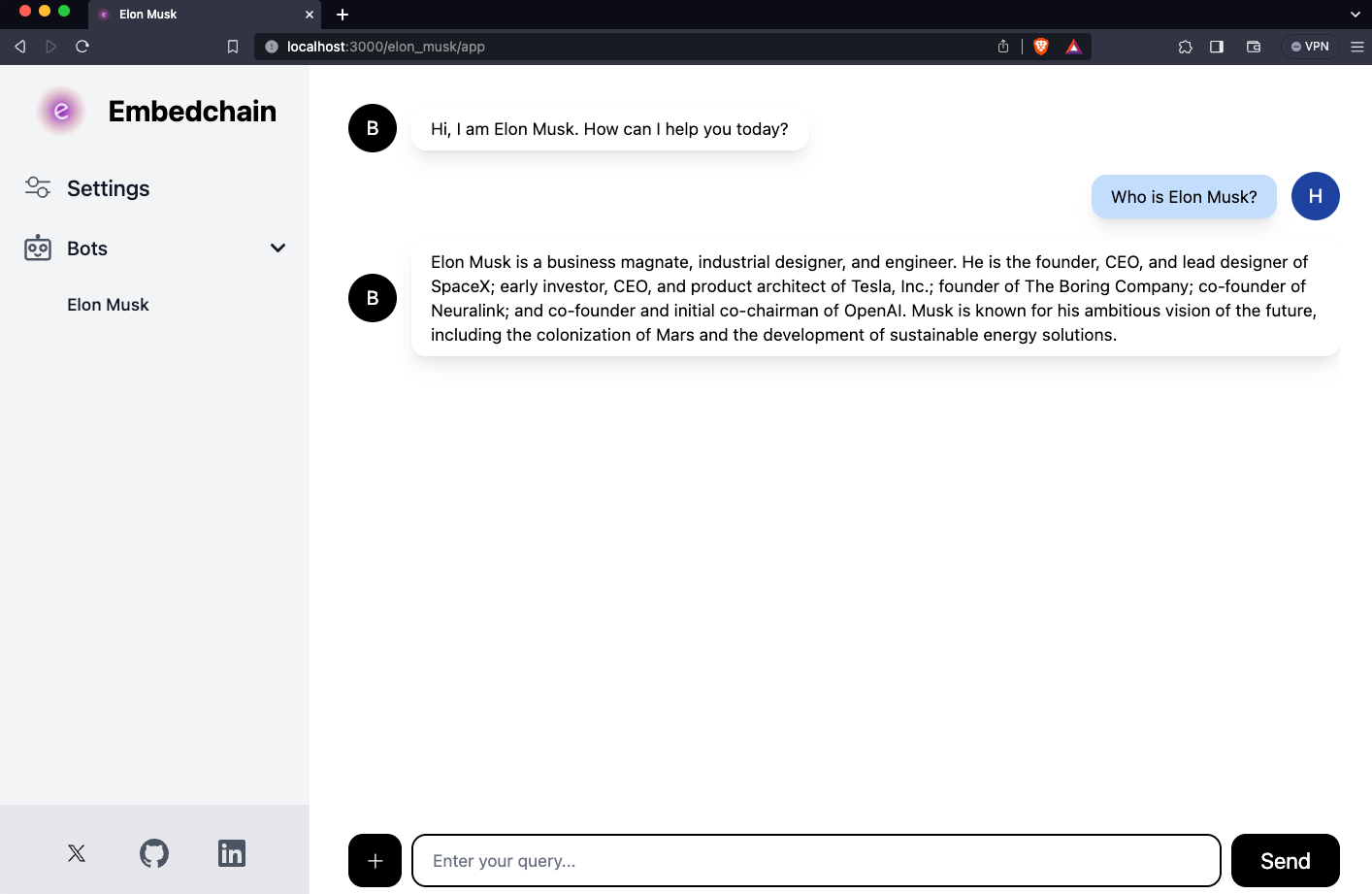
|
||||
|
||||
### 🚀 Usage Instructions
|
||||
|
||||
- Go to [http://localhost:3000/](http://localhost:3000/) in your browser to view the dashboard.
|
||||
|
||||
@@ -0,0 +1,130 @@
|
||||
---
|
||||
title: Notebooks & Replits
|
||||
---
|
||||
|
||||
# Explore awesome apps
|
||||
|
||||
Check out the remarkable work accomplished using [Embedchain](https://app.embedchain.ai/custom-gpts/).
|
||||
|
||||
## Collection of Google colab notebook and Replit links for users
|
||||
|
||||
Get started with Embedchain by trying out the examples below. You can run the examples in your browser using Google Colab or Replit.
|
||||
|
||||
<table>
|
||||
<thead>
|
||||
<tr>
|
||||
<th>LLM</th>
|
||||
<th>Google Colab</th>
|
||||
<th>Replit</th>
|
||||
</tr>
|
||||
</thead>
|
||||
<tbody>
|
||||
<tr>
|
||||
<td className="align-middle">OpenAI</td>
|
||||
<td className="align-middle"><a target="_blank" href="https://colab.research.google.com/github/embedchain/embedchain/blob/main/notebooks/openai.ipynb"><img src="https://colab.research.google.com/assets/colab-badge.svg" noZoom alt="Open In Colab"/></a></td>
|
||||
<td className="align-middle"><a target="_blank" href="https://replit.com/@taranjeetio/openai#main.py"><img src="https://replit.com/badge?caption=Try%20with%20Replit&variant=small" noZoom alt="Try with Replit Badge"/></a></td>
|
||||
</tr>
|
||||
<tr>
|
||||
<td className="align-middle">Anthropic</td>
|
||||
<td className="align-middle"><a target="_blank" href="https://colab.research.google.com/github/embedchain/embedchain/blob/main/notebooks/anthropic.ipynb"><img src="https://colab.research.google.com/assets/colab-badge.svg" noZoom alt="Open In Colab"/></a></td>
|
||||
<td className="align-middle"><a target="_blank" href="https://replit.com/@taranjeetio/anthropic#main.py"><img src="https://replit.com/badge?caption=Try%20with%20Replit&variant=small" noZoom alt="Try with Replit Badge"/></a></td>
|
||||
</tr>
|
||||
<tr>
|
||||
<td className="align-middle">Azure OpenAI</td>
|
||||
<td className="align-middle"><a target="_blank" href="https://colab.research.google.com/github/embedchain/embedchain/blob/main/notebooks/azure-openai.ipynb"><img src="https://colab.research.google.com/assets/colab-badge.svg" noZoom alt="Open In Colab"/></a></td>
|
||||
<td className="align-middle"><a target="_blank" href="https://replit.com/@taranjeetio/azureopenai#main.py"><img src="https://replit.com/badge?caption=Try%20with%20Replit&variant=small" noZoom alt="Try with Replit Badge"/></a></td>
|
||||
</tr>
|
||||
<tr>
|
||||
<td className="align-middle">VertexAI</td>
|
||||
<td className="align-middle"><a target="_blank" href="https://colab.research.google.com/github/embedchain/embedchain/blob/main/notebooks/vertex_ai.ipynb"><img src="https://colab.research.google.com/assets/colab-badge.svg" noZoom alt="Open In Colab"/></a></td>
|
||||
<td className="align-middle"><a target="_blank" href="https://replit.com/@taranjeetio/vertexai#main.py"><img src="https://replit.com/badge?caption=Try%20with%20Replit&variant=small" noZoom alt="Try with Replit Badge"/></a></td>
|
||||
</tr>
|
||||
<tr>
|
||||
<td className="align-middle">Cohere</td>
|
||||
<td className="align-middle"><a target="_blank" href="https://colab.research.google.com/github/embedchain/embedchain/blob/main/notebooks/cohere.ipynb"><img src="https://colab.research.google.com/assets/colab-badge.svg" noZoom alt="Open In Colab"/></a></td>
|
||||
<td className="align-middle"><a target="_blank" href="https://replit.com/@taranjeetio/cohere#main.py"><img src="https://replit.com/badge?caption=Try%20with%20Replit&variant=small" noZoom alt="Try with Replit Badge"/></a></td>
|
||||
</tr>
|
||||
<tr>
|
||||
<td className="align-middle">Hugging Face</td>
|
||||
<td className="align-middle"><a target="_blank" href="https://colab.research.google.com/github/embedchain/embedchain/blob/main/notebooks/hugging_face_hub.ipynb"><img src="https://colab.research.google.com/assets/colab-badge.svg" noZoom alt="Open In Colab"/></a></td>
|
||||
<td className="align-middle"><a target="_blank" href="https://replit.com/@taranjeetio/huggingface#main.py"><img src="https://replit.com/badge?caption=Try%20with%20Replit&variant=small" noZoom alt="Try with Replit Badge"/></a></td>
|
||||
</tr>
|
||||
<tr>
|
||||
<td className="align-middle">JinaChat</td>
|
||||
<td className="align-middle"><a target="_blank" href="https://colab.research.google.com/github/embedchain/embedchain/blob/main/notebooks/jina.ipynb"><img src="https://colab.research.google.com/assets/colab-badge.svg" noZoom alt="Open In Colab"/></a></td>
|
||||
<td className="align-middle"><a target="_blank" href="https://replit.com/@taranjeetio/jina#main.py"><img src="https://replit.com/badge?caption=Try%20with%20Replit&variant=small" noZoom alt="Try with Replit Badge"/></a></td>
|
||||
</tr>
|
||||
<tr>
|
||||
<td className="align-middle">GPT4All</td>
|
||||
<td className="align-middle"><a target="_blank" href="https://colab.research.google.com/github/embedchain/embedchain/blob/main/notebooks/gpt4all.ipynb"><img src="https://colab.research.google.com/assets/colab-badge.svg" noZoom alt="Open In Colab"/></a></td>
|
||||
<td className="align-middle"><a target="_blank" href="https://replit.com/@taranjeetio/gpt4all#main.py"><img src="https://replit.com/badge?caption=Try%20with%20Replit&variant=small" noZoom alt="Try with Replit Badge"/></a></td>
|
||||
</tr>
|
||||
<tr>
|
||||
<td className="align-middle">Llama2</td>
|
||||
<td className="align-middle"><a target="_blank" href="https://colab.research.google.com/github/embedchain/embedchain/blob/main/notebooks/llama2.ipynb"><img src="https://colab.research.google.com/assets/colab-badge.svg" noZoom alt="Open In Colab"/></a></td>
|
||||
<td className="align-middle"><a target="_blank" href="https://replit.com/@taranjeetio/llama2#main.py"><img src="https://replit.com/badge?caption=Try%20with%20Replit&variant=small" noZoom alt="Try with Replit Badge"/></a></td>
|
||||
</tr>
|
||||
</tbody>
|
||||
</table>
|
||||
<table>
|
||||
<thead>
|
||||
<tr>
|
||||
<th>Embedding model</th>
|
||||
<th>Google Colab</th>
|
||||
<th>Replit</th>
|
||||
</tr>
|
||||
</thead>
|
||||
<tbody>
|
||||
<tr>
|
||||
<td className="align-middle">OpenAI</td>
|
||||
<td className="align-middle"><a target="_blank" href="https://colab.research.google.com/github/embedchain/embedchain/blob/main/notebooks/openai.ipynb"><img src="https://colab.research.google.com/assets/colab-badge.svg" noZoom alt="Open In Colab"/></a></td>
|
||||
<td className="align-middle"><a target="_blank" href="https://replit.com/@taranjeetio/openai#main.py"><img src="https://replit.com/badge?caption=Try%20with%20Replit&variant=small" noZoom alt="Try with Replit Badge"/></a></td>
|
||||
</tr>
|
||||
<tr>
|
||||
<td className="align-middle">VertexAI</td>
|
||||
<td className="align-middle"><a target="_blank" href="https://colab.research.google.com/github/embedchain/embedchain/blob/main/notebooks/vertex_ai.ipynb"><img src="https://colab.research.google.com/assets/colab-badge.svg" noZoom alt="Open In Colab"/></a></td>
|
||||
<td className="align-middle"><a target="_blank" href="https://replit.com/@taranjeetio/vertexai#main.py"><img src="https://replit.com/badge?caption=Try%20with%20Replit&variant=small" noZoom alt="Try with Replit Badge"/></a></td>
|
||||
</tr>
|
||||
<tr>
|
||||
<td className="align-middle">GPT4All</td>
|
||||
<td className="align-middle"><a target="_blank" href="https://colab.research.google.com/github/embedchain/embedchain/blob/main/notebooks/gpt4all.ipynb"><img src="https://colab.research.google.com/assets/colab-badge.svg" noZoom alt="Open In Colab"/></a></td>
|
||||
<td className="align-middle"><a target="_blank" href="https://replit.com/@taranjeetio/gpt4all#main.py"><img src="https://replit.com/badge?caption=Try%20with%20Replit&variant=small" noZoom alt="Try with Replit Badge"/></a></td>
|
||||
</tr>
|
||||
<tr>
|
||||
<td className="align-middle">Hugging Face</td>
|
||||
<td className="align-middle"><a target="_blank" href="https://colab.research.google.com/github/embedchain/embedchain/blob/main/notebooks/hugging_face_hub.ipynb"><img src="https://colab.research.google.com/assets/colab-badge.svg" noZoom alt="Open In Colab"/></a></td>
|
||||
<td className="align-middle"><a target="_blank" href="https://replit.com/@taranjeetio/huggingface#main.py"><img src="https://replit.com/badge?caption=Try%20with%20Replit&variant=small" noZoom alt="Try with Replit Badge"/></a></td>
|
||||
</tr>
|
||||
</tbody>
|
||||
</table>
|
||||
<table>
|
||||
<thead>
|
||||
<tr>
|
||||
<th>Vector DB</th>
|
||||
<th>Google Colab</th>
|
||||
<th>Replit</th>
|
||||
</tr>
|
||||
</thead>
|
||||
<tbody>
|
||||
<tr>
|
||||
<td className="align-middle">ChromaDB</td>
|
||||
<td className="align-middle"><a target="_blank" href="https://colab.research.google.com/github/embedchain/embedchain/blob/main/notebooks/chromadb.ipynb"><img src="https://colab.research.google.com/assets/colab-badge.svg" noZoom alt="Open In Colab"/></a></td>
|
||||
<td className="align-middle"><a target="_blank" href="https://replit.com/@taranjeetio/chromadb#main.py"><img src="https://replit.com/badge?caption=Try%20with%20Replit&variant=small" noZoom alt="Try with Replit Badge"/></a></td>
|
||||
</tr>
|
||||
<tr>
|
||||
<td className="align-middle">Elasticsearch</td>
|
||||
<td className="align-middle"><a target="_blank" href="https://colab.research.google.com/github/embedchain/embedchain/blob/main/notebooks/elasticsearch.ipynb"><img src="https://colab.research.google.com/assets/colab-badge.svg" noZoom alt="Open In Colab"/></a></td>
|
||||
<td className="align-middle"><a target="_blank" href="https://replit.com/@taranjeetio/elasticsearchdb#main.py"><img src="https://replit.com/badge?caption=Try%20with%20Replit&variant=small" noZoom alt="Try with Replit Badge"/></a></td>
|
||||
</tr>
|
||||
<tr>
|
||||
<td className="align-middle">Opensearch</td>
|
||||
<td className="align-middle"><a target="_blank" href="https://colab.research.google.com/github/embedchain/embedchain/blob/main/notebooks/opensearch.ipynb"><img src="https://colab.research.google.com/assets/colab-badge.svg" noZoom alt="Open In Colab"/></a></td>
|
||||
<td className="align-middle"><a target="_blank" href="https://replit.com/@taranjeetio/opensearchdb#main.py"><img src="https://replit.com/badge?caption=Try%20with%20Replit&variant=small" noZoom alt="Try with Replit Badge"/></a></td>
|
||||
</tr>
|
||||
<tr>
|
||||
<td className="align-middle">Pinecone</td>
|
||||
<td className="align-middle"><a target="_blank" href="https://colab.research.google.com/github/embedchain/embedchain/blob/main/notebooks/pinecone.ipynb"><img src="https://colab.research.google.com/assets/colab-badge.svg" noZoom alt="Open In Colab"/></a></td>
|
||||
<td className="align-middle"><a target="_blank" href="https://replit.com/@taranjeetio/pineconedb#main.py"><img src="https://replit.com/badge?caption=Try%20with%20Replit&variant=small" noZoom alt="Try with Replit Badge"/></a></td>
|
||||
</tr>
|
||||
</tbody>
|
||||
</table>
|
||||
@@ -0,0 +1,60 @@
|
||||
---
|
||||
title: 'OpenAI Assistant'
|
||||
---
|
||||
|
||||
<img src="https://blogs.swarthmore.edu/its/wp-content/uploads/2022/05/openai.jpg" align="center" width="500" alt="OpenAI Logo"/>
|
||||
|
||||
Embedchain now supports [OpenAI Assistants API](https://platform.openai.com/docs/assistants/overview) which allows you to build AI assistants within your own applications. An Assistant has instructions and can leverage models, tools, and knowledge to respond to user queries.
|
||||
|
||||
At a high level, an integration of the Assistants API has the following flow:
|
||||
|
||||
1. Create an Assistant in the API by defining custom instructions and picking a model
|
||||
2. Create a Thread when a user starts a conversation
|
||||
3. Add Messages to the Thread as the user ask questions
|
||||
4. Run the Assistant on the Thread to trigger responses. This automatically calls the relevant tools.
|
||||
|
||||
Creating an OpenAI Assistant using Embedchain is very simple 3 step process.
|
||||
|
||||
## Step 1: Create OpenAI Assistant
|
||||
|
||||
Make sure that you have `OPENAI_API_KEY` set in the environment variable.
|
||||
|
||||
```python Initialize
|
||||
from embedchain.store.assistants import OpenAIAssistant
|
||||
|
||||
assistant = OpenAIAssistant(
|
||||
name="OpenAI DevDay Assistant",
|
||||
instructions="You are an organizer of OpenAI DevDay",
|
||||
)
|
||||
```
|
||||
|
||||
If you want to use the existing assistant, you can do something like this:
|
||||
|
||||
```python Initialize
|
||||
# Load an assistant and create a new thread
|
||||
assistant = OpenAIAssistant(assistant_id="asst_xxx")
|
||||
|
||||
# Load a specific thread for an assistant
|
||||
assistant = OpenAIAssistant(assistant_id="asst_xxx", thread_id="thread_xxx")
|
||||
```
|
||||
|
||||
## Step-2: Add data to thread
|
||||
|
||||
You can add any custom data source that is supported by Embedchain. Else, you can directly pass the file path on your local system and Embedchain propagates it to OpenAI Assistant.
|
||||
```python Add data
|
||||
assistant.add("/path/to/file.pdf")
|
||||
assistant.add("https://www.youtube.com/watch?v=U9mJuUkhUzk")
|
||||
assistant.add("https://openai.com/blog/new-models-and-developer-products-announced-at-devday")
|
||||
```
|
||||
|
||||
## Step-3: Chat with your Assistant
|
||||
```python Chat
|
||||
assistant.chat("How much OpenAI credits were offered to attendees during OpenAI DevDay?")
|
||||
# Response: 'Every attendee of OpenAI DevDay 2023 was offered $500 in OpenAI credits.'
|
||||
```
|
||||
|
||||
You can try it out yourself using the following Google Colab notebook:
|
||||
|
||||
<a href="https://colab.research.google.com/drive/1BKlXZYSl6AFRgiHZ5XIzXrXC_24kDYHQ?usp=sharing">
|
||||
<img src="https://camo.githubusercontent.com/84f0493939e0c4de4e6dbe113251b4bfb5353e57134ffd9fcab6b8714514d4d1/68747470733a2f2f636f6c61622e72657365617263682e676f6f676c652e636f6d2f6173736574732f636f6c61622d62616467652e737667" alt="Open in Colab" />
|
||||
</a>
|
||||
@@ -0,0 +1,51 @@
|
||||
---
|
||||
title: 'Open-Source AI Assistant'
|
||||
---
|
||||
|
||||
Embedchain also provides support for creating Open-Source AI Assistants (similar to [OpenAI Assistants API](https://platform.openai.com/docs/assistants/overview)) which allows you to build AI assistants within your own applications using any LLM (OpenAI or otherwise). An Assistant has instructions and can leverage models, tools, and knowledge to respond to user queries.
|
||||
|
||||
At a high level, the Open-Source AI Assistants API has the following flow:
|
||||
|
||||
1. Create an AI Assistant by picking a model
|
||||
2. Create a Thread when a user starts a conversation
|
||||
3. Add Messages to the Thread as the user ask questions
|
||||
4. Run the Assistant on the Thread to trigger responses. This automatically calls the relevant tools.
|
||||
|
||||
Creating an Open-Source AI Assistant is a simple 3 step process.
|
||||
|
||||
## Step 1: Instantiate AI Assistant
|
||||
|
||||
```python Initialize
|
||||
from embedchain.store.assistants import AIAssistant
|
||||
|
||||
assistant = AIAssistant(
|
||||
name="My Assistant",
|
||||
data_sources=[{"source": "https://www.youtube.com/watch?v=U9mJuUkhUzk"}])
|
||||
```
|
||||
|
||||
If you want to use the existing assistant, you can do something like this:
|
||||
|
||||
```python Initialize
|
||||
# Load an assistant and create a new thread
|
||||
assistant = AIAssistant(assistant_id="asst_xxx")
|
||||
|
||||
# Load a specific thread for an assistant
|
||||
assistant = AIAssistant(assistant_id="asst_xxx", thread_id="thread_xxx")
|
||||
```
|
||||
|
||||
## Step-2: Add data to thread
|
||||
|
||||
You can add any custom data source that is supported by Embedchain. Else, you can directly pass the file path on your local system and Embedchain propagates it to OpenAI Assistant.
|
||||
|
||||
```python Add data
|
||||
assistant.add("/path/to/file.pdf")
|
||||
assistant.add("https://www.youtube.com/watch?v=U9mJuUkhUzk")
|
||||
assistant.add("https://openai.com/blog/new-models-and-developer-products-announced-at-devday")
|
||||
```
|
||||
|
||||
## Step-3: Chat with your AI Assistant
|
||||
|
||||
```python Chat
|
||||
assistant.chat("How much OpenAI credits were offered to attendees during OpenAI DevDay?")
|
||||
# Response: 'Every attendee of OpenAI DevDay 2023 was offered $500 in OpenAI credits.'
|
||||
```
|
||||
@@ -0,0 +1,22 @@
|
||||
---
|
||||
openapi: post /{app_id}/add
|
||||
---
|
||||
|
||||
<RequestExample>
|
||||
|
||||
```bash Request
|
||||
curl --request POST \
|
||||
--url http://localhost:8080/{app_id}/add \
|
||||
-d "source=https://www.forbes.com/profile/elon-musk" \
|
||||
-d "data_type=web_page"
|
||||
```
|
||||
|
||||
</RequestExample>
|
||||
|
||||
<ResponseExample>
|
||||
|
||||
```json Response
|
||||
{ "response": "fec7fe91e6b2d732938a2ec2e32bfe3f" }
|
||||
```
|
||||
|
||||
</ResponseExample>
|
||||
@@ -0,0 +1,3 @@
|
||||
---
|
||||
openapi: post /{app_id}/chat
|
||||
---
|
||||
@@ -0,0 +1,20 @@
|
||||
---
|
||||
openapi: get /ping
|
||||
---
|
||||
|
||||
<RequestExample>
|
||||
|
||||
```bash Request
|
||||
curl --request GET \
|
||||
--url http://localhost:8080/ping
|
||||
```
|
||||
|
||||
</RequestExample>
|
||||
|
||||
<ResponseExample>
|
||||
|
||||
```json Response
|
||||
{ "ping": "pong" }
|
||||
```
|
||||
|
||||
</ResponseExample>
|
||||
@@ -0,0 +1,95 @@
|
||||
---
|
||||
openapi: post /create
|
||||
---
|
||||
|
||||
<RequestExample>
|
||||
|
||||
```bash Request
|
||||
curl --request POST \
|
||||
--url http://localhost:8080/create?app_id=app1 \
|
||||
-F "config=@/path/to/config.yaml"
|
||||
```
|
||||
|
||||
</RequestExample>
|
||||
|
||||
<ResponseExample>
|
||||
|
||||
```json Response
|
||||
{ "response": "App created successfully. App ID: app1" }
|
||||
```
|
||||
|
||||
</ResponseExample>
|
||||
|
||||
By default we will use the opensource **gpt4all** model to get started. You can also specify your own config by uploading a config YAML file.
|
||||
|
||||
For example, create a `config.yaml` file (adjust according to your requirements):
|
||||
|
||||
```yaml
|
||||
app:
|
||||
config:
|
||||
id: "default-app"
|
||||
|
||||
llm:
|
||||
provider: openai
|
||||
config:
|
||||
model: "gpt-3.5-turbo"
|
||||
temperature: 0.5
|
||||
max_tokens: 1000
|
||||
top_p: 1
|
||||
stream: false
|
||||
template: |
|
||||
Use the following pieces of context to answer the query at the end.
|
||||
If you don't know the answer, just say that you don't know, don't try to make up an answer.
|
||||
|
||||
$context
|
||||
|
||||
Query: $query
|
||||
|
||||
Helpful Answer:
|
||||
|
||||
vectordb:
|
||||
provider: chroma
|
||||
config:
|
||||
collection_name: "rest-api-app"
|
||||
dir: db
|
||||
allow_reset: true
|
||||
|
||||
embedder:
|
||||
provider: openai
|
||||
config:
|
||||
model: "text-embedding-ada-002"
|
||||
```
|
||||
|
||||
To learn more about custom configurations, check out the [custom configurations docs](https://docs.embedchain.ai/advanced/configuration). To explore more examples of config yamls for embedchain, visit [embedchain/configs](https://github.com/embedchain/embedchain/tree/main/configs).
|
||||
|
||||
Now, you can upload this config file in the request body.
|
||||
|
||||
For example,
|
||||
|
||||
```bash Request
|
||||
curl --request POST \
|
||||
--url http://localhost:8080/create?app_id=my-app \
|
||||
-F "config=@/path/to/config.yaml"
|
||||
```
|
||||
|
||||
**Note:** To use custom models, an **API key** might be required. Refer to the table below to determine the necessary API key for your provider.
|
||||
|
||||
| Keys | Providers |
|
||||
| -------------------------- | ------------------------------ |
|
||||
| `OPENAI_API_KEY ` | OpenAI, Azure OpenAI, Jina etc |
|
||||
| `OPENAI_API_TYPE` | Azure OpenAI |
|
||||
| `OPENAI_API_BASE` | Azure OpenAI |
|
||||
| `OPENAI_API_VERSION` | Azure OpenAI |
|
||||
| `COHERE_API_KEY` | Cohere |
|
||||
| `ANTHROPIC_API_KEY` | Anthropic |
|
||||
| `JINACHAT_API_KEY` | Jina |
|
||||
| `HUGGINGFACE_ACCESS_TOKEN` | Huggingface |
|
||||
| `REPLICATE_API_TOKEN` | LLAMA2 |
|
||||
|
||||
To add env variables, you can simply run the docker command with the `-e` flag.
|
||||
|
||||
For example,
|
||||
|
||||
```bash
|
||||
docker run --name embedchain -p 8080:8080 -e OPENAI_API_KEY=<YOUR_OPENAI_API_KEY> embedchain/rest-api:latest
|
||||
```
|
||||
@@ -0,0 +1,21 @@
|
||||
---
|
||||
openapi: delete /{app_id}/delete
|
||||
---
|
||||
|
||||
|
||||
<RequestExample>
|
||||
|
||||
```bash Request
|
||||
curl --request DELETE \
|
||||
--url http://localhost:8080/{app_id}/delete
|
||||
```
|
||||
|
||||
</RequestExample>
|
||||
|
||||
<ResponseExample>
|
||||
|
||||
```json Response
|
||||
{ "response": "App with id {app_id} deleted successfully." }
|
||||
```
|
||||
|
||||
</ResponseExample>
|
||||
@@ -0,0 +1,22 @@
|
||||
---
|
||||
openapi: post /{app_id}/deploy
|
||||
---
|
||||
|
||||
|
||||
<RequestExample>
|
||||
|
||||
```bash Request
|
||||
curl --request POST \
|
||||
--url http://localhost:8080/{app_id}/deploy \
|
||||
-d "api_key=ec-xxxx"
|
||||
```
|
||||
|
||||
</RequestExample>
|
||||
|
||||
<ResponseExample>
|
||||
|
||||
```json Response
|
||||
{ "response": "App deployed successfully." }
|
||||
```
|
||||
|
||||
</ResponseExample>
|
||||
@@ -0,0 +1,33 @@
|
||||
---
|
||||
openapi: get /apps
|
||||
---
|
||||
|
||||
<RequestExample>
|
||||
|
||||
```bash Request
|
||||
curl --request GET \
|
||||
--url http://localhost:8080/apps
|
||||
```
|
||||
|
||||
</RequestExample>
|
||||
|
||||
<ResponseExample>
|
||||
|
||||
```json Response
|
||||
{
|
||||
"results": [
|
||||
{
|
||||
"config": "config1.yaml",
|
||||
"id": 1,
|
||||
"app_id": "app1"
|
||||
},
|
||||
{
|
||||
"config": "config2.yaml",
|
||||
"id": 2,
|
||||
"app_id": "app2"
|
||||
}
|
||||
]
|
||||
}
|
||||
```
|
||||
|
||||
</ResponseExample>
|
||||
@@ -0,0 +1,28 @@
|
||||
---
|
||||
openapi: get /{app_id}/data
|
||||
---
|
||||
|
||||
<RequestExample>
|
||||
|
||||
```bash Request
|
||||
curl --request GET \
|
||||
--url http://localhost:8080/{app_id}/data
|
||||
```
|
||||
|
||||
</RequestExample>
|
||||
|
||||
<ResponseExample>
|
||||
|
||||
```json Response
|
||||
{
|
||||
"results": [
|
||||
{
|
||||
"data_type": "web_page",
|
||||
"data_value": "https://www.forbes.com/profile/elon-musk/",
|
||||
"metadata": "null"
|
||||
}
|
||||
]
|
||||
}
|
||||
```
|
||||
|
||||
</ResponseExample>
|
||||
@@ -0,0 +1,294 @@
|
||||
---
|
||||
title: "🌍 Getting Started"
|
||||
---
|
||||
|
||||
## Quickstart
|
||||
|
||||
To use Embedchain as a REST API service, run the following command:
|
||||
|
||||
```bash
|
||||
docker run --name embedchain -p 8080:8080 embedchain/rest-api:latest
|
||||
```
|
||||
|
||||
Navigate to [http://localhost:8080/docs](http://localhost:8080/docs) to interact with the API. There is a full-fledged Swagger docs playground with all the information about the API endpoints.
|
||||
|
||||
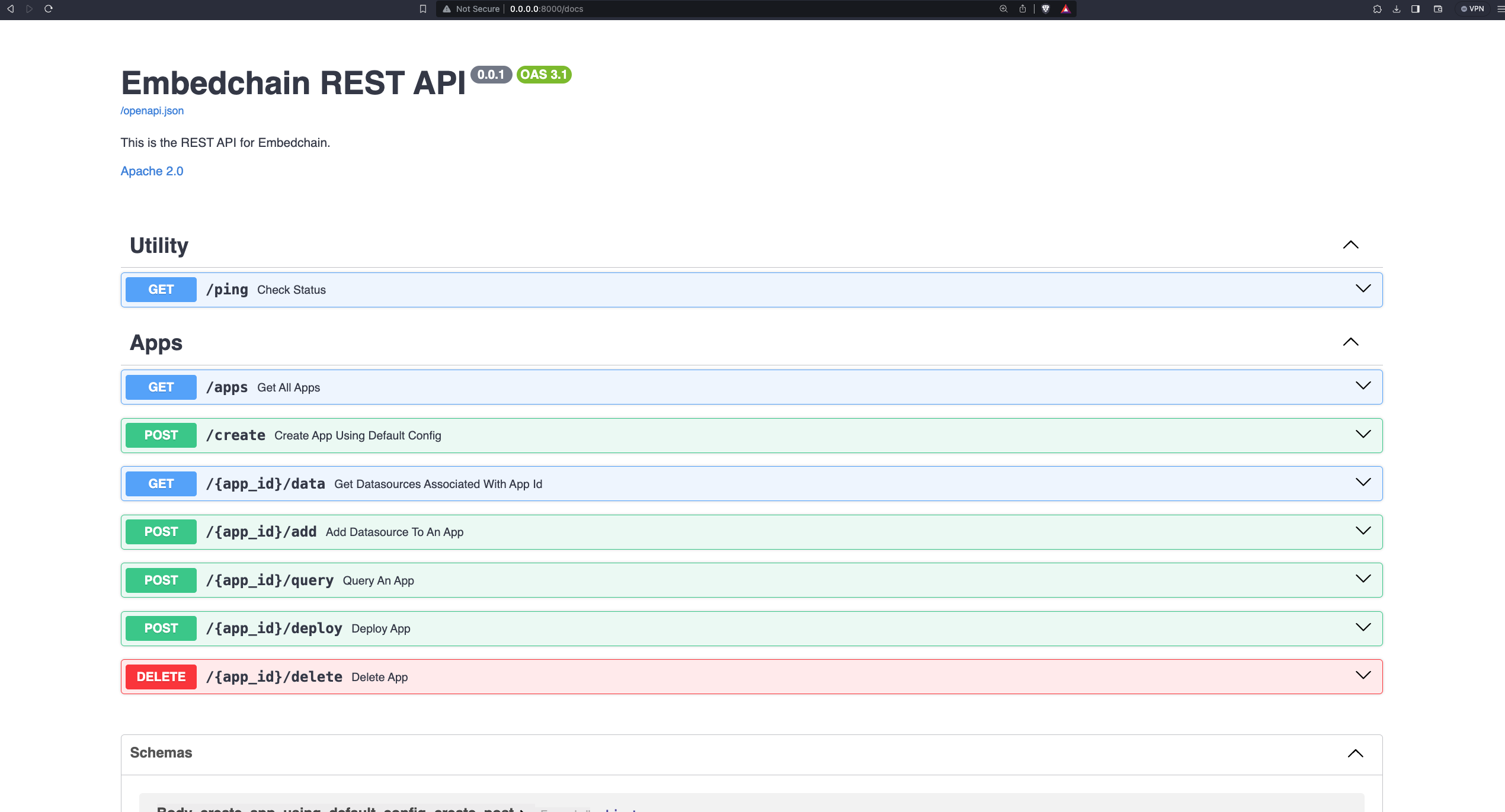
|
||||
|
||||
## ⚡ Steps to get started
|
||||
|
||||
<Steps>
|
||||
<Step title="⚙️ Create an app">
|
||||
<Tabs>
|
||||
<Tab title="cURL">
|
||||
```bash
|
||||
curl --request POST "http://localhost:8080/create?app_id=my-app" \
|
||||
-H "accept: application/json"
|
||||
```
|
||||
</Tab>
|
||||
<Tab title="python">
|
||||
```python
|
||||
import requests
|
||||
|
||||
url = "http://localhost:8080/create?app_id=my-app"
|
||||
|
||||
payload={}
|
||||
|
||||
response = requests.request("POST", url, data=payload)
|
||||
|
||||
print(response)
|
||||
```
|
||||
</Tab>
|
||||
<Tab title="javascript">
|
||||
```javascript
|
||||
const data = fetch("http://localhost:8080/create?app_id=my-app", {
|
||||
method: "POST",
|
||||
}).then((res) => res.json());
|
||||
|
||||
console.log(data);
|
||||
```
|
||||
</Tab>
|
||||
<Tab title="go">
|
||||
```go
|
||||
package main
|
||||
|
||||
import (
|
||||
"fmt"
|
||||
"net/http"
|
||||
"io/ioutil"
|
||||
)
|
||||
|
||||
func main() {
|
||||
|
||||
url := "http://localhost:8080/create?app_id=my-app"
|
||||
|
||||
payload := strings.NewReader("")
|
||||
|
||||
req, _ := http.NewRequest("POST", url, payload)
|
||||
|
||||
req.Header.Add("Content-Type", "application/json")
|
||||
|
||||
res, _ := http.DefaultClient.Do(req)
|
||||
|
||||
defer res.Body.Close()
|
||||
body, _ := ioutil.ReadAll(res.Body)
|
||||
|
||||
fmt.Println(res)
|
||||
fmt.Println(string(body))
|
||||
|
||||
}
|
||||
```
|
||||
</Tab>
|
||||
</Tabs>
|
||||
|
||||
</Step>
|
||||
<Step title="🗃️ Add data sources">
|
||||
<Tabs>
|
||||
<Tab title="cURL">
|
||||
```bash
|
||||
curl --request POST \
|
||||
--url http://localhost:8080/my-app/add \
|
||||
-d "source=https://www.forbes.com/profile/elon-musk" \
|
||||
-d "data_type=web_page"
|
||||
```
|
||||
</Tab>
|
||||
<Tab title="python">
|
||||
```python
|
||||
import requests
|
||||
|
||||
url = "http://localhost:8080/my-app/add"
|
||||
|
||||
payload = "source=https://www.forbes.com/profile/elon-musk&data_type=web_page"
|
||||
headers = {}
|
||||
|
||||
response = requests.request("POST", url, headers=headers, data=payload)
|
||||
|
||||
print(response)
|
||||
```
|
||||
</Tab>
|
||||
<Tab title="javascript">
|
||||
```javascript
|
||||
const data = fetch("http://localhost:8080/my-app/add", {
|
||||
method: "POST",
|
||||
body: "source=https://www.forbes.com/profile/elon-musk&data_type=web_page",
|
||||
}).then((res) => res.json());
|
||||
|
||||
console.log(data);
|
||||
```
|
||||
</Tab>
|
||||
<Tab title="go">
|
||||
```go
|
||||
package main
|
||||
|
||||
import (
|
||||
"fmt"
|
||||
"strings"
|
||||
"net/http"
|
||||
"io/ioutil"
|
||||
)
|
||||
|
||||
func main() {
|
||||
|
||||
url := "http://localhost:8080/my-app/add"
|
||||
|
||||
payload := strings.NewReader("source=https://www.forbes.com/profile/elon-musk&data_type=web_page")
|
||||
|
||||
req, _ := http.NewRequest("POST", url, payload)
|
||||
|
||||
req.Header.Add("Content-Type", "application/x-www-form-urlencoded")
|
||||
|
||||
res, _ := http.DefaultClient.Do(req)
|
||||
|
||||
defer res.Body.Close()
|
||||
body, _ := ioutil.ReadAll(res.Body)
|
||||
|
||||
fmt.Println(res)
|
||||
fmt.Println(string(body))
|
||||
|
||||
}
|
||||
```
|
||||
</Tab>
|
||||
</Tabs>
|
||||
|
||||
</Step>
|
||||
<Step title="💬 Query on your data">
|
||||
<Tabs>
|
||||
<Tab title="cURL">
|
||||
```bash
|
||||
curl --request POST \
|
||||
--url http://localhost:8080/my-app/query \
|
||||
-d "query=Who is Elon Musk?"
|
||||
```
|
||||
</Tab>
|
||||
<Tab title="python">
|
||||
```python
|
||||
import requests
|
||||
|
||||
url = "http://localhost:8080/my-app/query"
|
||||
|
||||
payload = "query=Who is Elon Musk?"
|
||||
headers = {}
|
||||
|
||||
response = requests.request("POST", url, headers=headers, data=payload)
|
||||
|
||||
print(response)
|
||||
```
|
||||
</Tab>
|
||||
<Tab title="javascript">
|
||||
```javascript
|
||||
const data = fetch("http://localhost:8080/my-app/query", {
|
||||
method: "POST",
|
||||
body: "query=Who is Elon Musk?",
|
||||
}).then((res) => res.json());
|
||||
|
||||
console.log(data);
|
||||
```
|
||||
</Tab>
|
||||
<Tab title="go">
|
||||
```go
|
||||
package main
|
||||
|
||||
import (
|
||||
"fmt"
|
||||
"strings"
|
||||
"net/http"
|
||||
"io/ioutil"
|
||||
)
|
||||
|
||||
func main() {
|
||||
|
||||
url := "http://localhost:8080/my-app/query"
|
||||
|
||||
payload := strings.NewReader("query=Who is Elon Musk?")
|
||||
|
||||
req, _ := http.NewRequest("POST", url, payload)
|
||||
|
||||
req.Header.Add("Content-Type", "application/x-www-form-urlencoded")
|
||||
|
||||
res, _ := http.DefaultClient.Do(req)
|
||||
|
||||
defer res.Body.Close()
|
||||
body, _ := ioutil.ReadAll(res.Body)
|
||||
|
||||
fmt.Println(res)
|
||||
fmt.Println(string(body))
|
||||
|
||||
}
|
||||
```
|
||||
</Tab>
|
||||
</Tabs>
|
||||
|
||||
</Step>
|
||||
<Step title="🚀 (Optional) Deploy your app to Embedchain Platform">
|
||||
<Tabs>
|
||||
<Tab title="cURL">
|
||||
```bash
|
||||
curl --request POST \
|
||||
--url http://localhost:8080/my-app/deploy \
|
||||
-d "api_key=ec-xxxx"
|
||||
```
|
||||
</Tab>
|
||||
<Tab title="python">
|
||||
```python
|
||||
import requests
|
||||
|
||||
url = "http://localhost:8080/my-app/deploy"
|
||||
|
||||
payload = "api_key=ec-xxxx"
|
||||
|
||||
response = requests.request("POST", url, data=payload)
|
||||
|
||||
print(response)
|
||||
```
|
||||
</Tab>
|
||||
<Tab title="javascript">
|
||||
```javascript
|
||||
const data = fetch("http://localhost:8080/my-app/deploy", {
|
||||
method: "POST",
|
||||
body: "api_key=ec-xxxx",
|
||||
}).then((res) => res.json());
|
||||
|
||||
console.log(data);
|
||||
```
|
||||
</Tab>
|
||||
<Tab title="go">
|
||||
```go
|
||||
package main
|
||||
|
||||
import (
|
||||
"fmt"
|
||||
"strings"
|
||||
"net/http"
|
||||
"io/ioutil"
|
||||
)
|
||||
|
||||
func main() {
|
||||
|
||||
url := "http://localhost:8080/my-app/deploy"
|
||||
|
||||
payload := strings.NewReader("api_key=ec-xxxx")
|
||||
|
||||
req, _ := http.NewRequest("POST", url, payload)
|
||||
|
||||
req.Header.Add("Content-Type", "application/x-www-form-urlencoded")
|
||||
|
||||
res, _ := http.DefaultClient.Do(req)
|
||||
|
||||
defer res.Body.Close()
|
||||
body, _ := ioutil.ReadAll(res.Body)
|
||||
|
||||
fmt.Println(res)
|
||||
fmt.Println(string(body))
|
||||
|
||||
}
|
||||
```
|
||||
</Tab>
|
||||
</Tabs>
|
||||
|
||||
</Step>
|
||||
</Steps>
|
||||
|
||||
And you're ready! 🎉
|
||||
|
||||
If you run into issues, please feel free to contact us using below links:
|
||||
|
||||
<Snippet file="get-help.mdx" />
|
||||
Some files were not shown because too many files have changed in this diff Show More
Reference in New Issue
Block a user