Compare commits
1 Commits
| Author | SHA1 | Date | |
|---|---|---|---|
 kartik-mem0 kartik-mem0
|
0c49e1aa0b |
@@ -12,7 +12,7 @@
|
||||
"name": "mem0",
|
||||
"source": "./mem0-plugin",
|
||||
"description": "Mem0 memory layer for AI applications. Add persistent memory, personalization, and semantic search to Claude workflows.",
|
||||
"version": "0.1.1"
|
||||
"version": "0.1.0"
|
||||
}
|
||||
]
|
||||
}
|
||||
|
||||
@@ -12,7 +12,7 @@
|
||||
"name": "mem0",
|
||||
"source": "./mem0-plugin",
|
||||
"description": "Mem0 memory layer for AI applications. Add persistent memory, personalization, and semantic search.",
|
||||
"version": "0.1.1"
|
||||
"version": "0.1.0"
|
||||
}
|
||||
]
|
||||
}
|
||||
|
||||
+2
-6
@@ -4,10 +4,6 @@ __pycache__/
|
||||
*$py.class
|
||||
**/node_modules/
|
||||
|
||||
# Self-hosted server local runtime state
|
||||
server/history/
|
||||
server/.env
|
||||
|
||||
# C extensions
|
||||
*.so
|
||||
|
||||
@@ -19,8 +15,8 @@ dist/
|
||||
downloads/
|
||||
eggs/
|
||||
.eggs/
|
||||
/lib/
|
||||
/lib64/
|
||||
lib/
|
||||
lib64/
|
||||
parts/
|
||||
sdist/
|
||||
var/
|
||||
|
||||
@@ -27,7 +27,7 @@ This is a **polyglot monorepo** containing Python and TypeScript packages, CLIs,
|
||||
| `server/` | FastAPI REST server for self-hosted Mem0 (Docker: FastAPI + PostgreSQL/pgvector + Neo4j) |
|
||||
| `openmemory/` | Self-hosted memory platform — `api/` (FastAPI + Alembic + MCP server) and `ui/` (Next.js 15 + React 19) |
|
||||
| `mem0-plugin/` | AI editor plugins (Claude Code, Cursor, Codex) — MCP server connection, lifecycle hooks, skills |
|
||||
| `skills/` | Claude Code skill definitions. Reference skills (SDK knowledge, always-on): `mem0/`, `mem0-cli/`, `mem0-vercel-ai-sdk/`. Pipeline skills (run on demand): `mem0-integrate/`, `mem0-test-integration/` |
|
||||
| `skills/` | Claude Code skill definitions — `mem0/`, `mem0-cli/`, `mem0-vercel-ai-sdk/` |
|
||||
| `docs/` | Documentation site (Mintlify) |
|
||||
| `tests/` | Python SDK tests (pytest) |
|
||||
| `evaluation/` | Benchmarking framework — LOCOMO evals, experiment runner, score generation |
|
||||
@@ -387,9 +387,7 @@ Model Context Protocol support in multiple places:
|
||||
### Plugin & Skills System
|
||||
|
||||
- `mem0-plugin/` provides integrations for Claude Code, Cursor, and Codex via MCP server connections and lifecycle hooks for automatic memory capture.
|
||||
- `skills/` contains structured skill definitions for AI agents, split into two categories:
|
||||
- **Reference skills** (always-on SDK knowledge): `mem0` (Python + TS SDKs, framework integrations), `mem0-cli` (terminal workflows), `mem0-vercel-ai-sdk` (Vercel AI provider).
|
||||
- **Pipeline skills** (run on demand): `mem0-integrate` wires Mem0 into an existing repo via a TDD pipeline; `mem0-test-integration` verifies what the integrator produced on the same branch. The two are loosely coupled via `.mem0-integration/` artifacts.
|
||||
- `skills/` contains structured skill definitions for AI agents, covering SDK usage, CLI workflows, and Vercel AI SDK patterns.
|
||||
|
||||
### Adding a New Provider
|
||||
|
||||
|
||||
@@ -1313,7 +1313,7 @@ async def delete_memory(memory_id: str):
|
||||
- **Documentation**: https://docs.mem0.ai
|
||||
- **GitHub Repository**: https://github.com/mem0ai/mem0
|
||||
- **Discord Community**: https://mem0.dev/DiG
|
||||
- **Platform**: https://app.mem0.ai?utm_source=oss&utm_medium=llm
|
||||
- **Platform**: https://app.mem0.ai
|
||||
- **Research Paper**: https://mem0.ai/research
|
||||
- **Examples**: https://github.com/mem0ai/mem0/tree/main/examples
|
||||
|
||||
|
||||
@@ -42,6 +42,9 @@ clean:
|
||||
test:
|
||||
hatch run test
|
||||
|
||||
test-py-3.9:
|
||||
hatch run dev_py_3_9:test
|
||||
|
||||
test-py-3.10:
|
||||
hatch run dev_py_3_10:test
|
||||
|
||||
|
||||
@@ -39,7 +39,7 @@
|
||||
</p>
|
||||
|
||||
<p align="center">
|
||||
<a href="https://mem0.ai/research"><strong>📄 Benchmarking Mem0's token-efficient memory algorithm →</strong></a>
|
||||
<a href="https://mem0.ai/research"><strong>📄 Building Production-Ready AI Agents with Scalable Long-Term Memory →</strong></a>
|
||||
</p>
|
||||
|
||||
## New Memory Algorithm (April 2026)
|
||||
@@ -85,17 +85,18 @@ See the [migration guide](https://docs.mem0.ai/migration/oss-v2-to-v3) for upgra
|
||||
|
||||
## 🚀 Quickstart Guide <a name="quickstart"></a>
|
||||
|
||||
| | Library | Self-Hosted Server | Cloud Platform |
|
||||
|---|---------|-------------------|----------------|
|
||||
| **Best for** | Testing, prototyping | Teams running on their own infrastructure | Zero-ops production use |
|
||||
| **Setup** | `pip install mem0ai` | `docker compose up` | Sign up at [app.mem0.ai](https://app.mem0.ai?utm_source=oss&utm_medium=readme) |
|
||||
| **Dashboard** | -- | [Yes](https://docs.mem0.ai/open-source/setup) | Yes |
|
||||
| **Auth & API Keys** | -- | Yes | Yes |
|
||||
| **Advanced Features** | -- | Teasers | All included |
|
||||
Choose between our hosted platform or self-hosted package:
|
||||
|
||||
Just testing? Use the library. Building for a team? Self-hosted. Want zero ops? Cloud.
|
||||
### Hosted Platform
|
||||
|
||||
### Library (pip / npm)
|
||||
Get up and running in minutes with automatic updates, analytics, and enterprise security.
|
||||
|
||||
1. Sign up on [Mem0 Platform](https://app.mem0.ai)
|
||||
2. Embed the memory layer via SDK or API keys
|
||||
|
||||
### Self-Hosted (Open Source)
|
||||
|
||||
Install the sdk via pip:
|
||||
|
||||
```bash
|
||||
pip install mem0ai
|
||||
@@ -109,30 +110,10 @@ python -m spacy download en_core_web_sm
|
||||
```
|
||||
|
||||
Install sdk via npm:
|
||||
|
||||
```bash
|
||||
npm install mem0ai
|
||||
```
|
||||
|
||||
### Self-Hosted Server
|
||||
|
||||
> **Note:** Self-hosted auth is on by default. Upgrading from a pre-auth build? Set `ADMIN_API_KEY`, register an admin through the wizard, or `AUTH_DISABLED=true` for local dev only. See [upgrade notes](https://docs.mem0.ai/open-source/setup#upgrade-notes).
|
||||
|
||||
```bash
|
||||
# Recommended: one command — start the stack, create an admin, issue the first API key.
|
||||
cd server && make bootstrap
|
||||
|
||||
# Manual: start the stack and finish setup via the browser wizard.
|
||||
cd server && docker compose up -d # http://localhost:3000
|
||||
```
|
||||
|
||||
See the [self-hosted docs](https://docs.mem0.ai/open-source/overview) for configuration.
|
||||
|
||||
### Cloud Platform
|
||||
|
||||
1. Sign up on [Mem0 Platform](https://app.mem0.ai?utm_source=oss&utm_medium=readme)
|
||||
2. Embed the memory layer via SDK or API keys
|
||||
|
||||
### CLI
|
||||
|
||||
Manage memories from your terminal:
|
||||
@@ -147,27 +128,6 @@ mem0 search "What does Alice prefer?" --user-id alice
|
||||
|
||||
See the [CLI documentation](https://docs.mem0.ai/platform/cli) for the full command reference.
|
||||
|
||||
### Agent Skills
|
||||
|
||||
Teach your AI coding assistant (Claude Code, Codex, Cursor, Windsurf, OpenCode, OpenClaw, and any tool that supports the skills standard) how to build with Mem0. Two categories:
|
||||
|
||||
**Reference skills — always on** (SDK knowledge loaded into the assistant's context):
|
||||
|
||||
```bash
|
||||
npx skills add https://github.com/mem0ai/mem0 --skill mem0
|
||||
npx skills add https://github.com/mem0ai/mem0 --skill mem0-cli
|
||||
npx skills add https://github.com/mem0ai/mem0 --skill mem0-vercel-ai-sdk
|
||||
```
|
||||
|
||||
**Pipeline skills — run on demand** (execute an end-to-end workflow in an existing repo):
|
||||
|
||||
```bash
|
||||
npx skills add https://github.com/mem0ai/mem0 --skill mem0-integrate
|
||||
npx skills add https://github.com/mem0ai/mem0 --skill mem0-test-integration
|
||||
```
|
||||
|
||||
Use `/mem0-integrate` to wire Mem0 into an existing repo via a test-first pipeline, then `/mem0-test-integration` to verify. See the [skills catalog](./skills/) or [Vibecoding with Mem0](https://docs.mem0.ai/vibecoding) for the full picture.
|
||||
|
||||
### Basic Usage
|
||||
|
||||
Mem0 requires an LLM to function, with `gpt-5-mini` from OpenAI as the default. However, it supports a variety of LLMs; for details, refer to our [Supported LLMs documentation](https://docs.mem0.ai/components/llms/overview).
|
||||
|
||||
@@ -1,6 +1,6 @@
|
||||
{
|
||||
"name": "@mem0/cli",
|
||||
"version": "0.2.4",
|
||||
"version": "0.2.3",
|
||||
"description": "The official CLI for mem0 — the memory layer for AI agents",
|
||||
"type": "module",
|
||||
"bin": {
|
||||
|
||||
@@ -15,6 +15,7 @@ export interface AddOptions {
|
||||
infer?: boolean;
|
||||
expires?: string;
|
||||
categories?: string[];
|
||||
enableGraph?: boolean;
|
||||
}
|
||||
|
||||
export interface SearchOptions {
|
||||
@@ -28,6 +29,7 @@ export interface SearchOptions {
|
||||
keyword?: boolean;
|
||||
filters?: Record<string, unknown>;
|
||||
fields?: string[];
|
||||
enableGraph?: boolean;
|
||||
}
|
||||
|
||||
export interface ListOptions {
|
||||
@@ -40,6 +42,7 @@ export interface ListOptions {
|
||||
category?: string;
|
||||
after?: string;
|
||||
before?: string;
|
||||
enableGraph?: boolean;
|
||||
}
|
||||
|
||||
export interface DeleteOptions {
|
||||
|
||||
@@ -115,9 +115,10 @@ export class PlatformBackend implements Backend {
|
||||
if (opts.infer === false) payload.infer = false;
|
||||
if (opts.expires) payload.expiration_date = opts.expires;
|
||||
if (opts.categories) payload.categories = opts.categories;
|
||||
if (opts.enableGraph) payload.enable_graph = true;
|
||||
payload.source = "CLI";
|
||||
|
||||
return (await this._request("POST", "/v3/memories/add/", {
|
||||
return (await this._request("POST", "/v1/memories/", {
|
||||
json: payload,
|
||||
})) as Record<string, unknown>;
|
||||
}
|
||||
@@ -175,9 +176,10 @@ export class PlatformBackend implements Backend {
|
||||
if (opts.rerank) payload.rerank = true;
|
||||
if (opts.keyword) payload.keyword_search = true;
|
||||
if (opts.fields) payload.fields = opts.fields;
|
||||
if (opts.enableGraph) payload.enable_graph = true;
|
||||
payload.source = "CLI";
|
||||
|
||||
const result = (await this._request("POST", "/v3/memories/search/", {
|
||||
const result = (await this._request("POST", "/v2/memories/search/", {
|
||||
json: payload,
|
||||
})) as unknown;
|
||||
if (Array.isArray(result)) return result;
|
||||
@@ -225,9 +227,10 @@ export class PlatformBackend implements Backend {
|
||||
extraFilters: Object.keys(extra).length > 0 ? extra : undefined,
|
||||
});
|
||||
if (apiFilters) payload.filters = apiFilters;
|
||||
if (opts.enableGraph) payload.enable_graph = true;
|
||||
payload.source = "CLI";
|
||||
|
||||
const result = (await this._request("POST", "/v3/memories/", {
|
||||
const result = (await this._request("POST", "/v2/memories/", {
|
||||
json: payload,
|
||||
params,
|
||||
})) as unknown;
|
||||
|
||||
@@ -96,7 +96,7 @@ export function printError(message: string, hint?: string): void {
|
||||
const resolvedHint =
|
||||
hint ??
|
||||
(message.includes("Authentication failed")
|
||||
? `Run ${brand("mem0 init")} to reconfigure your API key · https://app.mem0.ai/dashboard/api-keys?utm_source=oss&utm_medium=cli-node`
|
||||
? `Run ${brand("mem0 init")} to reconfigure your API key · https://app.mem0.ai/dashboard/api-keys`
|
||||
: undefined);
|
||||
if (resolvedHint) {
|
||||
console.error(` ${dim(resolvedHint)}`);
|
||||
|
||||
@@ -29,6 +29,7 @@ export function cmdConfigShow(opts: { output?: string } = {}): void {
|
||||
agent_id: config.defaults.agentId || null,
|
||||
app_id: config.defaults.appId || null,
|
||||
run_id: config.defaults.runId || null,
|
||||
enable_graph: config.defaults.enableGraph,
|
||||
},
|
||||
platform: {
|
||||
api_key: redactKey(config.platform.apiKey),
|
||||
@@ -55,6 +56,7 @@ export function cmdConfigShow(opts: { output?: string } = {}): void {
|
||||
]);
|
||||
table.push(["defaults.app_id", config.defaults.appId || dim("(not set)")]);
|
||||
table.push(["defaults.run_id", config.defaults.runId || dim("(not set)")]);
|
||||
table.push(["defaults.enable_graph", String(config.defaults.enableGraph)]);
|
||||
table.push(["", ""]);
|
||||
|
||||
// Platform
|
||||
|
||||
@@ -185,7 +185,7 @@ function promptLine(label: string, defaultValue?: string): Promise<string> {
|
||||
async function setupPlatform(config: Mem0Config): Promise<void> {
|
||||
console.log();
|
||||
console.log(
|
||||
` ${dim("Get your API key at https://app.mem0.ai/dashboard/api-keys?utm_source=oss&utm_medium=cli-node")}`,
|
||||
` ${dim("Get your API key at https://app.mem0.ai/dashboard/api-keys")}`,
|
||||
);
|
||||
console.log();
|
||||
|
||||
@@ -234,7 +234,7 @@ async function validatePlatform(config: Mem0Config): Promise<void> {
|
||||
} else {
|
||||
printError(
|
||||
`Could not connect: ${status.error ?? "Unknown error"}`,
|
||||
"Visit https://app.mem0.ai/dashboard/api-keys?utm_source=oss&utm_medium=cli-node to get a new key, or run mem0 init again.",
|
||||
"Visit https://app.mem0.ai/dashboard/api-keys to get a new key, or run mem0 init again.",
|
||||
);
|
||||
}
|
||||
} catch (e) {
|
||||
|
||||
@@ -49,6 +49,7 @@ export async function cmdAdd(
|
||||
noInfer: boolean;
|
||||
expires?: string;
|
||||
categories?: string;
|
||||
enableGraph: boolean;
|
||||
output: string;
|
||||
},
|
||||
): Promise<void> {
|
||||
@@ -139,6 +140,7 @@ export async function cmdAdd(
|
||||
infer: !opts.noInfer,
|
||||
expires: opts.expires,
|
||||
categories: cats,
|
||||
enableGraph: opts.enableGraph,
|
||||
});
|
||||
});
|
||||
} catch (e) {
|
||||
@@ -223,6 +225,7 @@ export async function cmdSearch(
|
||||
keyword: boolean;
|
||||
filterJson?: string;
|
||||
fields?: string;
|
||||
enableGraph: boolean;
|
||||
output: string;
|
||||
},
|
||||
): Promise<void> {
|
||||
@@ -271,6 +274,7 @@ export async function cmdSearch(
|
||||
keyword: opts.keyword,
|
||||
filters,
|
||||
fields: fieldList,
|
||||
enableGraph: opts.enableGraph,
|
||||
});
|
||||
});
|
||||
} catch (e) {
|
||||
@@ -364,6 +368,7 @@ export async function cmdList(
|
||||
category?: string;
|
||||
after?: string;
|
||||
before?: string;
|
||||
enableGraph: boolean;
|
||||
output: string;
|
||||
},
|
||||
): Promise<void> {
|
||||
@@ -391,6 +396,7 @@ export async function cmdList(
|
||||
category: opts.category,
|
||||
after: opts.after,
|
||||
before: opts.before,
|
||||
enableGraph: opts.enableGraph,
|
||||
});
|
||||
});
|
||||
} catch (e) {
|
||||
|
||||
@@ -63,7 +63,7 @@ export async function cmdStatus(
|
||||
` ${dim("Run")} ${brand("mem0 init")} ${dim("to reconfigure your API key")}`,
|
||||
);
|
||||
lines.push(
|
||||
` ${dim("Get a key at")} ${brand("https://app.mem0.ai/dashboard/api-keys?utm_source=oss&utm_medium=cli-node")}`,
|
||||
` ${dim("Get a key at")} ${brand("https://app.mem0.ai/dashboard/api-keys")}`,
|
||||
);
|
||||
}
|
||||
}
|
||||
|
||||
@@ -28,6 +28,7 @@ export interface DefaultsConfig {
|
||||
agentId: string;
|
||||
appId: string;
|
||||
runId: string;
|
||||
enableGraph: boolean;
|
||||
}
|
||||
|
||||
export interface TelemetryConfig {
|
||||
@@ -49,6 +50,7 @@ export function createDefaultConfig(): Mem0Config {
|
||||
agentId: "",
|
||||
appId: "",
|
||||
runId: "",
|
||||
enableGraph: false,
|
||||
},
|
||||
platform: {
|
||||
apiKey: "",
|
||||
@@ -85,6 +87,8 @@ export function loadConfig(): Mem0Config {
|
||||
config.defaults.agentId = defaults.agent_id ?? "";
|
||||
config.defaults.appId = defaults.app_id ?? "";
|
||||
config.defaults.runId = defaults.run_id ?? "";
|
||||
config.defaults.enableGraph = defaults.enable_graph ?? false;
|
||||
|
||||
const telemetry = data.telemetry ?? {};
|
||||
config.telemetry.anonymousId = telemetry.anonymous_id ?? "";
|
||||
}
|
||||
@@ -100,6 +104,12 @@ export function loadConfig(): Mem0Config {
|
||||
config.defaults.agentId = process.env.MEM0_AGENT_ID;
|
||||
if (process.env.MEM0_APP_ID) config.defaults.appId = process.env.MEM0_APP_ID;
|
||||
if (process.env.MEM0_RUN_ID) config.defaults.runId = process.env.MEM0_RUN_ID;
|
||||
if (process.env.MEM0_ENABLE_GRAPH) {
|
||||
config.defaults.enableGraph = ["true", "1", "yes"].includes(
|
||||
process.env.MEM0_ENABLE_GRAPH.toLowerCase(),
|
||||
);
|
||||
}
|
||||
|
||||
return config;
|
||||
}
|
||||
|
||||
@@ -113,6 +123,7 @@ export function saveConfig(config: Mem0Config): void {
|
||||
agent_id: config.defaults.agentId,
|
||||
app_id: config.defaults.appId,
|
||||
run_id: config.defaults.runId,
|
||||
enable_graph: config.defaults.enableGraph,
|
||||
},
|
||||
platform: {
|
||||
api_key: config.platform.apiKey,
|
||||
@@ -143,6 +154,7 @@ const KEY_MAP: Record<string, [keyof Mem0Config, string]> = {
|
||||
"defaults.agent_id": ["defaults", "agentId"],
|
||||
"defaults.app_id": ["defaults", "appId"],
|
||||
"defaults.run_id": ["defaults", "runId"],
|
||||
"defaults.enable_graph": ["defaults", "enableGraph"],
|
||||
// Short-form aliases
|
||||
api_key: ["platform", "apiKey"],
|
||||
base_url: ["platform", "baseUrl"],
|
||||
@@ -151,6 +163,7 @@ const KEY_MAP: Record<string, [keyof Mem0Config, string]> = {
|
||||
agent_id: ["defaults", "agentId"],
|
||||
app_id: ["defaults", "appId"],
|
||||
run_id: ["defaults", "runId"],
|
||||
enable_graph: ["defaults", "enableGraph"],
|
||||
};
|
||||
|
||||
export function getNestedValue(config: Mem0Config, dottedKey: string): unknown {
|
||||
|
||||
+24
-1
@@ -134,6 +134,18 @@ function resolveIds(
|
||||
};
|
||||
}
|
||||
|
||||
/**
|
||||
* Resolve graph tri-state: --no-graph > --graph > config default.
|
||||
*/
|
||||
function resolveGraph(
|
||||
config: Mem0Config,
|
||||
opts: { graph?: boolean; noGraph?: boolean },
|
||||
): boolean {
|
||||
if (opts.noGraph) return false;
|
||||
if (opts.graph) return true;
|
||||
return config.defaults.enableGraph;
|
||||
}
|
||||
|
||||
// ── Main program ──────────────────────────────────────────────────────────
|
||||
|
||||
program
|
||||
@@ -224,6 +236,8 @@ program
|
||||
.option("--no-infer", "Skip inference, store raw.")
|
||||
.option("--expires <date>", "Expiration date (YYYY-MM-DD).")
|
||||
.option("--categories <value>", "Categories (JSON array or comma-separated).")
|
||||
.option("--graph", "Enable graph memory extraction.", false)
|
||||
.option("--no-graph", "Disable graph memory extraction.")
|
||||
.option("-o, --output <format>", "Output format: text, json, quiet.", "text")
|
||||
.option("--api-key <key>", "Override API key.")
|
||||
.option("--base-url <url>", "Override API base URL.")
|
||||
@@ -239,8 +253,9 @@ program
|
||||
opts.baseUrl,
|
||||
);
|
||||
const ids = resolveIds(config, opts);
|
||||
const enableGraph = resolveGraph(config, opts);
|
||||
const output = isAgent ? "agent" : opts.output;
|
||||
await cmdAdd(backend, text, { ...ids, ...opts, output });
|
||||
await cmdAdd(backend, text, { ...ids, ...opts, enableGraph, output });
|
||||
});
|
||||
|
||||
// ── Memory: search ────────────────────────────────────────────────────────
|
||||
@@ -270,6 +285,8 @@ program
|
||||
.option("--keyword", "Use keyword search.", false)
|
||||
.option("--filter <json>", "Advanced filter expression (JSON).")
|
||||
.option("--fields <list>", "Specific fields to return (comma-separated).")
|
||||
.option("--graph", "Enable graph in search.", false)
|
||||
.option("--no-graph", "Disable graph in search.")
|
||||
.option("-o, --output <format>", "Output: text, json, table.", "text")
|
||||
.option("--api-key <key>", "Override API key.")
|
||||
.option("--base-url <url>", "Override API base URL.")
|
||||
@@ -293,6 +310,7 @@ program
|
||||
opts.baseUrl,
|
||||
);
|
||||
const ids = resolveIds(config, opts);
|
||||
const enableGraph = resolveGraph(config, opts);
|
||||
const output = isAgent ? "agent" : opts.output;
|
||||
await cmdSearch(backend, resolvedQuery, {
|
||||
...ids,
|
||||
@@ -302,6 +320,7 @@ program
|
||||
keyword: opts.keyword,
|
||||
filterJson: opts.filter,
|
||||
fields: opts.fields,
|
||||
enableGraph,
|
||||
output,
|
||||
});
|
||||
});
|
||||
@@ -345,6 +364,8 @@ program
|
||||
.option("--category <name>", "Filter by category.")
|
||||
.option("--after <date>", "Created after (YYYY-MM-DD).")
|
||||
.option("--before <date>", "Created before (YYYY-MM-DD).")
|
||||
.option("--graph", "Enable graph in listing.", false)
|
||||
.option("--no-graph", "Disable graph in listing.")
|
||||
.option("-o, --output <format>", "Output: text, json, table.", "table")
|
||||
.option("--api-key <key>", "Override API key.")
|
||||
.option("--base-url <url>", "Override API base URL.")
|
||||
@@ -360,6 +381,7 @@ program
|
||||
opts.baseUrl,
|
||||
);
|
||||
const ids = resolveIds(config, opts);
|
||||
const enableGraph = resolveGraph(config, opts);
|
||||
const output = isAgent ? "agent" : opts.output;
|
||||
await cmdList(backend, {
|
||||
...ids,
|
||||
@@ -368,6 +390,7 @@ program
|
||||
category: opts.category,
|
||||
after: opts.after,
|
||||
before: opts.before,
|
||||
enableGraph,
|
||||
output,
|
||||
});
|
||||
});
|
||||
|
||||
@@ -107,22 +107,22 @@ describe("CLI Integration — help and version", () => {
|
||||
expect(result.exitCode).toBe(0);
|
||||
});
|
||||
|
||||
it("add help has --output flag", () => {
|
||||
it("add help has --graph flag", () => {
|
||||
const result = run(["add", "--help"]);
|
||||
expect(result.exitCode).toBe(0);
|
||||
expect(result.stdout).toContain("--output");
|
||||
expect(result.stdout).toContain("--graph");
|
||||
});
|
||||
|
||||
it("search help has --rerank flag", () => {
|
||||
it("search help has --graph flag", () => {
|
||||
const result = run(["search", "--help"]);
|
||||
expect(result.exitCode).toBe(0);
|
||||
expect(result.stdout).toContain("--rerank");
|
||||
expect(result.stdout).toContain("--graph");
|
||||
});
|
||||
|
||||
it("list help has --category flag", () => {
|
||||
it("list help has --graph flag", () => {
|
||||
const result = run(["list", "--help"]);
|
||||
expect(result.exitCode).toBe(0);
|
||||
expect(result.stdout).toContain("--category");
|
||||
expect(result.stdout).toContain("--graph");
|
||||
});
|
||||
});
|
||||
|
||||
|
||||
@@ -42,7 +42,7 @@ describe("cmdAdd", () => {
|
||||
userId: "alice",
|
||||
immutable: false,
|
||||
noInfer: false,
|
||||
|
||||
enableGraph: false,
|
||||
output: "text",
|
||||
});
|
||||
expect(mockBackend.add).toHaveBeenCalledOnce();
|
||||
@@ -55,7 +55,7 @@ describe("cmdAdd", () => {
|
||||
messages: JSON.stringify([{ role: "user", content: "I love Python" }]),
|
||||
immutable: false,
|
||||
noInfer: false,
|
||||
|
||||
enableGraph: false,
|
||||
output: "text",
|
||||
});
|
||||
expect(mockBackend.add).toHaveBeenCalledOnce();
|
||||
@@ -67,7 +67,7 @@ describe("cmdAdd", () => {
|
||||
userId: "alice",
|
||||
immutable: false,
|
||||
noInfer: false,
|
||||
|
||||
enableGraph: false,
|
||||
output: "json",
|
||||
});
|
||||
expect(output).toContain("results");
|
||||
@@ -79,7 +79,7 @@ describe("cmdAdd", () => {
|
||||
userId: "alice",
|
||||
immutable: false,
|
||||
noInfer: false,
|
||||
|
||||
enableGraph: false,
|
||||
output: "quiet",
|
||||
});
|
||||
expect(output).not.toContain("dark mode");
|
||||
@@ -101,7 +101,7 @@ describe("cmdAdd deduplicates PENDING", () => {
|
||||
userId: "alice",
|
||||
immutable: false,
|
||||
noInfer: false,
|
||||
|
||||
enableGraph: false,
|
||||
output: "text",
|
||||
});
|
||||
expect(output.match(/Queued/g)?.length).toBe(1);
|
||||
@@ -114,7 +114,7 @@ describe("cmdAdd deduplicates PENDING", () => {
|
||||
userId: "alice",
|
||||
immutable: false,
|
||||
noInfer: false,
|
||||
|
||||
enableGraph: false,
|
||||
output: "json",
|
||||
});
|
||||
const data = JSON.parse(output);
|
||||
@@ -130,7 +130,7 @@ describe("cmdAdd deduplicates PENDING", () => {
|
||||
userId: "alice",
|
||||
immutable: false,
|
||||
noInfer: false,
|
||||
|
||||
enableGraph: false,
|
||||
output: "agent",
|
||||
});
|
||||
const data = JSON.parse(output);
|
||||
@@ -148,7 +148,7 @@ describe("cmdSearch", () => {
|
||||
threshold: 0.3,
|
||||
rerank: false,
|
||||
keyword: false,
|
||||
|
||||
enableGraph: false,
|
||||
output: "text",
|
||||
});
|
||||
expect(output).toContain("Found 2");
|
||||
@@ -162,7 +162,7 @@ describe("cmdSearch", () => {
|
||||
threshold: 0.3,
|
||||
rerank: false,
|
||||
keyword: false,
|
||||
|
||||
enableGraph: false,
|
||||
output: "json",
|
||||
});
|
||||
expect(output).toContain("memory");
|
||||
@@ -177,7 +177,7 @@ describe("cmdSearch", () => {
|
||||
threshold: 0.3,
|
||||
rerank: false,
|
||||
keyword: false,
|
||||
|
||||
enableGraph: false,
|
||||
output: "text",
|
||||
});
|
||||
expect(errOutput).toContain("No memories found");
|
||||
@@ -205,7 +205,7 @@ describe("cmdList", () => {
|
||||
userId: "alice",
|
||||
page: 1,
|
||||
pageSize: 100,
|
||||
|
||||
enableGraph: false,
|
||||
output: "table",
|
||||
});
|
||||
expect(output).toContain("dark mode");
|
||||
@@ -218,7 +218,7 @@ describe("cmdList", () => {
|
||||
userId: "alice",
|
||||
page: 1,
|
||||
pageSize: 100,
|
||||
|
||||
enableGraph: false,
|
||||
output: "text",
|
||||
});
|
||||
expect(errOutput).toContain("No memories found");
|
||||
@@ -316,7 +316,7 @@ describe("agent mode", () => {
|
||||
userId: "alice",
|
||||
immutable: false,
|
||||
noInfer: false,
|
||||
|
||||
enableGraph: false,
|
||||
output: "agent",
|
||||
});
|
||||
const parsed = JSON.parse(output.trim());
|
||||
@@ -336,7 +336,7 @@ describe("agent mode", () => {
|
||||
threshold: 0.3,
|
||||
rerank: false,
|
||||
keyword: false,
|
||||
|
||||
enableGraph: false,
|
||||
output: "agent",
|
||||
});
|
||||
const parsed = JSON.parse(output.trim());
|
||||
@@ -361,7 +361,7 @@ describe("agent mode", () => {
|
||||
userId: "alice",
|
||||
page: 1,
|
||||
pageSize: 100,
|
||||
|
||||
enableGraph: false,
|
||||
output: "agent",
|
||||
});
|
||||
const parsed = JSON.parse(output.trim());
|
||||
|
||||
@@ -64,6 +64,7 @@ describe("createDefaultConfig", () => {
|
||||
expect(config.platform.baseUrl).toBe("https://api.mem0.ai");
|
||||
expect(config.platform.apiKey).toBe("");
|
||||
expect(config.defaults.userId).toBe("");
|
||||
expect(config.defaults.enableGraph).toBe(false);
|
||||
});
|
||||
});
|
||||
|
||||
@@ -104,4 +105,9 @@ describe("setNestedValue", () => {
|
||||
expect(config.defaults.userId).toBe("bob");
|
||||
});
|
||||
|
||||
it("coerces boolean for enable_graph", () => {
|
||||
const config = createDefaultConfig();
|
||||
expect(setNestedValue(config, "defaults.enable_graph", "true")).toBe(true);
|
||||
expect(config.defaults.enableGraph).toBe(true);
|
||||
});
|
||||
});
|
||||
|
||||
@@ -4,7 +4,7 @@ build-backend = "hatchling.build"
|
||||
|
||||
[project]
|
||||
name = "mem0-cli"
|
||||
version = "0.2.4"
|
||||
version = "0.2.3"
|
||||
description = "The official CLI for mem0 — the memory layer for AI agents"
|
||||
readme = "README.md"
|
||||
license = "Apache-2.0"
|
||||
|
||||
@@ -1,3 +1,3 @@
|
||||
"""mem0 CLI — the command-line interface for the mem0 memory layer."""
|
||||
|
||||
__version__ = "0.2.4"
|
||||
__version__ = "0.2.3"
|
||||
|
||||
@@ -267,6 +267,8 @@ def add(
|
||||
categories: str | None = typer.Option(
|
||||
None, "--categories", help="Categories (JSON array or comma-separated)."
|
||||
),
|
||||
graph: bool = typer.Option(False, "--graph", help="Enable graph memory extraction."),
|
||||
no_graph: bool = typer.Option(False, "--no-graph", help="Disable graph memory extraction."),
|
||||
output: str = typer.Option(
|
||||
"text", "--output", "-o", help="Output format: text, json, quiet.", rich_help_panel="Output"
|
||||
),
|
||||
@@ -293,6 +295,13 @@ def add(
|
||||
backend, config = _get_backend_and_config(api_key, base_url)
|
||||
ids = _resolve_ids(config, user_id=user_id, agent_id=agent_id, app_id=app_id, run_id=run_id)
|
||||
|
||||
if no_graph:
|
||||
graph_enabled = False
|
||||
elif graph:
|
||||
graph_enabled = True
|
||||
else:
|
||||
graph_enabled = config.defaults.enable_graph
|
||||
|
||||
cmd_add(
|
||||
backend,
|
||||
text,
|
||||
@@ -304,6 +313,7 @@ def add(
|
||||
no_infer=no_infer,
|
||||
expires=expires,
|
||||
categories=categories,
|
||||
enable_graph=graph_enabled,
|
||||
output=output,
|
||||
)
|
||||
|
||||
@@ -347,6 +357,12 @@ def search(
|
||||
help="Specific fields to return (comma-separated).",
|
||||
rich_help_panel="Search",
|
||||
),
|
||||
graph: bool = typer.Option(
|
||||
False, "--graph", help="Enable graph in search.", rich_help_panel="Search"
|
||||
),
|
||||
no_graph: bool = typer.Option(
|
||||
False, "--no-graph", help="Disable graph in search.", rich_help_panel="Search"
|
||||
),
|
||||
output: str = typer.Option(
|
||||
"text", "--output", "-o", help="Output: text, json, table.", rich_help_panel="Output"
|
||||
),
|
||||
@@ -380,6 +396,13 @@ def search(
|
||||
backend, config = _get_backend_and_config(api_key, base_url)
|
||||
ids = _resolve_ids(config, user_id=user_id, agent_id=agent_id, app_id=app_id, run_id=run_id)
|
||||
|
||||
if no_graph:
|
||||
graph_enabled = False
|
||||
elif graph:
|
||||
graph_enabled = True
|
||||
else:
|
||||
graph_enabled = config.defaults.enable_graph
|
||||
|
||||
cmd_search(
|
||||
backend,
|
||||
query,
|
||||
@@ -390,6 +413,7 @@ def search(
|
||||
keyword=keyword,
|
||||
filter_json=filter_json,
|
||||
fields=fields,
|
||||
enable_graph=graph_enabled,
|
||||
output=output,
|
||||
)
|
||||
|
||||
@@ -456,6 +480,12 @@ def list_cmd(
|
||||
before: str | None = typer.Option(
|
||||
None, "--before", help="Created before (YYYY-MM-DD).", rich_help_panel="Filters"
|
||||
),
|
||||
graph: bool = typer.Option(
|
||||
False, "--graph", help="Enable graph in listing.", rich_help_panel="Filters"
|
||||
),
|
||||
no_graph: bool = typer.Option(
|
||||
False, "--no-graph", help="Disable graph in listing.", rich_help_panel="Filters"
|
||||
),
|
||||
output: str = typer.Option(
|
||||
"table", "--output", "-o", help="Output: text, json, table.", rich_help_panel="Output"
|
||||
),
|
||||
@@ -481,6 +511,13 @@ def list_cmd(
|
||||
backend, config = _get_backend_and_config(api_key, base_url)
|
||||
ids = _resolve_ids(config, user_id=user_id, agent_id=agent_id, app_id=app_id, run_id=run_id)
|
||||
|
||||
if no_graph:
|
||||
graph_enabled = False
|
||||
elif graph:
|
||||
graph_enabled = True
|
||||
else:
|
||||
graph_enabled = config.defaults.enable_graph
|
||||
|
||||
cmd_list(
|
||||
backend,
|
||||
**ids,
|
||||
@@ -489,6 +526,7 @@ def list_cmd(
|
||||
category=category,
|
||||
after=after,
|
||||
before=before,
|
||||
enable_graph=graph_enabled,
|
||||
output=output,
|
||||
)
|
||||
|
||||
|
||||
@@ -26,6 +26,7 @@ class Backend(ABC):
|
||||
infer: bool = True,
|
||||
expires: str | None = None,
|
||||
categories: list[str] | None = None,
|
||||
enable_graph: bool = False,
|
||||
) -> dict: ...
|
||||
|
||||
@abstractmethod
|
||||
@@ -43,6 +44,7 @@ class Backend(ABC):
|
||||
keyword: bool = False,
|
||||
filters: dict | None = None,
|
||||
fields: list[str] | None = None,
|
||||
enable_graph: bool = False,
|
||||
) -> list[dict]: ...
|
||||
|
||||
@abstractmethod
|
||||
@@ -61,6 +63,7 @@ class Backend(ABC):
|
||||
category: str | None = None,
|
||||
after: str | None = None,
|
||||
before: str | None = None,
|
||||
enable_graph: bool = False,
|
||||
) -> list[dict]: ...
|
||||
|
||||
@abstractmethod
|
||||
|
||||
@@ -64,6 +64,7 @@ class PlatformBackend(Backend):
|
||||
infer: bool = True,
|
||||
expires: str | None = None,
|
||||
categories: list[str] | None = None,
|
||||
enable_graph: bool = False,
|
||||
) -> dict:
|
||||
payload: dict[str, Any] = {}
|
||||
|
||||
@@ -90,9 +91,11 @@ class PlatformBackend(Backend):
|
||||
payload["expiration_date"] = expires
|
||||
if categories:
|
||||
payload["categories"] = categories
|
||||
if enable_graph:
|
||||
payload["enable_graph"] = True
|
||||
payload["source"] = "CLI"
|
||||
|
||||
return self._request("POST", "/v3/memories/add/", json=payload)
|
||||
return self._request("POST", "/v1/memories/", json=payload)
|
||||
|
||||
def _build_filters(
|
||||
self,
|
||||
@@ -103,7 +106,7 @@ class PlatformBackend(Backend):
|
||||
run_id: str | None = None,
|
||||
extra_filters: dict | None = None,
|
||||
) -> dict | None:
|
||||
"""Build a filters dict for v3 API endpoints.
|
||||
"""Build a filters dict for v2 API endpoints.
|
||||
|
||||
Entity IDs are ANDed (all provided IDs must match).
|
||||
Extra filters (date ranges, categories) are also ANDed.
|
||||
@@ -149,6 +152,7 @@ class PlatformBackend(Backend):
|
||||
keyword: bool = False,
|
||||
filters: dict | None = None,
|
||||
fields: list[str] | None = None,
|
||||
enable_graph: bool = False,
|
||||
) -> list[dict]:
|
||||
payload: dict[str, Any] = {"query": query, "top_k": top_k, "threshold": threshold}
|
||||
|
||||
@@ -167,9 +171,11 @@ class PlatformBackend(Backend):
|
||||
payload["keyword_search"] = True
|
||||
if fields:
|
||||
payload["fields"] = fields
|
||||
if enable_graph:
|
||||
payload["enable_graph"] = True
|
||||
payload["source"] = "CLI"
|
||||
|
||||
result = self._request("POST", "/v3/memories/search/", json=payload)
|
||||
result = self._request("POST", "/v2/memories/search/", json=payload)
|
||||
return (
|
||||
result
|
||||
if isinstance(result, list)
|
||||
@@ -191,11 +197,12 @@ class PlatformBackend(Backend):
|
||||
category: str | None = None,
|
||||
after: str | None = None,
|
||||
before: str | None = None,
|
||||
enable_graph: bool = False,
|
||||
) -> list[dict]:
|
||||
payload: dict[str, Any] = {}
|
||||
params = {"page": str(page), "page_size": str(page_size)}
|
||||
|
||||
# Build filters — entity IDs and date filters go inside "filters"
|
||||
# Build filters for v2 API — entity IDs and date filters go inside "filters"
|
||||
extra: dict[str, Any] = {}
|
||||
if category:
|
||||
extra["categories"] = {"contains": category}
|
||||
@@ -213,9 +220,11 @@ class PlatformBackend(Backend):
|
||||
)
|
||||
if api_filters:
|
||||
payload["filters"] = api_filters
|
||||
if enable_graph:
|
||||
payload["enable_graph"] = True
|
||||
payload["source"] = "CLI"
|
||||
|
||||
result = self._request("POST", "/v3/memories/", json=payload, params=params)
|
||||
result = self._request("POST", "/v2/memories/", json=payload, params=params)
|
||||
return (
|
||||
result
|
||||
if isinstance(result, list)
|
||||
|
||||
@@ -146,7 +146,7 @@ def timed_status(console: Console, message: str):
|
||||
if "Authentication failed" in ctx.error_msg:
|
||||
_err.print(
|
||||
f" [{DIM_COLOR}]Run [bold]mem0 init[/bold] to reconfigure your API key"
|
||||
f" · [bold]https://app.mem0.ai/dashboard/api-keys?utm_source=oss&utm_medium=cli-python[/bold][/]"
|
||||
f" · [bold]https://app.mem0.ai/dashboard/api-keys[/bold][/]"
|
||||
)
|
||||
raise
|
||||
else:
|
||||
|
||||
@@ -39,6 +39,7 @@ def cmd_config_show(*, output: str = "text") -> None:
|
||||
"agent_id": config.defaults.agent_id or None,
|
||||
"app_id": config.defaults.app_id or None,
|
||||
"run_id": config.defaults.run_id or None,
|
||||
"enable_graph": config.defaults.enable_graph,
|
||||
},
|
||||
"platform": {
|
||||
"api_key": redact_key(config.platform.api_key),
|
||||
@@ -72,6 +73,10 @@ def cmd_config_show(*, output: str = "text") -> None:
|
||||
"defaults.run_id",
|
||||
config.defaults.run_id or f"[{DIM_COLOR}](not set)[/]",
|
||||
)
|
||||
table.add_row(
|
||||
"defaults.enable_graph",
|
||||
str(config.defaults.enable_graph).lower(),
|
||||
)
|
||||
table.add_row("", "")
|
||||
|
||||
# Platform
|
||||
|
||||
@@ -19,13 +19,7 @@ from mem0_cli.branding import (
|
||||
print_info,
|
||||
print_success,
|
||||
)
|
||||
from mem0_cli.config import (
|
||||
CONFIG_FILE,
|
||||
DEFAULT_BASE_URL,
|
||||
Mem0Config,
|
||||
load_config,
|
||||
save_config,
|
||||
)
|
||||
from mem0_cli.config import CONFIG_FILE, DEFAULT_BASE_URL, Mem0Config, load_config, save_config
|
||||
|
||||
console = Console()
|
||||
err_console = Console(stderr=True)
|
||||
@@ -358,9 +352,7 @@ def run_init(
|
||||
def _setup_platform(config: Mem0Config) -> None:
|
||||
"""Platform setup flow."""
|
||||
console.print()
|
||||
console.print(
|
||||
f" [{DIM_COLOR}]Get your API key at https://app.mem0.ai/dashboard/api-keys?utm_source=oss&utm_medium=cli-python[/]"
|
||||
)
|
||||
console.print(f" [{DIM_COLOR}]Get your API key at https://app.mem0.ai/dashboard/api-keys[/]")
|
||||
console.print()
|
||||
|
||||
console.print(f" [{BRAND_COLOR}]API Key[/]: ", end="")
|
||||
@@ -412,7 +404,7 @@ def _validate_platform(config: Mem0Config) -> None:
|
||||
print_error(
|
||||
err_console,
|
||||
f"Could not connect: {status.get('error', 'Unknown error')}",
|
||||
hint="Visit https://app.mem0.ai/dashboard/api-keys?utm_source=oss&utm_medium=cli-python to get a new key, then run mem0 init again.",
|
||||
hint="Visit https://app.mem0.ai/dashboard/api-keys to get a new key, then run mem0 init again.",
|
||||
)
|
||||
except Exception as e:
|
||||
print_error(err_console, f"Connection test failed: {e}")
|
||||
|
||||
@@ -62,6 +62,7 @@ def cmd_add(
|
||||
no_infer: bool,
|
||||
expires: str | None,
|
||||
categories: str | None,
|
||||
enable_graph: bool = False,
|
||||
output: str = "text",
|
||||
) -> None:
|
||||
"""Add a memory."""
|
||||
@@ -144,6 +145,7 @@ def cmd_add(
|
||||
infer=not no_infer,
|
||||
expires=expires,
|
||||
categories=cats,
|
||||
enable_graph=enable_graph,
|
||||
)
|
||||
except Exception as e:
|
||||
ts.error_msg = str(e)
|
||||
@@ -224,6 +226,7 @@ def cmd_search(
|
||||
keyword: bool,
|
||||
filter_json: str | None,
|
||||
fields: str | None,
|
||||
enable_graph: bool = False,
|
||||
output: str = "text",
|
||||
) -> None:
|
||||
"""Search memories."""
|
||||
@@ -266,6 +269,7 @@ def cmd_search(
|
||||
keyword=keyword,
|
||||
filters=filters,
|
||||
fields=field_list,
|
||||
enable_graph=enable_graph,
|
||||
)
|
||||
except Exception as e:
|
||||
print_error(err_console, str(e))
|
||||
@@ -352,6 +356,7 @@ def cmd_list(
|
||||
category: str | None,
|
||||
after: str | None,
|
||||
before: str | None,
|
||||
enable_graph: bool = False,
|
||||
output: str = "table",
|
||||
) -> None:
|
||||
"""List memories."""
|
||||
@@ -380,6 +385,7 @@ def cmd_list(
|
||||
category=category,
|
||||
after=after,
|
||||
before=before,
|
||||
enable_graph=enable_graph,
|
||||
)
|
||||
except Exception as e:
|
||||
print_error(err_console, str(e))
|
||||
|
||||
@@ -77,7 +77,7 @@ def cmd_status(
|
||||
f" [{DIM_COLOR}]Run [bold]mem0 init[/bold] to reconfigure your API key[/]"
|
||||
)
|
||||
lines.append(
|
||||
f" [{DIM_COLOR}]Get a key at [bold]https://app.mem0.ai/dashboard/api-keys?utm_source=oss&utm_medium=cli-python[/bold][/]"
|
||||
f" [{DIM_COLOR}]Get a key at [bold]https://app.mem0.ai/dashboard/api-keys[/bold][/]"
|
||||
)
|
||||
lines.append(f" [{DIM_COLOR}]Latency:[/] {_elapsed:.2f}s")
|
||||
|
||||
|
||||
@@ -36,6 +36,7 @@ class DefaultsConfig:
|
||||
agent_id: str = ""
|
||||
app_id: str = ""
|
||||
run_id: str = ""
|
||||
enable_graph: bool = False
|
||||
|
||||
|
||||
@dataclass
|
||||
@@ -59,6 +60,7 @@ SHORT_KEY_ALIASES: dict[str, str] = {
|
||||
"agent_id": "defaults.agent_id",
|
||||
"app_id": "defaults.app_id",
|
||||
"run_id": "defaults.run_id",
|
||||
"enable_graph": "defaults.enable_graph",
|
||||
}
|
||||
|
||||
|
||||
@@ -89,6 +91,8 @@ def load_config() -> Mem0Config:
|
||||
config.defaults.agent_id = defaults.get("agent_id", "")
|
||||
config.defaults.app_id = defaults.get("app_id", "")
|
||||
config.defaults.run_id = defaults.get("run_id", "")
|
||||
config.defaults.enable_graph = defaults.get("enable_graph", False)
|
||||
|
||||
telemetry = data.get("telemetry", {})
|
||||
config.telemetry.anonymous_id = telemetry.get("anonymous_id", "")
|
||||
|
||||
@@ -117,6 +121,10 @@ def load_config() -> Mem0Config:
|
||||
if env_run_id:
|
||||
config.defaults.run_id = env_run_id
|
||||
|
||||
env_graph = os.environ.get("MEM0_ENABLE_GRAPH")
|
||||
if env_graph:
|
||||
config.defaults.enable_graph = env_graph.lower() in ("true", "1", "yes")
|
||||
|
||||
return config
|
||||
|
||||
|
||||
@@ -131,6 +139,7 @@ def save_config(config: Mem0Config) -> None:
|
||||
"agent_id": config.defaults.agent_id,
|
||||
"app_id": config.defaults.app_id,
|
||||
"run_id": config.defaults.run_id,
|
||||
"enable_graph": config.defaults.enable_graph,
|
||||
},
|
||||
"platform": {
|
||||
"api_key": config.platform.api_key,
|
||||
|
||||
@@ -224,13 +224,24 @@ class TestCLIIsolated:
|
||||
|
||||
|
||||
class TestCLINewFeatures:
|
||||
"""Tests for MCP parity features: --limit, entities delete."""
|
||||
"""Tests for MCP parity features: --graph, --limit, entities delete."""
|
||||
|
||||
def test_search_help_has_limit(self):
|
||||
def test_add_help_has_graph(self):
|
||||
result = _run(["add", "--help"])
|
||||
assert result.returncode == 0
|
||||
assert "--graph" in result.stdout
|
||||
|
||||
def test_search_help_has_graph_and_limit(self):
|
||||
result = _run(["search", "--help"])
|
||||
assert result.returncode == 0
|
||||
assert "--graph" in result.stdout
|
||||
assert "--limit" in result.stdout
|
||||
|
||||
def test_list_help_has_graph(self):
|
||||
result = _run(["list", "--help"])
|
||||
assert result.returncode == 0
|
||||
assert "--graph" in result.stdout
|
||||
|
||||
def test_delete_entity_via_delete_flag(self):
|
||||
"""delete --entity should appear in help output."""
|
||||
result = _run(["delete", "--help"])
|
||||
|
||||
@@ -997,6 +997,85 @@ class TestEntitiesDeleteCommand:
|
||||
mock_backend.delete_entities.assert_not_called()
|
||||
|
||||
|
||||
class TestEnableGraph:
|
||||
def test_add_with_graph(self, mock_backend):
|
||||
console, _buf = _make_console()
|
||||
err_console, _err_buf = _make_err_console()
|
||||
with (
|
||||
patch("mem0_cli.commands.memory.console", console),
|
||||
patch("mem0_cli.commands.memory.err_console", err_console),
|
||||
):
|
||||
cmd_add(
|
||||
mock_backend,
|
||||
"test",
|
||||
user_id="alice",
|
||||
agent_id=None,
|
||||
app_id=None,
|
||||
run_id=None,
|
||||
messages=None,
|
||||
file=None,
|
||||
metadata=None,
|
||||
immutable=False,
|
||||
no_infer=False,
|
||||
expires=None,
|
||||
categories=None,
|
||||
enable_graph=True,
|
||||
output="text",
|
||||
)
|
||||
call_kwargs = mock_backend.add.call_args
|
||||
assert call_kwargs.kwargs.get("enable_graph") is True
|
||||
|
||||
def test_search_with_graph(self, mock_backend):
|
||||
console, _buf = _make_console()
|
||||
err_console, _err_buf = _make_err_console()
|
||||
with (
|
||||
patch("mem0_cli.commands.memory.console", console),
|
||||
patch("mem0_cli.commands.memory.err_console", err_console),
|
||||
):
|
||||
cmd_search(
|
||||
mock_backend,
|
||||
"test",
|
||||
user_id="alice",
|
||||
agent_id=None,
|
||||
app_id=None,
|
||||
run_id=None,
|
||||
top_k=10,
|
||||
threshold=0.3,
|
||||
rerank=False,
|
||||
keyword=False,
|
||||
filter_json=None,
|
||||
fields=None,
|
||||
enable_graph=True,
|
||||
output="text",
|
||||
)
|
||||
call_kwargs = mock_backend.search.call_args
|
||||
assert call_kwargs.kwargs.get("enable_graph") is True
|
||||
|
||||
def test_list_with_graph(self, mock_backend):
|
||||
console, _buf = _make_console()
|
||||
err_console, _err_buf = _make_err_console()
|
||||
with (
|
||||
patch("mem0_cli.commands.memory.console", console),
|
||||
patch("mem0_cli.commands.memory.err_console", err_console),
|
||||
):
|
||||
cmd_list(
|
||||
mock_backend,
|
||||
user_id="alice",
|
||||
agent_id=None,
|
||||
app_id=None,
|
||||
run_id=None,
|
||||
page=1,
|
||||
page_size=100,
|
||||
category=None,
|
||||
after=None,
|
||||
before=None,
|
||||
enable_graph=True,
|
||||
output="table",
|
||||
)
|
||||
call_kwargs = mock_backend.list_memories.call_args
|
||||
assert call_kwargs.kwargs.get("enable_graph") is True
|
||||
|
||||
|
||||
class TestEventCommands:
|
||||
def test_event_list_table(self, mock_backend):
|
||||
console, buf = _make_console()
|
||||
|
||||
@@ -121,6 +121,46 @@ class TestConfig:
|
||||
assert config.defaults.agent_id == ""
|
||||
assert config.defaults.app_id == ""
|
||||
assert config.defaults.run_id == ""
|
||||
assert config.defaults.enable_graph is False
|
||||
|
||||
def test_enable_graph_save_and_load(self, isolate_config):
|
||||
config = Mem0Config()
|
||||
config.defaults.enable_graph = True
|
||||
save_config(config)
|
||||
loaded = load_config()
|
||||
assert loaded.defaults.enable_graph is True
|
||||
|
||||
def test_enable_graph_env_var_true(self, isolate_config, monkeypatch):
|
||||
monkeypatch.setenv("MEM0_ENABLE_GRAPH", "true")
|
||||
loaded = load_config()
|
||||
assert loaded.defaults.enable_graph is True
|
||||
|
||||
def test_enable_graph_env_var_false(self, isolate_config, monkeypatch):
|
||||
config = Mem0Config()
|
||||
config.defaults.enable_graph = True
|
||||
save_config(config)
|
||||
monkeypatch.setenv("MEM0_ENABLE_GRAPH", "false")
|
||||
loaded = load_config()
|
||||
assert loaded.defaults.enable_graph is False
|
||||
|
||||
def test_backward_compat_no_enable_graph_key(self, isolate_config):
|
||||
"""Old config files without 'enable_graph' key should default to False."""
|
||||
import json
|
||||
|
||||
from mem0_cli.config import CONFIG_FILE, ensure_config_dir
|
||||
|
||||
ensure_config_dir()
|
||||
data = {
|
||||
"version": 1,
|
||||
"defaults": {"user_id": "alice"},
|
||||
"platform": {"api_key": "m0-test", "base_url": "https://api.mem0.ai"},
|
||||
}
|
||||
with open(CONFIG_FILE, "w") as f:
|
||||
json.dump(data, f)
|
||||
|
||||
loaded = load_config()
|
||||
assert loaded.defaults.enable_graph is False
|
||||
assert loaded.defaults.user_id == "alice"
|
||||
|
||||
|
||||
class TestNestedAccess:
|
||||
@@ -152,6 +192,11 @@ class TestNestedAccess:
|
||||
assert set_nested_value(config, "defaults.user_id", "bob")
|
||||
assert config.defaults.user_id == "bob"
|
||||
|
||||
def test_set_defaults_enable_graph(self):
|
||||
config = Mem0Config()
|
||||
assert set_nested_value(config, "defaults.enable_graph", "true")
|
||||
assert config.defaults.enable_graph is True
|
||||
|
||||
|
||||
class TestResolveIds:
|
||||
def test_cli_flag_overrides_default(self):
|
||||
|
||||
@@ -10,7 +10,7 @@ description: "REST APIs for memory management, search, and entity operations"
|
||||
Mem0 provides a comprehensive REST API for integrating advanced memory capabilities into your applications. Create, search, update, and manage memories across users, agents, and custom entities with simple HTTP requests.
|
||||
|
||||
<Info>
|
||||
**Quick start:** Get your API key from the <a href="https://app.mem0.ai/dashboard/api-keys?utm_source=oss&utm_medium=api-reference" rel="nofollow">Mem0 Dashboard</a> and make your first memory operation in minutes.
|
||||
**Quick start:** Get your API key from the <a href="https://app.mem0.ai/dashboard/api-keys" rel="nofollow">Mem0 Dashboard</a> and make your first memory operation in minutes.
|
||||
</Info>
|
||||
|
||||
---
|
||||
@@ -87,7 +87,7 @@ All API requests require authentication using Token-based authentication. Includ
|
||||
Authorization: Token <your-api-key>
|
||||
```
|
||||
|
||||
Get your API key from the <a href="https://app.mem0.ai/dashboard/api-keys?utm_source=oss&utm_medium=api-reference" rel="nofollow">Mem0 Dashboard</a>.
|
||||
Get your API key from the <a href="https://app.mem0.ai/dashboard/api-keys" rel="nofollow">Mem0 Dashboard</a>.
|
||||
|
||||
<Warning>
|
||||
**Keep your API key secure.** Never expose it in client-side code or public repositories. Use environment variables and server-side requests only.
|
||||
|
||||
@@ -1,18 +1,18 @@
|
||||
---
|
||||
title: Add Memories
|
||||
description: "Add facts, messages, or metadata to a user memory store with async processing and event tracking via the V3 additive pipeline."
|
||||
openapi: post /v3/memories/add/
|
||||
title: 'Add Memories'
|
||||
description: "Add facts, messages, or metadata to a user memory store with support for async processing and event tracking."
|
||||
openapi: post /v1/memories/
|
||||
---
|
||||
|
||||
Extract and store memories from a conversation using the V3 additive pipeline. The endpoint uses single-pass ADD-only extraction — one LLM call, no UPDATE/DELETE. Memories accumulate over time; nothing is overwritten.
|
||||
Add new facts, messages, or metadata to a user’s memory store. The Add Memories endpoint accepts either raw text or conversational turns and commits them asynchronously so the memory is ready for later search, retrieval, and graph queries.
|
||||
|
||||
## Endpoint
|
||||
|
||||
- **Method**: `POST`
|
||||
- **URL**: `/v3/memories/add/`
|
||||
- **URL**: `/v1/memories/`
|
||||
- **Content-Type**: `application/json`
|
||||
|
||||
Processing is asynchronous. The response returns an `event_id` you can poll via `GET /v1/event/{event_id}/`.
|
||||
Memories are processed asynchronously by default. The response contains queued events you can track while the platform finalizes enrichment.
|
||||
|
||||
## Required headers
|
||||
|
||||
@@ -23,7 +23,7 @@ Processing is asynchronous. The response returns an `event_id` you can poll via
|
||||
|
||||
## Request body
|
||||
|
||||
Provide conversation messages for Mem0 to extract memories from. At least one entity ID (`user_id`, `agent_id`, `app_id`, or `run_id`) is required so the memory is scoped to a session. Entity IDs are accepted at the top level.
|
||||
Provide at least one message or direct memory string. Most callers supply `messages` so Mem0 can infer structured memories as part of ingestion.
|
||||
|
||||
<CodeGroup>
|
||||
```json Basic request
|
||||
@@ -43,15 +43,12 @@ Provide conversation messages for Mem0 to extract memories from. At least one en
|
||||
|
||||
| Field | Type | Required | Description |
|
||||
| --- | --- | --- | --- |
|
||||
| `messages` | array | Yes | Conversation turns for Mem0 to extract memories from. Each object should include `role` and `content`. |
|
||||
| `user_id` | string | No* | Associates the memory with a user. |
|
||||
| `agent_id` | string | No* | Associates the memory with an agent. |
|
||||
| `run_id` | string | No* | Associates the memory with a run. |
|
||||
| `app_id` | string | No* | Associates the memory with an app. |
|
||||
| `user_id` | string | No* | Associates the memory with a user. Provide when you want the memory scoped to a specific identity. |
|
||||
| `messages` | array | No* | Conversation turns for Mem0 to infer memories from. Each object should include `role` and `content`. |
|
||||
| `metadata` | object | Optional | Custom key/value metadata (e.g., `{"topic": "preferences"}`). |
|
||||
| `infer` | boolean (default `true`) | Optional | Set to `false` to skip inference and store the provided text as-is. |
|
||||
|
||||
> \* At least one entity ID (`user_id`, `agent_id`, `app_id`, or `run_id`) is required.
|
||||
> \* Provide at least one `messages` entry to describe what you are storing. For scoped memories, include `user_id`. You can also attach `agent_id`, `app_id`, `run_id`, `project_id`, or `org_id` to refine ownership.
|
||||
|
||||
<Tip>
|
||||
Need more details? See [all request parameters](#body-messages) below for complete field descriptions, types, and constraints.
|
||||
@@ -59,15 +56,19 @@ Provide conversation messages for Mem0 to extract memories from. At least one en
|
||||
|
||||
## Response
|
||||
|
||||
The request is queued for background processing. The response contains an `event_id` for tracking status.
|
||||
Successful requests return an array of events queued for processing. Each event includes the generated memory text and an identifier you can persist for auditing.
|
||||
|
||||
<CodeGroup>
|
||||
```json 200 response
|
||||
{
|
||||
"message": "Memory processing has been queued for background execution",
|
||||
"status": "PENDING",
|
||||
"event_id": "evt-uuid"
|
||||
}
|
||||
[
|
||||
{
|
||||
"id": "mem_01JF8ZS4Y0R0SPM13R5R6H32CJ",
|
||||
"event": "ADD",
|
||||
"data": {
|
||||
"memory": "The user moved to Austin in 2025."
|
||||
}
|
||||
}
|
||||
]
|
||||
```
|
||||
|
||||
```json 400 response
|
||||
@@ -80,7 +81,3 @@ The request is queued for background processing. The response contains an `event
|
||||
```
|
||||
</CodeGroup>
|
||||
|
||||
<Info>
|
||||
Poll the event status via `GET /v1/event/{event_id}/`. Status will be `SUCCEEDED` or `FAILED` once processing completes.
|
||||
</Info>
|
||||
|
||||
|
||||
@@ -1,12 +1,10 @@
|
||||
---
|
||||
title: "Get Memories"
|
||||
description: "Retrieve memories with paginated results and advanced filtering using logical operators like AND, OR, NOT, and comparison queries."
|
||||
openapi: post /v3/memories/
|
||||
description: "Retrieve memories with advanced filtering using logical operators like AND, OR, NOT, and comparison queries."
|
||||
openapi: post /v2/memories/
|
||||
---
|
||||
|
||||
List memories scoped by filters with paginated results. Entity IDs (`user_id`, `agent_id`, `app_id`, `run_id`) **must** be passed inside the `filters` object — top-level entity IDs are rejected with 400.
|
||||
|
||||
The `filters` object supports complex logical operations (AND, OR, NOT) and comparison operators:
|
||||
The v2 get memories API is powerful and flexible, allowing for more precise memory listing without the need for a search query. It supports complex logical operations (AND, OR, NOT) and comparison operators for advanced filtering capabilities. The comparison operators include:
|
||||
|
||||
- `in`: Matches any of the values specified
|
||||
- `gte`: Greater than or equal to
|
||||
@@ -17,8 +15,6 @@ The `filters` object supports complex logical operations (AND, OR, NOT) and comp
|
||||
- `icontains`: Case-insensitive containment check
|
||||
- `*`: Wildcard character that matches everything
|
||||
|
||||
Pass `page` and `page_size` as query parameters to paginate through results.
|
||||
|
||||
<CodeGroup>
|
||||
```python Code
|
||||
memories = client.get_all(
|
||||
@@ -31,17 +27,12 @@ memories = client.get_all(
|
||||
"created_at": {"gte": "2024-07-01", "lte": "2024-07-31"}
|
||||
}
|
||||
]
|
||||
},
|
||||
page=1,
|
||||
page_size=50
|
||||
}
|
||||
)
|
||||
```
|
||||
|
||||
```python Output
|
||||
{
|
||||
"count": 2,
|
||||
"next": null,
|
||||
"previous": null,
|
||||
"results": [
|
||||
{
|
||||
"id": "f4cbdb08-7062-4f3e-8eb2-9f5c80dfe64c",
|
||||
@@ -55,13 +46,10 @@ memories = client.get_all(
|
||||
"created_at": "2024-07-05T15:30:00Z",
|
||||
"updated_at": "2024-07-05T15:30:00Z"
|
||||
}
|
||||
]
|
||||
],
|
||||
"total": 2
|
||||
}
|
||||
```
|
||||
|
||||
</CodeGroup>
|
||||
|
||||
<Info>
|
||||
The response is a paginated envelope with `count`, `next`, `previous`, and `results`. Use `page` and `page_size` query params to step through results.
|
||||
</Info>
|
||||
|
||||
|
||||
@@ -1,14 +1,10 @@
|
||||
---
|
||||
title: 'Search Memories'
|
||||
description: "Search memories with hybrid retrieval (semantic + BM25 + entity matching) and advanced filtering using logical and comparison operators."
|
||||
openapi: post /v3/memories/search/
|
||||
description: "Search memories with semantic queries and advanced filtering using logical and comparison operators."
|
||||
openapi: post /v2/memories/search/
|
||||
---
|
||||
|
||||
Relevance-ranked hybrid search across stored memories. V3 uses multi-signal retrieval — semantic, BM25 keyword, and entity matching scored in parallel and fused. The returned `score` is a combined `[0, 1]` value.
|
||||
|
||||
Entity IDs (`user_id`, `agent_id`, `app_id`, `run_id`) **must** be passed inside the `filters` object — top-level entity IDs are rejected with 400. At least one entity ID is required.
|
||||
|
||||
The `filters` object supports complex logical operations (AND, OR, NOT) and comparison operators:
|
||||
The v2 search API is powerful and flexible, allowing for more precise memory retrieval. It supports complex logical operations (AND, OR, NOT) and comparison operators for advanced filtering capabilities. The comparison operators include:
|
||||
- `in`: Matches any of the values specified
|
||||
- `gte`: Greater than or equal to
|
||||
- `lte`: Less than or equal to
|
||||
@@ -18,14 +14,6 @@ The `filters` object supports complex logical operations (AND, OR, NOT) and comp
|
||||
- `icontains`: Case-insensitive containment check
|
||||
- `*`: Wildcard character that matches everything
|
||||
|
||||
### Search parameter defaults
|
||||
|
||||
| Parameter | V1/V2 | V3 |
|
||||
| --- | --- | --- |
|
||||
| `top_k` | Supported (default 10) | Supported (1-1000, default 10) |
|
||||
| `threshold` | No default | Default `0.1` (pass `0.0` to disable) |
|
||||
| `rerank` | Default `true` | Default `false` (pass `true` to enable) |
|
||||
|
||||
<CodeGroup>
|
||||
```python Platform API Example
|
||||
related_memories = client.search(
|
||||
@@ -45,19 +33,20 @@ related_memories = client.search(
|
||||
|
||||
```json Output
|
||||
{
|
||||
"results": [
|
||||
"memories": [
|
||||
{
|
||||
"id": "ea925981-272f-40dd-b576-be64e4871429",
|
||||
"memory": "Likes to play cricket and plays cricket on weekends.",
|
||||
"metadata": {
|
||||
"category": "hobbies"
|
||||
},
|
||||
"score": 0.82,
|
||||
"score": 0.32116443111457704,
|
||||
"created_at": "2024-07-26T10:29:36.630547-07:00",
|
||||
"updated_at": null,
|
||||
"categories": ["hobbies"]
|
||||
"user_id": "alice",
|
||||
"agent_id": "sports-agent"
|
||||
}
|
||||
]
|
||||
],
|
||||
}
|
||||
```
|
||||
</CodeGroup>
|
||||
|
||||
@@ -109,19 +109,6 @@ client.project.update(
|
||||
)
|
||||
```
|
||||
|
||||
#### Toggle Memory Decay
|
||||
|
||||
`decay` is a per-project boolean that turns on [Memory Decay](/platform/features/memory-decay) — a search-time ranking bias that reinforces recently-accessed memories and gently dampens stale ones. The flag is `false` by default; set it via the same project-update endpoint:
|
||||
|
||||
```bash cURL
|
||||
curl -X PATCH https://api.mem0.ai/api/v1/orgs/organizations/$ORG_ID/projects/$PROJECT_ID/ \
|
||||
-H "Authorization: Token $MEM0_API_KEY" \
|
||||
-H "Content-Type: application/json" \
|
||||
-d '{"decay": true}'
|
||||
```
|
||||
|
||||
The current state is returned on every project read (and supports `?fields=decay` for a minimal response). Toggling has no effect on stored memories, only on how v3 search ranks them.
|
||||
|
||||
### Delete Project
|
||||
|
||||
<Warning>
|
||||
|
||||
@@ -4,19 +4,6 @@ description: "Major product launches, headline features, and milestones for Mem0
|
||||
mode: "wide"
|
||||
---
|
||||
|
||||
<Update label="2026-05-08" description="Memory Decay">
|
||||
|
||||
**Memory Decay — Recently-Used Memories Surface Higher, Automatically**
|
||||
|
||||
Per-project search-time ranking bias that boosts recently-touched memories and gently dampens stale ones. Off by default; opt in per project via the `decay` field on the project endpoint, or via `client.project.update(decay=True)` in the SDKs (Python `v2.0.2` / TypeScript `v3.0.3`).
|
||||
|
||||
- **Soft bias, never a filter.** The scaling factor stays in `0.3×–1.5×`. Decay can reorder candidates but never zeros them out — anything that surfaced before decay can still surface after.
|
||||
- **Reinforcement loop.** Every memory returned in a search has its access history updated, so frequently-used facts naturally float to the top over time.
|
||||
- **Public score still clamped to `[0, 1]`.** Existing API contract preserved; no client-side changes needed.
|
||||
- **v3 search only**, fully reversible. See [Memory Decay docs](/platform/features/memory-decay).
|
||||
|
||||
</Update>
|
||||
|
||||
<Update label="2026-04-14" description="Mem0 SDK v2.0.0 / v3.0.0">
|
||||
|
||||
**New Memory Algorithm — State-of-the-Art Accuracy at ~3-4x Lower Cost**
|
||||
|
||||
@@ -4,97 +4,6 @@ description: "Release notes for the OpenClaw plugin and agent harness."
|
||||
mode: "wide"
|
||||
---
|
||||
|
||||
<Update label="2026-04-29" description="v1.0.11">
|
||||
|
||||
**New Features:**
|
||||
- **Skills-mode auto-setup:** `enableSkillsConfig()` now runs automatically after onboarding — enables triage, recall (with reranking + keyword search), and dream consolidation with `tools.profile = "full"` and disables the built-in session-memory hook to avoid conflicts
|
||||
- **Memory runtime capability:** Plugin now exposes `runtime.getMemorySearchManager()` and `resolveMemoryBackendConfig()` on the registered memory capability, enabling OpenClaw gateway to query memory status and backend config directly
|
||||
- **Dimension-aware collections:** OSS wizard detects embedder dimension changes and creates a new collection (`mem0_<dims>d`) automatically, with a warning about old memories being inaccessible under the new embedder
|
||||
- **Tool documentation in skills:** Both `memory-triage` and `memory-dream` SKILL.md files now include full tool reference sections listing all available tools with parameters
|
||||
|
||||
**Improvements:**
|
||||
- **Auto-capture and auto-recall default to enabled:** `autoCapture` and `autoRecall` now default to `true` (was `false`). Manifest descriptions updated accordingly. Ignored in skills mode
|
||||
- **`memory_update` over delete+add:** Skills now prefer `memory_update` for in-place edits — atomic and preserves edit history. Consolidation pattern updated: update best memory, delete redundant ones
|
||||
- **Search threshold lowered:** Default `searchThreshold` reduced from `0.5` to `0.1` for broader recall. Removed hardcoded `0.6` recall-specific override — all searches now use the configured threshold
|
||||
- **Embedder dimension propagation:** Vector store config auto-resolves dimensions from embedder config when not explicitly set. Syncs `dimension` and `embeddingModelDims` fields for Qdrant/PGVector compatibility
|
||||
- **Config file write safety:** `writeFullConfig()` now re-reads and deep-merges the `plugins` section before writing, preserving `installs` and `slots` written by the OpenClaw gateway
|
||||
- **Additional embedder models:** Added `mxbai-embed-large` (1024), `all-minilm` (384), and `snowflake-arctic-embed` (1024) to known embedder dimensions
|
||||
|
||||
**Security:**
|
||||
- Bumped `protobufjs` to `>=7.5.5` via pnpm overrides (GHSA-xq3m-2v4x-88gg) ([#5012](https://github.com/mem0ai/mem0/pull/5012))
|
||||
|
||||
**Fixes:**
|
||||
- Moved `bootstrapTelemetryFlag()` and removed `ensureInstallRecord()` from module-level side effects — both now run inside `register()` to avoid crashes when loaded outside OpenClaw gateway
|
||||
- Fixed OSS history DB path resolution: absolute paths no longer passed through `resolvePath()`, preventing double-prefix bugs
|
||||
- Manifest `providerAuthEnvVars` replaced with spec-compliant `setup.providers` format using `id` + `envVars`
|
||||
|
||||
**Dependencies:**
|
||||
- Bumped `mem0ai` from `3.0.1` to `3.0.2`
|
||||
- Bumped `pluginApi` and `minGatewayVersion` compat to `>=2026.4.24`
|
||||
|
||||
</Update>
|
||||
|
||||
<Update label="2026-04-23" description="v1.0.10">
|
||||
|
||||
**Security:**
|
||||
- Telemetry `distinct_id` now uses SHA-256 instead of MD5 — prevents rainbow-table reversal of API key hashes
|
||||
- User email is now SHA-256 hashed before sending as `distinct_id` — no PII in telemetry payloads
|
||||
- Declared PostHog telemetry endpoint (`us.i.posthog.com`) in `providerEndpoints`
|
||||
|
||||
**Fixes:**
|
||||
- Fixed version-pinned install records preventing plugin updates. `ensureInstallRecord()` now detects semver-pinned specs (e.g. `@mem0/openclaw-mem0@1.0.7`) and rewrites them to `@latest` or `clawhub:` prefix so `openclaw plugins update` resolves to the newest release
|
||||
- Fixed `searchThreshold` default inconsistency: standardized to `0.3` across docs, README, and manifest
|
||||
- `PLUGIN_VERSION` now injected at build time via tsup `define` from `package.json` — no more hardcoded version strings
|
||||
|
||||
**Manifest Compliance:**
|
||||
- Removed non-spec fields: `requiredEnvVars`, `dataLocations`, `privacy`, `setup` (with `externalEndpoints`, `providers`, `requiresRuntime`, `postInstallHint`)
|
||||
- Replaced `setup.externalEndpoints` with spec-compliant `providerEndpoints` using `endpointClass` + `hosts` format
|
||||
- Env var declarations now rely solely on `providerAuthEnvVars` (already spec-compliant)
|
||||
|
||||
**Docs:**
|
||||
- Fixed `openclaw plugins update` command: uses plugin ID (`openclaw-mem0`), not npm package name (`@mem0/openclaw-mem0`)
|
||||
- Added update section to README
|
||||
- Removed redundant "Key Features" and "Conclusion" sections from integration docs
|
||||
|
||||
</Update>
|
||||
|
||||
<Update label="2026-04-22" description="v1.0.9">
|
||||
|
||||
**Security & Compliance:**
|
||||
- Added top-level `requiredEnvVars` to plugin manifest, declaring env vars per mode (platform, OSS OpenAI, OSS Anthropic, OSS Ollama). Fixes ClaHub scanner "required env vars: none" mismatch
|
||||
- Added `sensitive: true` and descriptions to `apiKey` and `userEmail` in `configSchema` — previously only declared in `uiHints`
|
||||
- Added `default: false` with descriptions to `autoCapture` and `autoRecall` in `configSchema` so scanner can confirm opt-in defaults
|
||||
- Added `dataLocations` field to manifest declaring all persistence paths (config, vectorStore, historyDb, dreamState)
|
||||
- Added `privacy` field to manifest documenting data flow for platform vs open-source mode and credential storage guidance
|
||||
- Added `externalEndpoints` to `setup` section declaring api.mem0.ai and app.mem0.ai with purpose and requirement context
|
||||
|
||||
**Tests:**
|
||||
- Replaced direct `process.env` access in `tests/cli-commands.test.ts` and `tests/fs-safe.test.ts` with `vi.stubEnv`/`vi.unstubAllEnvs`. Fixes ClaHub static analysis flag for "environment variable access combined with network send"
|
||||
- 421 tests across 15 test files
|
||||
|
||||
</Update>
|
||||
|
||||
<Update label="2026-04-21" description="v1.0.8">
|
||||
|
||||
**New Features:**
|
||||
- **OSS Onboarding Wizard:** New guided 4-step interactive setup for open-source mode — walks through LLM provider, embedding provider, vector store, and user ID selection with prefilled defaults
|
||||
- **Agent-Friendly CLI:** Added `--json` flag to all 16 CLI commands for machine-readable output. Agents can call `openclaw mem0 help --json` to discover every command and flag
|
||||
- **Non-Interactive OSS Setup:** Added `--mode open-source` with `--oss-llm`, `--oss-embedder`, `--oss-vector` flags for fully automated OSS configuration without prompts
|
||||
- **JSON Helpers Module:** New `cli/json-helpers.ts` with `jsonOut`, `jsonErr`, and `redactSecrets` utilities for consistent structured output
|
||||
|
||||
**Improvements:**
|
||||
- **Init Flow Redesigned:** Replaced 3-option flat menu with 2-level structure: Platform (email login or API key) and Open Source (guided wizard)
|
||||
- **Provider Selection:** LLM providers: OpenAI, Ollama, Anthropic. Embedding providers: OpenAI, Ollama. Vector stores: Qdrant, PGVector
|
||||
- **Input Prefill:** All prompts with defaults (base URL, user ID) now prefill the input field instead of showing defaults in brackets
|
||||
- **Smart Reuse:** When LLM and embedder use the same provider, API key and base URL are automatically reused from the LLM step
|
||||
- **Default Model:** Updated default LLM model to `gpt-5-mini`
|
||||
- **Manifest Compliance:** Removed undocumented fields, aligned env var declarations between SKILL.md and manifest, fixed `configSchema.required` for clean installs
|
||||
|
||||
**Tests:**
|
||||
- 404 tests across 15 test files (+3 new: `json-helpers.test.ts`, `oss-wizard.test.ts`, `cli-commands.test.ts`)
|
||||
|
||||
</Update>
|
||||
|
||||
<Update label="2026-04-20" description="v1.0.7">
|
||||
|
||||
**New Features:**
|
||||
|
||||
@@ -4,13 +4,6 @@ description: "Release notes for the Mem0 hosted platform — backend, dashboard,
|
||||
mode: "wide"
|
||||
---
|
||||
|
||||
<Update label="2026-05-04" description="">
|
||||
|
||||
**New Features:**
|
||||
- **Memory Decay:** Per-project search-time ranking bias that boosts recently-used memories and gently dampens stale ones. Opt-in via `decay` on the project endpoint; off by default. The scaling factor stays in `0.3×–1.5×`, the public `score` remains clamped to `[0, 1]`, and the bias never filters a candidate out. See [Memory Decay docs](/platform/features/memory-decay).
|
||||
|
||||
</Update>
|
||||
|
||||
<Update label="2026-04-16" description="">
|
||||
|
||||
**Improvements:**
|
||||
|
||||
@@ -7,37 +7,6 @@ mode: "wide"
|
||||
<Tabs>
|
||||
<Tab title="Python">
|
||||
|
||||
<Update label="2026-05-08" description="v2.0.2">
|
||||
|
||||
**Bug Fixes:**
|
||||
- **Telemetry:** Stitch OSS and platform PostHog identities on `MemoryClient` init so `$identify` events fire and a single user is no longer tracked as two or three disconnected personas ([#5040](https://github.com/mem0ai/mem0/pull/5040))
|
||||
- **Security:** Harden against SQL injection and prompt injection ([#4997](https://github.com/mem0ai/mem0/pull/4997))
|
||||
|
||||
**New Features:**
|
||||
- **SDK:** Expose `decay` on `project.update` ([#5062](https://github.com/mem0ai/mem0/pull/5062))
|
||||
|
||||
**Improvements:**
|
||||
- **Plugin:** Hand `mem0` search decisions to the agent ([#4992](https://github.com/mem0ai/mem0/pull/4992))
|
||||
|
||||
</Update>
|
||||
|
||||
<Update label="2026-04-25" description="v2.0.1">
|
||||
|
||||
**Bug Fixes:**
|
||||
- **Client:** Map `user_id`, `agent_id`, `run_id` entity params to filters in `GET /memories` ([#4960](https://github.com/mem0ai/mem0/pull/4960))
|
||||
- **Memory:** Honor `prompt` param in vector store extraction pipeline ([#4914](https://github.com/mem0ai/mem0/pull/4914))
|
||||
- **Memory:** Add missing `text_lemmatized` field in `AsyncMemory._create_memory` ([#4886](https://github.com/mem0ai/mem0/pull/4886))
|
||||
- **Memory:** Merge same-key operator dicts in AND metadata filters ([#4853](https://github.com/mem0ai/mem0/pull/4853))
|
||||
- **LLMs:** Narrow `_is_reasoning_model` check to not match `gpt-5.x` variants ([#4746](https://github.com/mem0ai/mem0/pull/4746))
|
||||
- **Vector Stores:** Add `ca_certs` config option for Elasticsearch vector store ([#3993](https://github.com/mem0ai/mem0/pull/3993))
|
||||
- **Vector Stores:** Add `agent_id` and `run_id` to Elasticsearch/OpenSearch default mappings ([#4906](https://github.com/mem0ai/mem0/pull/4906))
|
||||
- **Embeddings:** Set FastEmbed `embedding_dims` from model metadata at init ([#4711](https://github.com/mem0ai/mem0/pull/4711))
|
||||
|
||||
**Security:**
|
||||
- Bump vulnerable dependencies to patched versions ([#4835](https://github.com/mem0ai/mem0/pull/4835))
|
||||
|
||||
</Update>
|
||||
|
||||
<Update label="2026-04-14" description="v2.0.0">
|
||||
|
||||
**Major Release** — Python SDK with V3 memory pipeline, ADD-only extraction, and cleaned-up API surface.
|
||||
@@ -924,29 +893,6 @@ See the [OSS v1 to v2 migration guide](https://docs.mem0.ai/migration/oss-v1-to-
|
||||
</Tab>
|
||||
|
||||
<Tab title="TypeScript">
|
||||
<Update label="2026-05-08" description="v3.0.3">
|
||||
|
||||
**Bug Fixes:**
|
||||
- **Telemetry:** Stitch OSS and platform PostHog identities on `MemoryClient` init so `$identify` events fire and a single user is no longer tracked as two or three disconnected personas ([#5040](https://github.com/mem0ai/mem0/pull/5040))
|
||||
- **Vector Stores:** Fix inverted vector distance in PGVector implementation ([#4944](https://github.com/mem0ai/mem0/pull/4944))
|
||||
- **Security:** Harden against SQL injection and prompt injection ([#4997](https://github.com/mem0ai/mem0/pull/4997))
|
||||
|
||||
**New Features:**
|
||||
- **SDK:** Expose `decay` on `project.update` ([#5062](https://github.com/mem0ai/mem0/pull/5062))
|
||||
|
||||
</Update>
|
||||
|
||||
<Update label="2026-04-25" description="v3.0.2">
|
||||
|
||||
**Bug Fixes:**
|
||||
- **LLMs:** Forward `timeout` config to OpenAI client in JS OSS LLM providers ([#4770](https://github.com/mem0ai/mem0/pull/4770))
|
||||
|
||||
**Improvements:**
|
||||
- **Telemetry:** Harden TS telemetry version injection and require changelog entry on version bump ([#4900](https://github.com/mem0ai/mem0/pull/4900))
|
||||
- **Docs:** Update memory tool list, CLI usage, and config file reading logic ([#4861](https://github.com/mem0ai/mem0/pull/4861))
|
||||
|
||||
</Update>
|
||||
|
||||
<Update label="2026-04-20" description="v3.0.1">
|
||||
|
||||
**Bug Fixes:**
|
||||
@@ -1323,16 +1269,6 @@ See the [TypeScript SDK migration guide](https://docs.mem0.ai/migration/ts-v2-to
|
||||
|
||||
<Tab title="CLI">
|
||||
|
||||
<Update label="2026-04-22" description="Python v0.2.4 / Node v0.2.4">
|
||||
|
||||
**New Features:**
|
||||
- **V3 API Routes:** Migrated `add`, `search`, and `list` commands from v1/v2 to v3 API endpoints — `POST /v3/memories/add/`, `POST /v3/memories/search/`, `POST /v3/memories/`. Aligns both CLIs with the Python and TypeScript SDKs which already use v3 ([#4916](https://github.com/mem0ai/mem0/pull/4916))
|
||||
|
||||
**Breaking Changes:**
|
||||
- **`--graph` / `--no-graph` removed:** The `enable_graph` config option, `--graph` and `--no-graph` CLI flags, and `MEM0_ENABLE_GRAPH` environment variable have been removed from both CLIs. Graph memory is now a project-level setting on the Platform ([#4916](https://github.com/mem0ai/mem0/pull/4916))
|
||||
|
||||
</Update>
|
||||
|
||||
<Update label="2026-04-11" description="Python v0.2.3 / Node v0.2.3">
|
||||
|
||||
**Bug Fixes:**
|
||||
|
||||
@@ -45,7 +45,7 @@ Before you begin, follow these steps to set up the demo application:
|
||||
OPENAI_API_KEY=your_openai_api_key
|
||||
MEM0_API_KEY=your_mem0_api_key
|
||||
```
|
||||
You can obtain your `MEM0_API_KEY` by signing up at <a href="https://app.mem0.ai/dashboard/api-keys?utm_source=oss&utm_medium=cookbook-companions-quickstart" rel="nofollow">Mem0 API Dashboard</a>.
|
||||
You can obtain your `MEM0_API_KEY` by signing up at <a href="https://app.mem0.ai/dashboard/api-keys" rel="nofollow">Mem0 API Dashboard</a>.
|
||||
|
||||
5. Start the development server:
|
||||
```bash
|
||||
|
||||
@@ -38,7 +38,7 @@ client = MemoryClient(api_key="your-api-key")
|
||||
```
|
||||
|
||||
<Note>
|
||||
Replace `your-api-key` with your actual Mem0 API key from the <a href="https://app.mem0.ai?utm_source=oss&utm_medium=cookbook-memory-ingestion" rel="nofollow">dashboard</a>. Without proper API authentication, memory operations will fail.
|
||||
Replace `your-api-key` with your actual Mem0 API key from the <a href="https://app.mem0.ai" rel="nofollow">dashboard</a>. Without proper API authentication, memory operations will fail.
|
||||
</Note>
|
||||
|
||||
---
|
||||
|
||||
@@ -17,7 +17,7 @@ from mem0 import MemoryClient
|
||||
client = MemoryClient(api_key="m0-...")
|
||||
```
|
||||
|
||||
Grab an API key from the <a href="https://app.mem0.ai/?utm_source=oss&utm_medium=cookbook-entity-partitioning" rel="nofollow">Mem0 dashboard</a> to get started.
|
||||
Grab an API key from the <a href="https://app.mem0.ai/" rel="nofollow">Mem0 dashboard</a> to get started.
|
||||
|
||||
## Store and Retrieve Scoped Memories
|
||||
|
||||
|
||||
@@ -20,7 +20,7 @@ client = MemoryClient(api_key="your-api-key")
|
||||
```
|
||||
|
||||
<Note>
|
||||
Your API key needs export permissions to download memory data. Check your project settings on the <a href="https://app.mem0.ai?utm_source=oss&utm_medium=cookbook-exporting-memories" rel="nofollow">dashboard</a> if export operations fail with authentication errors.
|
||||
Your API key needs export permissions to download memory data. Check your project settings on the <a href="https://app.mem0.ai" rel="nofollow">dashboard</a> if export operations fail with authentication errors.
|
||||
</Note>
|
||||
|
||||
Let's add some sample memories to work with:
|
||||
|
||||
@@ -42,7 +42,7 @@ Create a `.env` file in the root of the project and add the following (you can u
|
||||
|
||||
```bash
|
||||
# Mem0 Configuration
|
||||
MEM0_API_KEY= # Mem0 API Key (get from https://app.mem0.ai/dashboard/api-keys?utm_source=oss&utm_medium=cookbook-eliza-os)
|
||||
MEM0_API_KEY= # Mem0 API Key (get from https://app.mem0.ai/dashboard/api-keys)
|
||||
MEM0_USER_ID= # Default: eliza-os-user
|
||||
MEM0_PROVIDER= # Default: openai
|
||||
MEM0_PROVIDER_API_KEY= # API Key for the provider (OpenAI, Anthropic, etc.)
|
||||
|
||||
@@ -55,7 +55,7 @@ GEMINI_API_KEY=your-gemini-api-key-here
|
||||
```
|
||||
|
||||
<Note>
|
||||
Ensure you have your Mem0 API key from the <a href="https://app.mem0.ai?utm_source=oss&utm_medium=cookbook-gemini-3" rel="nofollow">Mem0 Dashboard</a> and your Gemini API key from the [Google AI Studio](https://ai.studio/app/api-keys).
|
||||
Ensure you have your Mem0 API key from the <a href="https://app.mem0.ai" rel="nofollow">Mem0 Dashboard</a> and your Gemini API key from the [Google AI Studio](https://ai.studio/app/api-keys).
|
||||
</Note>
|
||||
|
||||
## Gemini Memory Agent
|
||||
|
||||
@@ -41,7 +41,7 @@ Set up your environment variables:
|
||||
- `MEM0_API_KEY`: Your Mem0 Platform API key
|
||||
- `OPENAI_API_KEY`: Your OpenAI API key
|
||||
|
||||
You can obtain your Mem0 Platform API key from the <a href="https://app.mem0.ai?utm_source=oss&utm_medium=cookbook-llamaindex-multiagent" rel="nofollow">Mem0 Platform</a>.
|
||||
You can obtain your Mem0 Platform API key from the <a href="https://app.mem0.ai" rel="nofollow">Mem0 Platform</a>.
|
||||
|
||||
## Complete Implementation
|
||||
|
||||
@@ -357,7 +357,7 @@ Based on our previous session, I remember we covered Vision Language Models and
|
||||
## Help & Resources
|
||||
|
||||
- [LlamaIndex Agent Workflows](https://docs.llamaindex.ai/en/stable/use_cases/agents/)
|
||||
- <a href="https://app.mem0.ai/?utm_source=oss&utm_medium=cookbook-llamaindex-multiagent" rel="nofollow">Mem0 Platform</a>
|
||||
- <a href="https://app.mem0.ai/" rel="nofollow">Mem0 Platform</a>
|
||||
|
||||
---
|
||||
|
||||
|
||||
@@ -25,7 +25,7 @@ os.environ["OPENAI_API_KEY"] = "<your-openai-api-key>"
|
||||
llm = OpenAI(model="gpt-5-mini")
|
||||
```
|
||||
|
||||
Initialize the Mem0 client. You can find your API key <a href="https://app.mem0.ai/dashboard/api-keys?utm_source=oss&utm_medium=cookbook-llamaindex-react" rel="nofollow">here</a>. Read about Mem0 [Open Source](https://docs.mem0.ai/open-source/overview).
|
||||
Initialize the Mem0 client. You can find your API key <a href="https://app.mem0.ai/dashboard/api-keys" rel="nofollow">here</a>. Read about Mem0 [Open Source](https://docs.mem0.ai/open-source/overview).
|
||||
```python
|
||||
os.environ["MEM0_API_KEY"] = "<your-mem0-api-key>"
|
||||
|
||||
|
||||
@@ -223,7 +223,7 @@ context = Mem0Context(user_id="user123")
|
||||
## Resources
|
||||
|
||||
- [Mem0 Documentation](https://docs.mem0.ai/introduction)
|
||||
- <a href="https://app.mem0.ai/dashboard?utm_source=oss&utm_medium=cookbook-agents-sdk-tool" rel="nofollow">Mem0 Dashboard</a>
|
||||
- <a href="https://app.mem0.ai/dashboard" rel="nofollow">Mem0 Dashboard</a>
|
||||
- [API Reference](https://docs.mem0.ai/api-reference)
|
||||
|
||||
---
|
||||
|
||||
@@ -23,7 +23,7 @@ MEM0_API_KEY=your_mem0_api_key
|
||||
OPENAI_API_KEY=your_openai_api_key
|
||||
```
|
||||
|
||||
Get your Mem0 API key from the <a href="https://app.mem0.ai/dashboard/api-keys?utm_source=oss&utm_medium=cookbook-openai-tool-calls" rel="nofollow">Mem0 Dashboard</a>.
|
||||
Get your Mem0 API key from the <a href="https://app.mem0.ai/dashboard/api-keys" rel="nofollow">Mem0 Dashboard</a>.
|
||||
|
||||
### Configuration
|
||||
|
||||
@@ -303,7 +303,7 @@ run().catch(console.error);
|
||||
## Resources
|
||||
|
||||
- [Mem0 Documentation](https://docs.mem0.ai/introduction)
|
||||
- <a href="https://app.mem0.ai/dashboard?utm_source=oss&utm_medium=cookbook-openai-tool-calls" rel="nofollow">Mem0 Dashboard</a>
|
||||
- <a href="https://app.mem0.ai/dashboard" rel="nofollow">Mem0 Dashboard</a>
|
||||
- [API Reference](https://docs.mem0.ai/api-reference)
|
||||
- [OpenAI Documentation](https://platform.openai.com/docs)
|
||||
|
||||
|
||||
@@ -216,7 +216,7 @@ memory.delete_all(user_id="alice")
|
||||
## Put it into practice
|
||||
|
||||
- Review the <Link href="/api-reference/memory/delete-memory">Delete Memory API reference</Link>, plus <Link href="/api-reference/memory/batch-delete">Batch Delete</Link> and <Link href="/api-reference/memory/delete-memories">Filtered Delete</Link>.
|
||||
- Pair deletes with <Link href="/platform/features/platform-overview">Expiration Policies</Link> to automate retention.
|
||||
- Pair deletes with <Link href="/platform/features/expiration-date">Expiration Policies</Link> to automate retention.
|
||||
|
||||
## See it live
|
||||
|
||||
@@ -236,6 +236,6 @@ memory.delete_all(user_id="alice")
|
||||
title="Enable Expiration Policies"
|
||||
description="Automate retention with the platform’s expiration feature."
|
||||
icon="clock"
|
||||
href="/platform/features/platform-overview"
|
||||
href="/platform/features/expiration-date"
|
||||
/>
|
||||
</CardGroup>
|
||||
|
||||
+32
-13
@@ -83,8 +83,7 @@
|
||||
"platform/advanced-memory-operations",
|
||||
"platform/features/criteria-retrieval",
|
||||
"platform/features/contextual-add",
|
||||
"platform/features/custom-instructions",
|
||||
"platform/features/memory-decay"
|
||||
"platform/features/custom-instructions"
|
||||
]
|
||||
},
|
||||
{
|
||||
@@ -154,7 +153,6 @@
|
||||
"icon": "rocket",
|
||||
"pages": [
|
||||
"open-source/overview",
|
||||
"open-source/setup",
|
||||
"vibecoding",
|
||||
"open-source/python-quickstart",
|
||||
"open-source/node-quickstart"
|
||||
@@ -401,8 +399,6 @@
|
||||
"integrations/langgraph",
|
||||
"integrations/llama-index",
|
||||
"integrations/crewai",
|
||||
"integrations/autogen",
|
||||
"integrations/agno",
|
||||
"integrations/camel-ai",
|
||||
"integrations/openai-agents-sdk",
|
||||
"integrations/google-ai-adk",
|
||||
@@ -431,12 +427,7 @@
|
||||
"group": "Developer Tools",
|
||||
"icon": "wrench",
|
||||
"pages": [
|
||||
"integrations/dify",
|
||||
"integrations/flowise",
|
||||
"integrations/langchain-tools",
|
||||
"integrations/agentops",
|
||||
"integrations/keywords",
|
||||
"integrations/raycast"
|
||||
"integrations/langchain-tools"
|
||||
]
|
||||
}
|
||||
]
|
||||
@@ -580,7 +571,7 @@
|
||||
"primary": {
|
||||
"type": "button",
|
||||
"label": "Your Dashboard",
|
||||
"href": "https://app.mem0.ai?utm_source=oss&utm_medium=docs-nav"
|
||||
"href": "https://app.mem0.ai"
|
||||
}
|
||||
},
|
||||
"footer": {
|
||||
@@ -610,7 +601,7 @@
|
||||
"title": "Try in Playground",
|
||||
"description": "Open this example in the interactive Mem0 playground",
|
||||
"icon": "play",
|
||||
"href": "https://app.mem0.ai/playground?utm_source=oss&utm_medium=docs-nav"
|
||||
"href": "https://app.mem0.ai/playground"
|
||||
}
|
||||
]
|
||||
},
|
||||
@@ -1103,6 +1094,34 @@
|
||||
"source": "/v0x/faqs",
|
||||
"destination": "/platform/faqs"
|
||||
},
|
||||
{
|
||||
"source": "/integrations/raycast",
|
||||
"destination": "/integrations"
|
||||
},
|
||||
{
|
||||
"source": "/integrations/autogen",
|
||||
"destination": "/integrations"
|
||||
},
|
||||
{
|
||||
"source": "/integrations/keywords",
|
||||
"destination": "/integrations"
|
||||
},
|
||||
{
|
||||
"source": "/integrations/agentops",
|
||||
"destination": "/integrations"
|
||||
},
|
||||
{
|
||||
"source": "/integrations/flowise",
|
||||
"destination": "/integrations"
|
||||
},
|
||||
{
|
||||
"source": "/integrations/agno",
|
||||
"destination": "/integrations"
|
||||
},
|
||||
{
|
||||
"source": "/integrations/dify",
|
||||
"destination": "/integrations"
|
||||
},
|
||||
{
|
||||
"source": "/integrations/multion",
|
||||
"destination": "/integrations"
|
||||
|
||||

Binary file not shown.
|
Before Width: | Height: | Size: 139 KiB After Width: | Height: | Size: 293 KiB |
@@ -20,23 +20,6 @@ Here are the available integrations for Mem0:
|
||||
## Integrations
|
||||
|
||||
<CardGroup cols={2}>
|
||||
<Card
|
||||
title="AgentOps"
|
||||
icon={
|
||||
<svg
|
||||
xmlns="http://www.w3.org/2000/svg"
|
||||
width="25"
|
||||
height="26"
|
||||
viewBox="0 0 30 36"
|
||||
fill="none"
|
||||
>
|
||||
<path d="M10.4659 6.47277C10.45 6.37428 10.4381 6.27986 10.4303 6.18101L10.4285 6.16388C10.4212 6.09482 10.414 6.02566 10.4106 5.95626L1.18538 21.8752C0.505422 23.0493 0.323356 24.4208 0.675227 25.7289C0.849119 26.3869 1.14971 26.9859 1.55323 27.5098C1.95675 28.0338 2.46282 28.4751 3.05175 28.8143C3.83464 29.2675 4.70856 29.5 5.59028 29.5C6.03318 29.5 6.4798 29.4408 6.91899 29.3226C8.23581 28.972 9.3349 28.1326 10.0152 26.9545L15.9268 16.749V16.7449L16.5001 15.7637L17.6431 13.7936L16.5001 11.8234L15.9309 10.8381L15.9268 10.8341L13.7836 7.13406C13.6651 6.933 13.5741 6.72418 13.5109 6.51165C13.2817 5.80223 13.3292 5.04172 13.6097 4.37599L13.8115 4.02535C14.3532 3.09155 15.31 2.53987 16.3184 2.47692C16.3738 2.46915 16.4251 2.46915 16.4804 2.46915C16.5421 2.46915 16.6038 2.47257 16.6654 2.47599L16.6822 2.47692C17.6906 2.53987 18.6474 3.09155 19.1892 4.02535L21.2216 7.52838L21.8146 8.55289L21.8421 8.60399L30.1024 22.8601C30.5174 23.5814 30.6281 24.4167 30.4148 25.2205C30.1975 26.0244 29.6832 26.6942 28.9598 27.1081C28.2364 27.5258 27.3977 27.6361 26.5911 27.4195C25.7844 27.2066 25.1123 26.6905 24.6968 25.9696L18.2119 14.7788L17.069 16.7449L22.9847 26.9545C23.6646 28.1326 24.7641 28.972 26.0809 29.3226C26.5197 29.4408 26.9626 29.5 27.4096 29.5C28.2914 29.5 29.1612 29.2675 29.9482 28.8143C31.1264 28.1367 31.9728 27.0411 32.3247 25.7289C32.6766 24.4208 32.4949 23.0493 31.8145 21.8752L21.1261 3.43034C20.7029 2.51617 20.0033 1.72011 19.0621 1.18027C18.5281 0.877027 17.9708 0.675975 17.3975 0.581189C17.3027 0.565268 17.2076 0.549717 17.1129 0.537868C17.0099 0.52602 16.9074 0.518244 16.8045 0.510469C16.6027 0.498621 16.3972 0.494548 16.1914 0.510469C16.0885 0.518244 15.9859 0.52639 15.883 0.537868C15.795 0.54887 15.7067 0.563384 15.6187 0.577852L15.5984 0.581189C15.0291 0.675605 14.4673 0.876657 13.9375 1.18027C12.9885 1.72789 12.2766 2.53579 11.8537 3.46181C11.7742 3.63473 11.707 3.81282 11.6471 3.99314C11.6361 4.02668 11.6269 4.06051 11.6177 4.09435C11.612 4.11503 11.6064 4.13579 11.6003 4.15642C11.5624 4.28601 11.5275 4.41634 11.4996 4.54853C11.4885 4.60231 11.4794 4.65668 11.4703 4.71111L11.4666 4.73329C11.4443 4.86399 11.4264 4.99543 11.4145 5.12762C11.4093 5.18686 11.4045 5.24573 11.4012 5.30534C11.3934 5.44567 11.3923 5.58637 11.3963 5.72744C11.3969 5.74403 11.3962 5.76062 11.3956 5.7772C11.3949 5.79616 11.3942 5.81512 11.3952 5.83407C11.3952 5.86184 11.3952 5.88924 11.3993 5.92071C11.3998 5.9291 11.4006 5.93736 11.4014 5.94564C11.402 5.95125 11.4026 5.95687 11.403 5.96255C11.4045 5.98181 11.4064 6.00106 11.4082 6.02031C11.4097 6.03577 11.4109 6.05122 11.4122 6.06674C11.4142 6.09134 11.4163 6.11621 11.419 6.14139L11.4428 6.32282C11.4506 6.38983 11.4625 6.46092 11.4744 6.52757C11.5063 6.68863 11.5468 6.84896 11.5936 7.0078C11.5944 7.0102 11.5949 7.0127 11.5955 7.0152C11.5958 7.01662 11.5961 7.01804 11.5965 7.01944C11.5967 7.02051 11.597 7.02157 11.5974 7.02261C11.6483 7.19293 11.7081 7.36177 11.7787 7.52838C11.8619 7.72943 11.9607 7.92641 12.0715 8.11932L12.3245 8.5566V8.56067L12.4984 8.85614L12.7199 9.24232H12.7239L12.728 9.25417L14.7802 12.7927V12.7968L14.7883 12.805V12.809L15.3576 13.7943L14.7883 14.7796L8.30344 25.9703C7.88431 26.6912 7.21216 27.2077 6.40921 27.4202C6.14019 27.4913 5.86338 27.5306 5.59474 27.5306C5.053 27.5306 4.51906 27.3888 4.04085 27.1089C3.31705 26.6953 2.79909 26.0251 2.58581 25.2213C2.36845 24.4174 2.47917 23.5821 2.89829 22.8609L11.1585 8.60473L11.186 8.56141V8.55734C11.1266 8.45478 11.0753 8.35629 11.024 8.25409C11.0105 8.22496 10.9969 8.19611 10.9834 8.16739C10.9458 8.08735 10.9086 8.00836 10.8739 7.92715C10.8718 7.92504 10.8708 7.92194 10.8698 7.91887C10.8688 7.91602 10.8679 7.91319 10.8661 7.91123V7.90346C10.8423 7.8483 10.8186 7.79311 10.7989 7.73795C10.7476 7.60799 10.7041 7.47803 10.6644 7.3477C10.6012 7.15479 10.5536 6.96152 10.518 6.76861C10.4942 6.67012 10.4786 6.5757 10.4667 6.47684C10.4667 6.47684 10.47 6.47684 10.4659 6.47277Z" fill="currentColor"></path>
|
||||
</svg>
|
||||
}
|
||||
href="/integrations/agentops"
|
||||
>
|
||||
Monitor and analyze Mem0 operations with comprehensive AI agent analytics and LLM observability.
|
||||
</Card>
|
||||
<Card
|
||||
title="Camel AI"
|
||||
href="/integrations/camel-ai"
|
||||
@@ -103,27 +86,6 @@ Here are the available integrations for Mem0:
|
||||
>
|
||||
Build RAG applications with LlamaIndex and Mem0.
|
||||
</Card>
|
||||
<Card
|
||||
title="AutoGen"
|
||||
icon={
|
||||
<svg
|
||||
xmlns="http://www.w3.org/2000/svg"
|
||||
width="24"
|
||||
height="24"
|
||||
viewBox="0 0 96 85"
|
||||
fill="none"
|
||||
>
|
||||
<rect width="96" height="85" rx="6" fill="#2D2D2F" />
|
||||
<path
|
||||
d="M32.6484 28.7109L23.3672 57H15.8906L28.5703 22.875H33.3281L32.6484 28.7109ZM40.3594 57L31.0547 28.7109L30.3047 22.875H35.1094L47.8594 57H40.3594ZM39.9375 44.2969V49.8047H21.9141V44.2969H39.9375ZM77.6484 39.1641V52.6875C77.1172 53.3281 76.2969 54.0234 75.1875 54.7734C74.0781 55.5078 72.6484 56.1406 70.8984 56.6719C69.1484 57.2031 67.0312 57.4688 64.5469 57.4688C62.3438 57.4688 60.3359 57.1094 58.5234 56.3906C56.7109 55.6562 55.1484 54.5859 53.8359 53.1797C52.5391 51.7734 51.5391 50.0547 50.8359 48.0234C50.1328 45.9766 49.7812 43.6406 49.7812 41.0156V38.8828C49.7812 36.2578 50.1172 33.9219 50.7891 31.875C51.4766 29.8281 52.4531 28.1016 53.7188 26.6953C54.9844 25.2891 56.4922 24.2188 58.2422 23.4844C59.9922 22.75 61.9375 22.3828 64.0781 22.3828C67.0469 22.3828 69.4844 22.8672 71.3906 23.8359C73.2969 24.7891 74.75 26.1172 75.75 27.8203C76.7656 29.5078 77.3906 31.4453 77.625 33.6328H70.8047C70.6328 32.4766 70.3047 31.4688 69.8203 30.6094C69.3359 29.75 68.6406 29.0781 67.7344 28.5938C66.8438 28.1094 65.6875 27.8672 64.2656 27.8672C63.0938 27.8672 62.0469 28.1094 61.125 28.5938C60.2188 29.0625 59.4531 29.7578 58.8281 30.6797C58.2031 31.6016 57.7266 32.7422 57.3984 34.1016C57.0703 35.4609 56.9062 37.0391 56.9062 38.8359V41.0156C56.9062 42.7969 57.0781 44.375 57.4219 45.75C57.7656 47.1094 58.2734 48.2578 58.9453 49.1953C59.6328 50.1172 60.4766 50.8125 61.4766 51.2812C62.4766 51.75 63.6406 51.9844 64.9688 51.9844C66.0781 51.9844 67 51.8906 67.7344 51.7031C68.4844 51.5156 69.0859 51.2891 69.5391 51.0234C70.0078 50.7422 70.3672 50.4766 70.6172 50.2266V44.1797H64.1953V39.1641H77.6484Z"
|
||||
fill="white"
|
||||
/>
|
||||
</svg>
|
||||
}
|
||||
href="/integrations/autogen"
|
||||
>
|
||||
Build multi-agent systems with persistent memory capabilities.
|
||||
</Card>
|
||||
<Card
|
||||
title="CrewAI"
|
||||
icon={
|
||||
@@ -205,26 +167,6 @@ Here are the available integrations for Mem0:
|
||||
>
|
||||
Use Mem0 with LangChain Tools for enhanced agent capabilities.
|
||||
</Card>
|
||||
<Card
|
||||
title="Dify"
|
||||
icon={
|
||||
<svg
|
||||
xmlns="http://www.w3.org/2000/svg"
|
||||
width="24"
|
||||
height="24"
|
||||
viewBox="0 0 200 200"
|
||||
fill="none"
|
||||
>
|
||||
<path
|
||||
d="M40 20 H120 C160 20, 160 180, 120 180 H40 V20"
|
||||
fill="currentColor"
|
||||
/>
|
||||
</svg>
|
||||
}
|
||||
href="/integrations/dify"
|
||||
>
|
||||
Build AI applications with persistent memory using Dify and Mem0.
|
||||
</Card>
|
||||
<Card
|
||||
title="Livekit"
|
||||
icon={
|
||||
@@ -290,63 +232,6 @@ Here are the available integrations for Mem0:
|
||||
>
|
||||
Build conversational AI agents with memory using Pipecat.
|
||||
</Card>
|
||||
<Card
|
||||
title="Agno"
|
||||
icon={
|
||||
<svg
|
||||
xmlns="http://www.w3.org/2000/svg"
|
||||
width="24"
|
||||
height="24"
|
||||
viewBox="0 0 24 24"
|
||||
fill="none"
|
||||
>
|
||||
<path d="M8 4h8v12h8" stroke="currentColor" strokeWidth="2" fill="none" transform="rotate(15, 12, 12)"/>
|
||||
</svg>
|
||||
}
|
||||
href="/integrations/agno"
|
||||
>
|
||||
Build autonomous agents with memory using Agno framework.
|
||||
</Card>
|
||||
|
||||
<Card
|
||||
title="Keywords AI"
|
||||
icon={
|
||||
<svg
|
||||
xmlns="http://www.w3.org/2000/svg"
|
||||
width="24"
|
||||
height="24"
|
||||
viewBox="0 0 24 24"
|
||||
fill="none"
|
||||
>
|
||||
<path fill-rule="evenodd" clip-rule="evenodd" d="M9.07513 1.1863C9.21663 1.07722 9.39144 1.01009 9.56624 1.01009C9.83261 1.01009 10.0823 1.12756 10.2405 1.33734L15.0101 7.4964V12.4136L16.4335 13.8401C16.7582 14.1673 16.7582 14.7043 16.4335 15.0316C16.1089 15.3588 15.5762 15.3588 15.2515 15.0316L13.3453 13.1016V8.07538L8.92529 2.36944V2.36105C8.64228 2.00024 8.70887 1.4716 9.07513 1.1863ZM18.976 14.4133C18.8344 14.3778 18.7003 14.3042 18.5894 14.1925L16.9163 12.5059C16.7249 12.3129 16.6416 12.0528 16.6749 11.8094V6.88385H16.6499L11.8553 0.691225C11.7282 0.529117 11.6716 0.333133 11.6803 0.140562C11.134 0.0481292 10.5726 0 10 0C4.47715 0 0 4.47715 0 10C0 15.5228 4.47715 20 10 20C13.9387 20 17.3456 17.7229 18.976 14.4133Z" fill="currentColor"></path>
|
||||
</svg>
|
||||
}
|
||||
href="/integrations/keywords"
|
||||
>
|
||||
Build AI applications with persistent memory and comprehensive LLM observability.
|
||||
</Card>
|
||||
<Card
|
||||
title="Raycast"
|
||||
icon={
|
||||
<svg
|
||||
xmlns="http://www.w3.org/2000/svg"
|
||||
width="24"
|
||||
height="24"
|
||||
viewBox="0 0 24 24"
|
||||
fill="none"
|
||||
>
|
||||
<path
|
||||
d="M3 12L21 12M12 3L12 21M7.5 7.5L16.5 16.5M16.5 7.5L7.5 16.5"
|
||||
stroke="currentColor"
|
||||
strokeWidth="2"
|
||||
strokeLinecap="round"
|
||||
/>
|
||||
</svg>
|
||||
}
|
||||
href="/integrations/raycast"
|
||||
>
|
||||
Mem0 Raycast extension for intelligent memory management and retrieval.
|
||||
</Card>
|
||||
<Card
|
||||
title="Mastra"
|
||||
icon={
|
||||
@@ -395,13 +280,6 @@ Here are the available integrations for Mem0:
|
||||
>
|
||||
Integrate Mem0 with Google Agent Development Kit for persistent memory across multi-agent workflows.
|
||||
</Card>
|
||||
<Card
|
||||
title="Flowise"
|
||||
icon="diagram-project"
|
||||
href="/integrations/flowise"
|
||||
>
|
||||
Add persistent Mem0 memory to Flowise chatflows for context-aware conversations in the low-code builder.
|
||||
</Card>
|
||||
<Card
|
||||
title="AWS Bedrock"
|
||||
icon="cloud"
|
||||
|
||||
@@ -1,175 +0,0 @@
|
||||
---
|
||||
title: AgentOps
|
||||
description: "Integrate Mem0 with AgentOps for automatic monitoring, analytics, and real-time tracking of memory operations."
|
||||
---
|
||||
|
||||
Integrate [**Mem0**](https://github.com/mem0ai/mem0) with [AgentOps](https://agentops.ai), a comprehensive monitoring and analytics platform for AI agents. This integration enables automatic tracking and analysis of memory operations, providing insights into agent performance and memory usage patterns.
|
||||
|
||||
## Overview
|
||||
|
||||
1. Automatic monitoring of Mem0 operations and performance metrics
|
||||
2. Real-time tracking of memory add, search, and retrieval operations
|
||||
3. Analytics dashboard with memory usage patterns and insights
|
||||
4. Error tracking and debugging capabilities for memory operations
|
||||
|
||||
## Prerequisites
|
||||
|
||||
Before setting up Mem0 with AgentOps, ensure you have:
|
||||
|
||||
1. Installed the required packages:
|
||||
```bash
|
||||
pip install mem0ai agentops python-dotenv
|
||||
```
|
||||
|
||||
2. Valid API keys:
|
||||
- [AgentOps API Key](https://app.agentops.ai/dashboard/api-keys)
|
||||
- OpenAI API Key (for LLM operations)
|
||||
- <a href="https://app.mem0.ai/dashboard/api-keys?utm_source=oss&utm_medium=integration-agentops" rel="nofollow">Mem0 API Key</a> (optional, for cloud operations)
|
||||
|
||||
## Basic Integration Example
|
||||
|
||||
The following example demonstrates how to integrate Mem0 with AgentOps monitoring for comprehensive memory operation tracking:
|
||||
|
||||
```python
|
||||
#Import the required libraries for local memory management with Mem0
|
||||
from mem0 import Memory, AsyncMemory
|
||||
import os
|
||||
import asyncio
|
||||
import logging
|
||||
from dotenv import load_dotenv
|
||||
import agentops
|
||||
import openai
|
||||
|
||||
load_dotenv()
|
||||
#Set up environment variables for API keys
|
||||
os.environ["AGENTOPS_API_KEY"] = os.getenv("AGENTOPS_API_KEY")
|
||||
os.environ["OPENAI_API_KEY"] = os.getenv("OPENAI_API_KEY")
|
||||
|
||||
#Set up the configuration for local memory storage and define sample user data.
|
||||
local_config = {
|
||||
"llm": {
|
||||
"provider": "openai",
|
||||
"config": {
|
||||
"model": "gpt-5-mini",
|
||||
"temperature": 0.1,
|
||||
"max_tokens": 2000,
|
||||
},
|
||||
}
|
||||
}
|
||||
user_id = "alice_demo"
|
||||
agent_id = "assistant_demo"
|
||||
run_id = "session_001"
|
||||
|
||||
sample_messages = [
|
||||
{"role": "user", "content": "I'm planning to watch a movie tonight. Any recommendations?"},
|
||||
{"role": "assistant", "content": "How about a thriller? They can be quite engaging."},
|
||||
{"role": "user", "content": "I'm not a big fan of thriller movies but I love sci-fi movies."},
|
||||
{
|
||||
"role": "assistant",
|
||||
"content": "Got it! I'll avoid thriller recommendations and suggest sci-fi movies in the future.",
|
||||
},
|
||||
]
|
||||
|
||||
sample_preferences = [
|
||||
"I prefer dark roast coffee over light roast",
|
||||
"I exercise every morning at 6 AM",
|
||||
"I'm vegetarian and avoid all meat products",
|
||||
"I love reading science fiction novels",
|
||||
"I work in software engineering",
|
||||
]
|
||||
|
||||
#This function demonstrates sequential memory operations using the synchronous Memory class
|
||||
def demonstrate_sync_memory(local_config, sample_messages, sample_preferences, user_id):
|
||||
"""
|
||||
Demonstrate synchronous Memory class operations.
|
||||
"""
|
||||
|
||||
agentops.start_trace("mem0_memory_example", tags=["mem0_memory_example"])
|
||||
try:
|
||||
|
||||
memory = Memory.from_config(local_config)
|
||||
|
||||
result = memory.add(
|
||||
sample_messages, user_id=user_id, metadata={"category": "movie_preferences", "session": "demo"}
|
||||
)
|
||||
|
||||
for i, preference in enumerate(sample_preferences):
|
||||
result = memory.add(preference, user_id=user_id, metadata={"type": "preference", "index": i})
|
||||
|
||||
search_queries = [
|
||||
"What movies does the user like?",
|
||||
"What are the user's food preferences?",
|
||||
"When does the user exercise?",
|
||||
]
|
||||
|
||||
for query in search_queries:
|
||||
results = memory.search(query, filters={"user_id": user_id})
|
||||
|
||||
if results and "results" in results:
|
||||
for j, result in enumerate(results['results']):
|
||||
print(f"Result {j+1}: {result.get('memory', 'N/A')}")
|
||||
else:
|
||||
print("No results found")
|
||||
|
||||
all_memories = memory.get_all(filters={"user_id": user_id})
|
||||
if all_memories and "results" in all_memories:
|
||||
print(f"Total memories: {len(all_memories['results'])}")
|
||||
|
||||
delete_all_result = memory.delete_all(user_id=user_id)
|
||||
print(f"Delete all result: {delete_all_result}")
|
||||
|
||||
agentops.end_trace(end_state="success")
|
||||
except Exception as e:
|
||||
agentops.end_trace(end_state="error")
|
||||
|
||||
# Execute sync demonstrations
|
||||
demonstrate_sync_memory(local_config, sample_messages, sample_preferences, user_id)
|
||||
|
||||
```
|
||||
|
||||
For detailed information on this integration, refer to the official [Agentops Mem0 integration documentation](https://docs.agentops.ai/v2/integrations/mem0).
|
||||
|
||||
|
||||
## Key Features
|
||||
|
||||
### 1. Automatic Operation Tracking
|
||||
|
||||
AgentOps automatically monitors all Mem0 operations:
|
||||
|
||||
- **Memory Operations**: Track add, search, get_all, delete operations and much more
|
||||
- **Performance Metrics**: Monitor response times and success rates
|
||||
- **Error Tracking**: Capture and analyze operation failures
|
||||
|
||||
### 2. Real-time Analytics Dashboard
|
||||
|
||||
Access comprehensive analytics through the AgentOps dashboard:
|
||||
|
||||
- **Usage Patterns**: Visualize memory usage trends over time
|
||||
- **User Behavior**: Analyze how different users interact with memory
|
||||
- **Performance Insights**: Identify bottlenecks and optimization opportunities
|
||||
|
||||
### 3. Session Management
|
||||
|
||||
Organize your monitoring with structured sessions:
|
||||
|
||||
- **Session Tracking**: Group related operations into logical sessions
|
||||
- **Success/Failure Rates**: Track session outcomes for reliability monitoring
|
||||
- **Custom Metadata**: Add context to sessions for better analysis
|
||||
|
||||
## Best Practices
|
||||
|
||||
1. **Initialize Early**: Always initialize AgentOps before importing Mem0 classes
|
||||
2. **Session Management**: Use meaningful session names and end sessions appropriately
|
||||
3. **Error Handling**: Wrap operations in try-catch blocks and report failures
|
||||
4. **Tagging**: Use tags to organize different types of memory operations
|
||||
5. **Environment Separation**: Use different projects or tags for dev/staging/prod
|
||||
|
||||
<CardGroup cols={2}>
|
||||
<Card title="CrewAI Integration" icon="users" href="/integrations/crewai">
|
||||
Monitor multi-agent CrewAI systems
|
||||
</Card>
|
||||
<Card title="LangChain Integration" icon="link" href="/integrations/langchain">
|
||||
Track LangChain agent performance
|
||||
</Card>
|
||||
</CardGroup>
|
||||
|
||||
@@ -1,207 +0,0 @@
|
||||
---
|
||||
title: Agno
|
||||
description: "Add persistent multimodal memory to Agno-based agents using Mem0 for text and image interactions."
|
||||
---
|
||||
|
||||
This integration of [**Mem0**](https://github.com/mem0ai/mem0) with [Agno](https://github.com/agno-agi/agno) enables persistent, multimodal memory for Agno-based agents - improving personalization, context awareness, and continuity across conversations.
|
||||
|
||||
## Overview
|
||||
|
||||
1. Store and retrieve memories from Mem0 within Agno agents
|
||||
2. Support for multimodal interactions (text and images)
|
||||
3. Semantic search for relevant past conversations
|
||||
4. Personalized responses based on user history
|
||||
5. One-line memory integration via `Mem0Tools`
|
||||
|
||||
## Prerequisites
|
||||
|
||||
Before setting up Mem0 with Agno, ensure you have:
|
||||
|
||||
1. Installed the required packages:
|
||||
```bash
|
||||
pip install agno mem0ai python-dotenv
|
||||
```
|
||||
|
||||
2. Valid API keys:
|
||||
- <a href="https://app.mem0.ai/dashboard/api-keys?utm_source=oss&utm_medium=integration-agno" rel="nofollow">Mem0 API Key</a>
|
||||
- OpenAI API Key (for the agent model)
|
||||
|
||||
## Quick Integration (Using `Mem0Tools`)
|
||||
|
||||
The simplest way to integrate Mem0 with Agno Agents is to use Mem0 as a tool using built-in `Mem0Tools`:
|
||||
|
||||
```python
|
||||
from agno.agent import Agent
|
||||
from agno.models.openai import OpenAIChat
|
||||
from agno.tools.mem0 import Mem0Tools
|
||||
|
||||
agent = Agent(
|
||||
name="Memory Agent",
|
||||
model=OpenAIChat(id="gpt-5-mini"),
|
||||
tools=[Mem0Tools()],
|
||||
description="An assistant that remembers and personalizes using Mem0 memory."
|
||||
)
|
||||
```
|
||||
|
||||
This enables memory functionality out of the box:
|
||||
|
||||
- **Persistent memory writing**: `Mem0Tools` uses `MemoryClient.add(...)` to store messages from user-agent interactions, including optional metadata such as user ID or session.
|
||||
- **Contextual memory search**: Compatible queries use `MemoryClient.search(...)` to retrieve relevant past messages, improving contextual understanding.
|
||||
- **Multimodal support**: Both text and image inputs are supported, allowing richer memory records.
|
||||
|
||||
> `Mem0Tools` uses the `MemoryClient` under the hood and requires no additional setup. You can customize its behavior by modifying your tools list or extending it in code.
|
||||
|
||||
## Full Manual Example
|
||||
|
||||
> Note: Mem0 can also be used with Agno Agents as a separate memory layer.
|
||||
|
||||
The following example demonstrates how to create an Agno agent with Mem0 memory integration, including support for image processing:
|
||||
|
||||
```python
|
||||
import base64
|
||||
from pathlib import Path
|
||||
from typing import Optional
|
||||
|
||||
from agno.agent import Agent
|
||||
from agno.media import Image
|
||||
from agno.models.openai import OpenAIChat
|
||||
from mem0 import MemoryClient
|
||||
|
||||
# Initialize the Mem0 client
|
||||
client = MemoryClient()
|
||||
|
||||
# Define the agent
|
||||
agent = Agent(
|
||||
name="Personal Agent",
|
||||
model=OpenAIChat(id="gpt-4"),
|
||||
description="You are a helpful personal agent that helps me with day to day activities."
|
||||
"You can process both text and images.",
|
||||
markdown=True
|
||||
)
|
||||
|
||||
|
||||
def chat_user(
|
||||
user_input: Optional[str] = None,
|
||||
user_id: str = "alex",
|
||||
image_path: Optional[str] = None
|
||||
) -> str:
|
||||
"""
|
||||
Handle user input with memory integration, supporting both text and images.
|
||||
|
||||
Args:
|
||||
user_input: The user's text input
|
||||
user_id: Unique identifier for the user
|
||||
image_path: Path to an image file if provided
|
||||
|
||||
Returns:
|
||||
The agent's response as a string
|
||||
"""
|
||||
if image_path:
|
||||
# Convert image to base64
|
||||
with open(image_path, "rb") as image_file:
|
||||
base64_image = base64.b64encode(image_file.read()).decode("utf-8")
|
||||
|
||||
# Create message objects for text and image
|
||||
messages = []
|
||||
|
||||
if user_input:
|
||||
messages.append({
|
||||
"role": "user",
|
||||
"content": user_input
|
||||
})
|
||||
|
||||
messages.append({
|
||||
"role": "user",
|
||||
"content": {
|
||||
"type": "image_url",
|
||||
"image_url": {
|
||||
"url": f"data:image/jpeg;base64,{base64_image}"
|
||||
}
|
||||
}
|
||||
})
|
||||
|
||||
# Store messages in memory
|
||||
client.add(messages, user_id=user_id)
|
||||
print("✅ Image and text stored in memory.")
|
||||
|
||||
if user_input:
|
||||
# Search for relevant memories
|
||||
memories = client.search(user_input, filters={"user_id": user_id})
|
||||
memory_context = "\n".join(f"- {m['memory']}" for m in memories['results'])
|
||||
|
||||
# Construct the prompt
|
||||
prompt = f"""
|
||||
You are a helpful personal assistant who helps users with their day-to-day activities and keeps track of everything.
|
||||
|
||||
Your task is to:
|
||||
1. Analyze the given image (if present) and extract meaningful details to answer the user's question.
|
||||
2. Use your past memory of the user to personalize your answer.
|
||||
3. Combine the image content and memory to generate a helpful, context-aware response.
|
||||
|
||||
Here is what I remember about the user:
|
||||
{memory_context}
|
||||
|
||||
User question:
|
||||
{user_input}
|
||||
"""
|
||||
# Get response from agent
|
||||
if image_path:
|
||||
response = agent.run(prompt, images=[Image(filepath=Path(image_path))])
|
||||
else:
|
||||
response = agent.run(prompt)
|
||||
|
||||
# Store the interaction in memory
|
||||
interaction_message = [{"role": "user", "content": f"User: {user_input}\nAssistant: {response.content}"}]
|
||||
client.add(interaction_message, user_id=user_id)
|
||||
return response.content
|
||||
|
||||
return "No user input or image provided."
|
||||
|
||||
|
||||
# Example Usage
|
||||
if __name__ == "__main__":
|
||||
response = chat_user(
|
||||
"I like to travel and my favorite destination is London",
|
||||
image_path="travel_items.jpeg",
|
||||
user_id="alex"
|
||||
)
|
||||
print(response)
|
||||
```
|
||||
|
||||
## Key Features
|
||||
|
||||
### 1. Multimodal Memory Storage
|
||||
|
||||
The integration supports storing both text and image data:
|
||||
|
||||
- **Text Storage**: Conversation history is saved in a structured format
|
||||
- **Image Analysis**: Agents can analyze images and store visual information
|
||||
- **Combined Context**: Memory retrieval combines both text and visual data
|
||||
|
||||
### 2. Personalized Agent Responses
|
||||
|
||||
Improve your agent's context awareness:
|
||||
|
||||
- **Memory Retrieval**: Semantic search finds relevant past interactions
|
||||
- **User Preferences**: Personalize responses based on stored user information
|
||||
- **Continuity**: Maintain conversation threads across multiple sessions
|
||||
|
||||
### 3. Flexible Configuration
|
||||
|
||||
Customize the integration to your needs:
|
||||
|
||||
- **Use `Mem0Tools()`** for drop-in memory support
|
||||
- **Use `MemoryClient` directly** for advanced control
|
||||
- **User Identification**: Organize memories by user ID
|
||||
- **Memory Search**: Configure search relevance and result count
|
||||
- **Memory Formatting**: Support for various OpenAI message formats
|
||||
|
||||
<CardGroup cols={2}>
|
||||
<Card title="OpenAI Agents SDK" icon="cube" href="/integrations/openai-agents-sdk">
|
||||
Build agents with OpenAI SDK and Mem0
|
||||
</Card>
|
||||
<Card title="Mastra Integration" icon="star" href="/integrations/mastra">
|
||||
Create intelligent agents with Mastra framework
|
||||
</Card>
|
||||
</CardGroup>
|
||||
|
||||
@@ -1,142 +0,0 @@
|
||||
---
|
||||
title: AutoGen
|
||||
description: "Build conversational AI agents with AutoGen and Mem0 for context-aware, personalized interactions."
|
||||
---
|
||||
|
||||
Build conversational AI agents with memory capabilities. This integration combines AutoGen for creating AI agents with Mem0 for memory management, enabling context-aware and personalized interactions.
|
||||
|
||||
## Overview
|
||||
|
||||
This guide demonstrates creating a conversational AI system with memory. We'll build a customer service bot that can recall previous interactions and provide personalized responses.
|
||||
|
||||
## Setup and Configuration
|
||||
|
||||
Install necessary libraries:
|
||||
|
||||
```bash
|
||||
pip install autogen mem0ai openai python-dotenv
|
||||
```
|
||||
|
||||
First, we'll import the necessary libraries and set up our configurations.
|
||||
|
||||
<Note>Remember to get the Mem0 API key from <a href="https://app.mem0.ai?utm_source=oss&utm_medium=integration-autogen" rel="nofollow">Mem0 Platform</a>.</Note>
|
||||
|
||||
```python
|
||||
import os
|
||||
from autogen import ConversableAgent
|
||||
from mem0 import MemoryClient
|
||||
from openai import OpenAI
|
||||
from dotenv import load_dotenv
|
||||
|
||||
load_dotenv()
|
||||
|
||||
# Configuration
|
||||
# OPENAI_API_KEY = 'sk-xxx' # Replace with your actual OpenAI API key
|
||||
# MEM0_API_KEY = 'your-mem0-key' # Replace with your actual Mem0 API key from https://app.mem0.ai?utm_source=oss&utm_medium=integration-autogen
|
||||
USER_ID = "alice"
|
||||
|
||||
# Set up OpenAI API key
|
||||
OPENAI_API_KEY = os.environ.get('OPENAI_API_KEY')
|
||||
# os.environ['MEM0_API_KEY'] = MEM0_API_KEY
|
||||
|
||||
# Initialize Mem0 and AutoGen agents
|
||||
memory_client = MemoryClient()
|
||||
agent = ConversableAgent(
|
||||
"chatbot",
|
||||
llm_config={"config_list": [{"model": "gpt-4", "api_key": OPENAI_API_KEY}]},
|
||||
code_execution_config=False,
|
||||
human_input_mode="NEVER",
|
||||
)
|
||||
```
|
||||
|
||||
## Storing Conversations in Memory
|
||||
|
||||
Add conversation history to Mem0 for future reference:
|
||||
|
||||
```python
|
||||
conversation = [
|
||||
{"role": "assistant", "content": "Hi, I'm Best Buy's chatbot! How can I help you?"},
|
||||
{"role": "user", "content": "I'm seeing horizontal lines on my TV."},
|
||||
{"role": "assistant", "content": "I'm sorry to hear that. Can you provide your TV model?"},
|
||||
{"role": "user", "content": "It's a Sony - 77\" Class BRAVIA XR A80K OLED 4K UHD Smart Google TV"},
|
||||
{"role": "assistant", "content": "Thank you for the information. Let's troubleshoot this issue..."}
|
||||
]
|
||||
|
||||
memory_client.add(messages=conversation, user_id=USER_ID)
|
||||
print("Conversation added to memory.")
|
||||
```
|
||||
|
||||
## Retrieving and Using Memory
|
||||
|
||||
Create a function to get context-aware responses based on user's question and previous interactions:
|
||||
|
||||
```python
|
||||
def get_context_aware_response(question):
|
||||
relevant_memories = memory_client.search(question, filters={"user_id": USER_ID})
|
||||
context = "\n".join([m["memory"] for m in relevant_memories.get('results', [])])
|
||||
|
||||
prompt = f"""Answer the user question considering the previous interactions:
|
||||
Previous interactions:
|
||||
{context}
|
||||
|
||||
Question: {question}
|
||||
"""
|
||||
|
||||
reply = agent.generate_reply(messages=[{"content": prompt, "role": "user"}])
|
||||
return reply
|
||||
|
||||
# Example usage
|
||||
question = "What was the issue with my TV?"
|
||||
answer = get_context_aware_response(question)
|
||||
print("Context-aware answer:", answer)
|
||||
```
|
||||
|
||||
## Multi-Agent Conversation
|
||||
|
||||
For more complex scenarios, you can create multiple agents:
|
||||
|
||||
```python
|
||||
manager = ConversableAgent(
|
||||
"manager",
|
||||
system_message="You are a manager who helps in resolving complex customer issues.",
|
||||
llm_config={"config_list": [{"model": "gpt-4", "api_key": OPENAI_API_KEY}]},
|
||||
human_input_mode="NEVER"
|
||||
)
|
||||
|
||||
def escalate_to_manager(question):
|
||||
relevant_memories = memory_client.search(question, filters={"user_id": USER_ID})
|
||||
context = "\n".join([m["memory"] for m in relevant_memories.get('results', [])])
|
||||
|
||||
prompt = f"""
|
||||
Context from previous interactions:
|
||||
{context}
|
||||
|
||||
Customer question: {question}
|
||||
|
||||
As a manager, how would you address this issue?
|
||||
"""
|
||||
|
||||
manager_response = manager.generate_reply(messages=[{"content": prompt, "role": "user"}])
|
||||
return manager_response
|
||||
|
||||
# Example usage
|
||||
complex_question = "I'm not satisfied with the troubleshooting steps. What else can be done?"
|
||||
manager_answer = escalate_to_manager(complex_question)
|
||||
print("Manager's response:", manager_answer)
|
||||
```
|
||||
|
||||
## Conclusion
|
||||
|
||||
By integrating AutoGen with Mem0, you've created a conversational AI system with memory capabilities. This example demonstrates a customer service bot that can recall previous interactions and provide context-aware responses, with the ability to escalate complex issues to a manager agent.
|
||||
|
||||
This integration enables the creation of more intelligent and personalized AI agents for various applications, such as customer support, virtual assistants, and interactive chatbots.
|
||||
|
||||
<CardGroup cols={2}>
|
||||
<Card title="CrewAI Integration" icon="users" href="/integrations/crewai">
|
||||
Build multi-agent systems with CrewAI and Mem0
|
||||
</Card>
|
||||
<Card title="LangGraph Integration" icon="diagram-project" href="/integrations/langgraph">
|
||||
Create stateful workflows with LangGraph
|
||||
</Card>
|
||||
</CardGroup>
|
||||
|
||||
@@ -18,7 +18,7 @@ In this guide, you'll:
|
||||
- **Python 3.12+**
|
||||
- **[uv](https://docs.astral.sh/uv/)** — Python package manager
|
||||
- **Node.js 18+** and **npm** — only needed if using the web console
|
||||
- A **Mem0 API key** from <a href="https://app.mem0.ai?utm_source=oss&utm_medium=integration-chatdev" rel="nofollow">app.mem0.ai</a>
|
||||
- A **Mem0 API key** from <a href="https://app.mem0.ai" rel="nofollow">app.mem0.ai</a>
|
||||
- An **OpenAI API key** (or another LLM provider supported by ChatDev)
|
||||
|
||||
## Setup and Configuration
|
||||
@@ -39,7 +39,7 @@ cd frontend && npm install && cd ..
|
||||
|
||||
Set up your environment variables in a `.env` file:
|
||||
|
||||
<Note>Get your Mem0 API key from <a href="https://app.mem0.ai?utm_source=oss&utm_medium=integration-chatdev" rel="nofollow">Mem0 Platform</a>.</Note>
|
||||
<Note>Get your Mem0 API key from <a href="https://app.mem0.ai" rel="nofollow">Mem0 Platform</a>.</Note>
|
||||
|
||||
```bash
|
||||
MEM0_API_KEY=your-mem0-api-key
|
||||
@@ -194,7 +194,7 @@ This means retrieval returns memories from **both** the user's scope and the age
|
||||
|
||||
| Field | Required | Description |
|
||||
|-------|----------|-------------|
|
||||
| `api_key` | Yes | Mem0 API key from <a href="https://app.mem0.ai?utm_source=oss&utm_medium=integration-chatdev" rel="nofollow">app.mem0.ai</a> |
|
||||
| `api_key` | Yes | Mem0 API key from <a href="https://app.mem0.ai" rel="nofollow">app.mem0.ai</a> |
|
||||
| `user_id` | No | Scope memories to a specific user |
|
||||
| `agent_id` | No | Scope memories to a specific agent |
|
||||
|
||||
@@ -216,9 +216,9 @@ This means retrieval returns memories from **both** the user's scope and the age
|
||||
|
||||
- **No memories returned on first run** — This is expected. Memories are stored *after* the agent responds, so the first interaction has no prior context. Memories appear starting from the second interaction onward.
|
||||
- **`mem0ai` not installed** — If you see `ImportError: mem0ai is required for Mem0Memory`, run `uv add mem0ai` or `pip install mem0ai` to add the dependency.
|
||||
- **Invalid API key** — A wrong or expired `MEM0_API_KEY` will log errors like `Mem0 search failed` or `Mem0 add failed` but won't crash the agent. Check your key at <a href="https://app.mem0.ai?utm_source=oss&utm_medium=integration-chatdev" rel="nofollow">app.mem0.ai</a>.
|
||||
- **Invalid API key** — A wrong or expired `MEM0_API_KEY` will log errors like `Mem0 search failed` or `Mem0 add failed` but won't crash the agent. Check your key at <a href="https://app.mem0.ai" rel="nofollow">app.mem0.ai</a>.
|
||||
- **Pipeline headers in memories** — ChatDev automatically strips internal pipeline headers (e.g., `=== INPUT FROM TASK (user) ===`) before sending text to Mem0, so your memories stay clean.
|
||||
- **Clearing test memories** — To delete memories created during testing, use the Mem0 dashboard at <a href="https://app.mem0.ai?utm_source=oss&utm_medium=integration-chatdev" rel="nofollow">app.mem0.ai</a> or the Python SDK: `MemoryClient().delete_all(user_id="your-test-user")`.
|
||||
- **Clearing test memories** — To delete memories created during testing, use the Mem0 dashboard at <a href="https://app.mem0.ai" rel="nofollow">app.mem0.ai</a> or the Python SDK: `MemoryClient().delete_all(user_id="your-test-user")`.
|
||||
|
||||
## Key Features
|
||||
|
||||
@@ -237,7 +237,7 @@ By adding Mem0 as a memory store in ChatDev, your multi-agent workflows gain per
|
||||
<Card title="CrewAI Integration" icon="users" href="/integrations/crewai">
|
||||
Build multi-agent systems with CrewAI and Mem0
|
||||
</Card>
|
||||
<Card title="AutoGen Integration" icon="robot" href="/integrations/autogen">
|
||||
Build conversational agents with AutoGen and Mem0
|
||||
<Card title="OpenAI Agents SDK" icon="robot" href="/integrations/openai-agents-sdk">
|
||||
Build conversational agents with OpenAI Agents SDK and Mem0
|
||||
</Card>
|
||||
</CardGroup>
|
||||
|
||||
@@ -17,8 +17,8 @@ Add persistent memory to [**Claude Code**](https://docs.anthropic.com/en/docs/cl
|
||||
Before setting up Mem0 with Claude Code, ensure you have:
|
||||
|
||||
1. A Mem0 Platform account and API key:
|
||||
- <a href="https://app.mem0.ai?utm_source=oss&utm_medium=integration-claude-code" rel="nofollow">Sign up at app.mem0.ai</a>
|
||||
- <a href="https://app.mem0.ai/dashboard/api-keys?utm_source=oss&utm_medium=integration-claude-code" rel="nofollow">Get your API key</a> (starts with `m0-`)
|
||||
- <a href="https://app.mem0.ai" rel="nofollow">Sign up at app.mem0.ai</a>
|
||||
- <a href="https://app.mem0.ai/dashboard/api-keys" rel="nofollow">Get your API key</a> (starts with `m0-`)
|
||||
|
||||
2. Claude Code CLI or Claude Cowork desktop app installed
|
||||
|
||||
@@ -32,19 +32,12 @@ export MEM0_API_KEY="m0-your-api-key"
|
||||
|
||||
### Option A — Plugin Marketplace (Recommended)
|
||||
|
||||
Install the full plugin including MCP server, lifecycle hooks, and SDK skill.
|
||||
Install the full plugin including MCP server, lifecycle hooks, and SDK skill:
|
||||
|
||||
1. Add the Mem0 marketplace:
|
||||
|
||||
```
|
||||
/plugin marketplace add mem0ai/mem0
|
||||
```
|
||||
|
||||
2. Install the plugin:
|
||||
|
||||
```
|
||||
/plugin install mem0@mem0-plugins
|
||||
```
|
||||
```
|
||||
/plugin marketplace add mem0ai/mem0
|
||||
/plugin install mem0@mem0-plugins
|
||||
```
|
||||
|
||||
**Claude Cowork desktop app:** Open the Cowork tab, click **Customize** in the sidebar, click **Browse plugins**, and install Mem0.
|
||||
|
||||
|
||||
+70
-83
@@ -17,8 +17,8 @@ Add persistent memory to [**OpenAI Codex**](https://openai.com/index/codex/) wit
|
||||
Before setting up Mem0 with Codex, ensure you have:
|
||||
|
||||
1. A Mem0 Platform account and API key:
|
||||
- <a href="https://app.mem0.ai?utm_source=oss&utm_medium=integration-codex" rel="nofollow">Sign up at app.mem0.ai</a>
|
||||
- <a href="https://app.mem0.ai/dashboard/api-keys?utm_source=oss&utm_medium=integration-codex" rel="nofollow">Get your API key</a> (starts with `m0-`)
|
||||
- <a href="https://app.mem0.ai" rel="nofollow">Sign up at app.mem0.ai</a>
|
||||
- <a href="https://app.mem0.ai/dashboard/api-keys" rel="nofollow">Get your API key</a> (starts with `m0-`)
|
||||
|
||||
2. OpenAI Codex access
|
||||
|
||||
@@ -30,100 +30,91 @@ export MEM0_API_KEY="m0-your-api-key"
|
||||
|
||||
## Installation
|
||||
|
||||
### Option A — Direct MCP (Recommended)
|
||||
### Option A — Repo Marketplace (Recommended for Teams)
|
||||
|
||||
The fastest way to connect Codex to Mem0 — no downloads, no marketplace. Codex reads MCP servers from `~/.codex/config.toml` as TOML. Add:
|
||||
Add a `.agents/plugins/marketplace.json` to your repository root:
|
||||
|
||||
```toml
|
||||
[mcp_servers.mem0]
|
||||
url = "https://mcp.mem0.ai/mcp"
|
||||
bearer_token_env_var = "MEM0_API_KEY"
|
||||
```json
|
||||
{
|
||||
"name": "mem0-plugins",
|
||||
"interface": {
|
||||
"displayName": "Mem0 Plugins"
|
||||
},
|
||||
"plugins": [
|
||||
{
|
||||
"name": "mem0",
|
||||
"source": {
|
||||
"source": "local",
|
||||
"path": "./plugins/mem0"
|
||||
},
|
||||
"policy": {
|
||||
"installation": "AVAILABLE",
|
||||
"authentication": "ON_INSTALL"
|
||||
},
|
||||
"category": "Productivity"
|
||||
}
|
||||
]
|
||||
}
|
||||
```
|
||||
|
||||
Make sure `MEM0_API_KEY` is exported in the shell you launch Codex from, then restart Codex.
|
||||
Then in Codex, browse the repo's plugin directory and install Mem0.
|
||||
|
||||
<Info>
|
||||
Codex's `codex mcp add` CLI only supports stdio MCP servers. Because Mem0's MCP is HTTP/streamable, you configure it by editing `config.toml` directly (or via the **Plugins → Connect to a custom MCP → Streamable HTTP** UI in the Codex app).
|
||||
</Info>
|
||||
### Option B — Personal Marketplace
|
||||
|
||||
### Option B — Sideload the Plugin (Advanced)
|
||||
Add to `~/.agents/plugins/marketplace.json`:
|
||||
|
||||
For the full plugin experience — MCP server **plus** the Mem0 SDK skill, memory protocol skill, and opt-in lifecycle hooks — sideload the plugin from a local clone. The Mem0 repo already ships a marketplace manifest at [`.agents/plugins/marketplace.json`](https://github.com/mem0ai/mem0/blob/main/.agents/plugins/marketplace.json), so there's no JSON to author by hand. This follows the Codex [build-plugins](https://developers.openai.com/codex/plugins/build) local-testing workflow.
|
||||
|
||||
<Info>
|
||||
Don't combine Option B with Option A. The plugin manifest declares its MCP server via [`.codex-mcp.json`](https://github.com/mem0ai/mem0/blob/main/mem0-plugin/.codex-mcp.json), so Codex auto-registers the `mem0` MCP server when the plugin loads. Adding the same `[mcp_servers.mem0]` block to `~/.codex/config.toml` will create a duplicate registration.
|
||||
</Info>
|
||||
|
||||
**Step 1.** Clone the Mem0 repository anywhere on disk:
|
||||
|
||||
```bash
|
||||
git clone https://github.com/mem0ai/mem0.git ~/codex-plugins/mem0-source
|
||||
```json
|
||||
{
|
||||
"name": "mem0-plugins",
|
||||
"interface": {
|
||||
"displayName": "Mem0 Plugins"
|
||||
},
|
||||
"plugins": [
|
||||
{
|
||||
"name": "mem0",
|
||||
"source": {
|
||||
"source": "local",
|
||||
"path": "/path/to/mem0-plugin"
|
||||
},
|
||||
"policy": {
|
||||
"installation": "AVAILABLE",
|
||||
"authentication": "ON_INSTALL"
|
||||
},
|
||||
"category": "Productivity"
|
||||
}
|
||||
]
|
||||
}
|
||||
```
|
||||
|
||||
**Step 2.** Register the bundled marketplace with Codex's CLI:
|
||||
### Option C — Manual MCP Configuration
|
||||
|
||||
```bash
|
||||
codex plugin marketplace add ~/codex-plugins/mem0-source
|
||||
Add to your Codex MCP config:
|
||||
|
||||
```json
|
||||
{
|
||||
"mcpServers": {
|
||||
"mem0": {
|
||||
"type": "http",
|
||||
"url": "https://mcp.mem0.ai/mcp/",
|
||||
"headers": {
|
||||
"Authorization": "Token ${MEM0_API_KEY}"
|
||||
}
|
||||
}
|
||||
}
|
||||
}
|
||||
```
|
||||
|
||||
This points Codex at the repo's `.agents/plugins/marketplace.json`. The bundled file uses `path: "./mem0-plugin"`, which Codex resolves relative to the clone root.
|
||||
|
||||
<Info>
|
||||
**Why we recommend this over hand-authoring `~/.agents/plugins/marketplace.json`:** Codex requires `source.path` in any marketplace manifest to be **relative** (starting with `./`) and **inside the marketplace root**. The repo's bundled manifest already satisfies this — the marketplace root is the clone directory, and `mem0-plugin/` lives inside it. With a personal `~/.agents/plugins/marketplace.json`, the root is `~/` and the clone has to live under `~/` too. The CLI form sidesteps that constraint.
|
||||
</Info>
|
||||
|
||||
**Step 3.** Restart Codex, run `/plugins`, browse the `Mem0 Plugins` marketplace, and install **Mem0**.
|
||||
|
||||
**Step 4 (optional) — enable lifecycle hooks.** Codex doesn't auto-wire hooks from plugin manifests; it only reads them from `~/.codex/hooks.json` (or `<repo>/.codex/hooks.json`). Run the bundled installer once to merge the Mem0 entries into your global hooks file:
|
||||
|
||||
```bash
|
||||
python3 ~/codex-plugins/mem0-source/mem0-plugin/scripts/install_codex_hooks.py
|
||||
```
|
||||
|
||||
Then enable the hooks feature flag in `~/.codex/config.toml`:
|
||||
|
||||
```toml
|
||||
[features]
|
||||
codex_hooks = true
|
||||
```
|
||||
|
||||
Restart Codex. The installer registers three hooks pointing at scripts inside your clone:
|
||||
|
||||
| Event | Behavior |
|
||||
|-------|----------|
|
||||
| `SessionStart` | Loads prior memories as bootstrap context |
|
||||
| `UserPromptSubmit` | Injects relevant memories before each prompt |
|
||||
| `Stop` | Reminds the agent to persist learnings at turn end |
|
||||
|
||||
Re-running the installer is idempotent. To remove the hooks: `python3 ~/codex-plugins/mem0-source/mem0-plugin/scripts/install_codex_hooks.py --uninstall`.
|
||||
|
||||
<Warning>
|
||||
The hooks file stores absolute paths into your clone (e.g. `~/codex-plugins/mem0-source/mem0-plugin/scripts/...`). If you move or delete the clone, the hooks will break silently — re-run the installer from the new location, or run `--uninstall` first.
|
||||
</Warning>
|
||||
|
||||
### Managing the Plugin
|
||||
|
||||
Codex provides CLI commands for managing marketplaces after install:
|
||||
|
||||
```bash
|
||||
codex plugin marketplace upgrade # pull latest plugin versions
|
||||
codex plugin marketplace remove mem0-plugins # unregister the marketplace
|
||||
```
|
||||
|
||||
To pull updates to the plugin source itself, `git pull` inside your clone (`~/codex-plugins/mem0-source`) and then run `codex plugin marketplace upgrade` to refresh Codex's plugin cache. Plugins are cached at `~/.codex/plugins/cache/<marketplace>/<plugin>/<version>/`.
|
||||
|
||||
<Info icon="check">
|
||||
After either option, start a new Codex task and ask: *"List my mem0 entities"* or *"Search my memories for hello"*. If the `mem0` tools appear and respond, you're all set.
|
||||
Start a new Codex task and ask: *"List my mem0 entities"* or *"Search my memories for hello"*. If the `mem0` tools appear and respond, you're all set.
|
||||
</Info>
|
||||
|
||||
## What's Included
|
||||
|
||||
| Component | Sideloaded Plugin | Direct MCP |
|
||||
|-----------|:-----------------:|:----------:|
|
||||
| Component | Plugin Install | MCP Only |
|
||||
|-----------|:--------------:|:--------:|
|
||||
| MCP Server (9 memory tools) | Yes | Yes |
|
||||
| Memory Protocol Skill | Yes | No |
|
||||
| Mem0 SDK Skill | Yes | No |
|
||||
| Lifecycle Hooks (opt-in) | Yes | No |
|
||||
|
||||
## Available MCP Tools
|
||||
|
||||
@@ -143,7 +134,7 @@ Once installed, the following tools are available in every Codex session:
|
||||
|
||||
## Memory Protocol Skill
|
||||
|
||||
When the plugin is sideloaded, the memory protocol skill instructs the agent to:
|
||||
Codex uses a skill-based approach instead of lifecycle hooks. When installed via the plugin marketplace, the memory protocol skill instructs the agent to:
|
||||
|
||||
### On Every New Task
|
||||
1. Call `search_memories` with a query related to the current task to load relevant context
|
||||
@@ -208,12 +199,8 @@ You: Add WebSocket support for real-time notification delivery.
|
||||
|
||||
- **"Connection failed"** — Verify `MEM0_API_KEY` is set in your shell: `echo $MEM0_API_KEY`
|
||||
- **No tools appearing** — Restart your Codex session after plugin installation
|
||||
- **Duplicate `mem0` MCP server / "tool collision" errors** — You combined Option A (Direct MCP) with Option B (sideload). The sideloaded plugin auto-registers `mem0` from `.codex-mcp.json`, so remove the `[mcp_servers.mem0]` block from `~/.codex/config.toml`.
|
||||
- **`plugin/read failed in TUI`** — Codex can't find the plugin directory the marketplace points at. If you used `codex plugin marketplace add <path>`, confirm the path is your clone root and that `<clone>/.agents/plugins/marketplace.json` exists. If you hand-authored `~/.agents/plugins/marketplace.json`, `source.path` must be relative (start with `./`), inside the marketplace root (`~/` for personal installs), and end in `mem0-plugin` — e.g. `"./codex-plugins/mem0-source/mem0-plugin"`.
|
||||
- **Plugin not found in `/plugins`** — Run `codex plugin marketplace add ~/path/to/clone` again, or confirm the marketplace was registered with `codex plugin marketplace remove mem0-plugins` then re-add.
|
||||
- **Skills not loading** — Verify the `skills` field in `plugin.json` points to a valid directory containing `SKILL.md` files.
|
||||
- **Hooks not firing** — Confirm `codex_hooks = true` is in `~/.codex/config.toml` under `[features]`, and that `~/.codex/hooks.json` contains the Mem0 entries (re-run the installer if not). Restart Codex after enabling the flag.
|
||||
- **Hooks broke after moving the clone** — The installer bakes absolute paths into `~/.codex/hooks.json` pointing at scripts inside your clone. If you moved or renamed the clone directory, run `python3 <new-clone>/mem0-plugin/scripts/install_codex_hooks.py` from the new location — the installer is idempotent and replaces the old entries.
|
||||
- **Plugin not found** — Ensure `.agents/plugins/marketplace.json` is at the repository root and `source.path` points to the correct plugin directory
|
||||
- **Skills not loading** — Verify the `skills` field in `plugin.json` points to a valid directory containing `SKILL.md` files
|
||||
|
||||
<CardGroup cols={2}>
|
||||
<Card title="Mem0 MCP Setup" icon="puzzle-piece" href="/platform/mem0-mcp">
|
||||
|
||||
@@ -22,7 +22,7 @@ pip install crewai crewai-tools mem0ai
|
||||
|
||||
Import required modules and set up configurations:
|
||||
|
||||
<Note>Remember to get your API keys from <a href="https://app.mem0.ai?utm_source=oss&utm_medium=integration-crewai" rel="nofollow">Mem0 Platform</a>, [OpenAI](https://platform.openai.com) and [Serper Dev](https://serper.dev) for search capabilities.</Note>
|
||||
<Note>Remember to get your API keys from <a href="https://app.mem0.ai" rel="nofollow">Mem0 Platform</a>, [OpenAI](https://platform.openai.com) and [Serper Dev](https://serper.dev) for search capabilities.</Note>
|
||||
|
||||
```python
|
||||
import os
|
||||
@@ -162,8 +162,8 @@ if __name__ == "__main__":
|
||||
By combining CrewAI with Mem0, you can create sophisticated AI systems that maintain context and provide personalized experiences while leveraging the power of autonomous agents.
|
||||
|
||||
<CardGroup cols={2}>
|
||||
<Card title="AutoGen Integration" icon="users" href="/integrations/autogen">
|
||||
Build multi-agent systems with AutoGen and Mem0
|
||||
<Card title="OpenAI Agents SDK" icon="users" href="/integrations/openai-agents-sdk">
|
||||
Build multi-agent systems with OpenAI Agents SDK and Mem0
|
||||
</Card>
|
||||
<Card title="LangGraph Integration" icon="diagram-project" href="/integrations/langgraph">
|
||||
Create stateful agent workflows with memory
|
||||
|
||||
@@ -17,8 +17,8 @@ Add persistent memory to [**Cursor**](https://cursor.com) with the Mem0 plugin.
|
||||
Before setting up Mem0 with Cursor, ensure you have:
|
||||
|
||||
1. A Mem0 Platform account and API key:
|
||||
- <a href="https://app.mem0.ai?utm_source=oss&utm_medium=integration-cursor" rel="nofollow">Sign up at app.mem0.ai</a>
|
||||
- <a href="https://app.mem0.ai/dashboard/api-keys?utm_source=oss&utm_medium=integration-cursor" rel="nofollow">Get your API key</a> (starts with `m0-`)
|
||||
- <a href="https://app.mem0.ai" rel="nofollow">Sign up at app.mem0.ai</a>
|
||||
- <a href="https://app.mem0.ai/dashboard/api-keys" rel="nofollow">Get your API key</a> (starts with `m0-`)
|
||||
|
||||
2. Cursor installed ([cursor.com](https://cursor.com))
|
||||
|
||||
|
||||
@@ -1,42 +0,0 @@
|
||||
---
|
||||
title: Dify
|
||||
description: "Integrate Mem0 as a plugin in Dify AI workflows for persistent conversation storage and retrieval."
|
||||
---
|
||||
|
||||
# Integrating Mem0 with Dify AI
|
||||
|
||||
Mem0 brings a robust memory layer to Dify AI, empowering your AI agents with persistent conversation storage and retrieval capabilities. With Mem0, your Dify applications gain the ability to recall past interactions and maintain context, ensuring more natural and insightful conversations.
|
||||
|
||||
---
|
||||
|
||||
## How to Integrate Mem0 in Your Dify Workflow
|
||||
|
||||
1. **Install the Mem0 Plugin:**
|
||||
Head to the [Dify Marketplace](https://marketplace.dify.ai/plugins/yevanchen/mem0) and install the Mem0 plugin. This is your first step toward adding intelligent memory to your AI applications.
|
||||
|
||||
2. **Create or Open Your Dify Project:**
|
||||
Whether you're starting fresh or updating an existing project, simply create or open your Dify workspace.
|
||||
|
||||
3. **Add the Mem0 Plugin to Your Project:**
|
||||
Within your project, add the Mem0 plugin. This integration connects Mem0’s memory management capabilities directly to your Dify application.
|
||||
|
||||
4. **Configure Your Mem0 Settings:**
|
||||
Customize Mem0 to suit your needs—set preferences for how conversation history is stored, the search parameters, and any other context-aware features.
|
||||
|
||||
5. **Leverage Mem0 in Your Workflow:**
|
||||
Use Mem0 to store every conversation turn and retrieve past interactions seamlessly. This integration ensures that your AI agents can refer back to important context, making multi-turn dialogues more effective and user-centric.
|
||||
|
||||
---
|
||||
|
||||

|
||||
|
||||
Enhance your Dify-powered AI with Mem0 and transform your conversational experiences. Start integrating intelligent memory management today and give your agents the context they need to excel!
|
||||
|
||||
<CardGroup cols={2}>
|
||||
<Card title="Flowise Integration" icon="share-nodes" href="/integrations/flowise">
|
||||
Build visual AI workflows with Flowise
|
||||
</Card>
|
||||
<Card title="LangChain Integration" icon="link" href="/integrations/langchain">
|
||||
Create LangChain-powered applications
|
||||
</Card>
|
||||
</CardGroup>
|
||||
@@ -1,127 +0,0 @@
|
||||
---
|
||||
title: Flowise
|
||||
description: "Add persistent Mem0 memory to Flowise chatflows for context-aware conversations in the low-code builder."
|
||||
---
|
||||
|
||||
The [**Mem0 Memory**](https://github.com/mem0ai/mem0) integration with [Flowise](https://github.com/FlowiseAI/Flowise) enables persistent memory capabilities for your AI chatflows. [Flowise](https://flowiseai.com/) is an open-source low-code tool for developers to build customized LLM orchestration flows & AI agents using a drag & drop interface.
|
||||
|
||||
## Overview
|
||||
|
||||
1. Provides persistent memory storage for Flowise chatflows
|
||||
2. Seamless integration with existing Flowise templates
|
||||
3. Compatible with various LLM nodes in Flowise
|
||||
4. Supports custom memory configurations
|
||||
5. Easy to set up and manage
|
||||
|
||||
## Prerequisites
|
||||
|
||||
Before setting up Mem0 with Flowise, ensure you have:
|
||||
|
||||
1. [Flowise installed](https://github.com/FlowiseAI/Flowise#⚡quick-start) (NodeJS >= 18.15.0 required):
|
||||
```bash
|
||||
npm install -g flowise
|
||||
npx flowise start
|
||||
```
|
||||
|
||||
2. Access to the Flowise UI at http://localhost:3000
|
||||
3. Basic familiarity with [Flowise's LLM orchestration](https://flowiseai.com/#features) concepts
|
||||
|
||||
## Setup and Configuration
|
||||
|
||||
### 1. Set Up Flowise
|
||||
|
||||
1. Open the Flowise application and create a new canvas, or select a template from the Flowise marketplace.
|
||||
2. In this example, we use the **Conversation Chain** template.
|
||||
3. Replace the default **Buffer Memory** with **Mem0 Memory**.
|
||||
|
||||

|
||||
|
||||
### 2. Obtain Your Mem0 API Key
|
||||
|
||||
1. Navigate to the <a href="https://app.mem0.ai/dashboard/api-keys?utm_source=oss&utm_medium=integration-flowise" rel="nofollow">Mem0 API Key dashboard</a>.
|
||||
2. Generate or copy your existing Mem0 API Key.
|
||||
|
||||

|
||||
|
||||
### 3. Configure Mem0 Credentials
|
||||
|
||||
1. Enter the **Mem0 API Key** in the Mem0 Credentials section.
|
||||
2. Configure additional settings as needed:
|
||||
|
||||
```typescript
|
||||
{
|
||||
"apiKey": "m0-xxx",
|
||||
"userId": "user-123", // Optional: Specify user ID
|
||||
"projectId": "proj-xxx", // Optional: Specify project ID
|
||||
"orgId": "org-xxx" // Optional: Specify organization ID
|
||||
}
|
||||
```
|
||||
|
||||
<figure>
|
||||
<img src="https://raw.githubusercontent.com/FlowiseAI/FlowiseDocs/main/en/.gitbook/assets/mem0/creds.png" alt="Mem0 Credentials" />
|
||||
<figcaption>Configure API Credentials</figcaption>
|
||||
</figure>
|
||||
|
||||
## Memory Features
|
||||
|
||||
### 1. Basic Memory Storage
|
||||
|
||||
Test your memory configuration:
|
||||
|
||||
1. Save your Flowise configuration
|
||||
2. Run a test chat and store some information
|
||||
3. Verify the stored memories in the <a href="https://app.mem0.ai/dashboard/requests?utm_source=oss&utm_medium=integration-flowise" rel="nofollow">Mem0 Dashboard</a>
|
||||
|
||||

|
||||
|
||||
### 2. Memory Retention
|
||||
|
||||
Validate memory persistence:
|
||||
|
||||
1. Clear the chat history in Flowise
|
||||
2. Ask a question about previously stored information
|
||||
3. Confirm that the AI remembers the context
|
||||
|
||||

|
||||
|
||||
## Advanced Configuration
|
||||
|
||||
### Memory Settings
|
||||
|
||||

|
||||
|
||||
Available settings include:
|
||||
|
||||
1. **Search Only Mode**: Enable memory retrieval without creating new memories
|
||||
2. **Mem0 Entities**: Configure identifiers:
|
||||
- `user_id`: Unique identifier for each user
|
||||
- `run_id`: Specific conversation session ID
|
||||
- `app_id`: Application identifier
|
||||
- `agent_id`: AI agent identifier
|
||||
3. **Project ID**: Assign memories to specific projects
|
||||
4. **Organization ID**: Organize memories by organization
|
||||
|
||||
### Platform Configuration
|
||||
|
||||
Additional settings available in <a href="https://app.mem0.ai/dashboard/project-settings?utm_source=oss&utm_medium=integration-flowise" rel="nofollow">Mem0 Project Settings</a>:
|
||||
|
||||
1. **Custom Instructions**: Define memory extraction rules
|
||||
2. **Expiration Date**: Set automatic memory cleanup periods
|
||||
|
||||

|
||||
|
||||
## Best Practices
|
||||
|
||||
1. **User Identification**: Use consistent `user_id` values for reliable memory retrieval
|
||||
2. **Memory Organization**: Utilize projects and organizations for better memory management
|
||||
3. **Regular Maintenance**: Monitor and clean up unused memories periodically
|
||||
|
||||
<CardGroup cols={2}>
|
||||
<Card title="LangChain Integration" icon="link" href="/integrations/langchain">
|
||||
Build LangChain-powered flows with memory
|
||||
</Card>
|
||||
<Card title="Dify Integration" icon="blocks" href="/integrations/dify">
|
||||
Create AI workflows with Dify platform
|
||||
</Card>
|
||||
</CardGroup>
|
||||
|
||||
@@ -22,7 +22,7 @@ pip install google-adk mem0ai python-dotenv
|
||||
```
|
||||
|
||||
2. Valid API keys:
|
||||
- <a href="https://app.mem0.ai/dashboard/api-keys?utm_source=oss&utm_medium=integration-google-ai-adk" rel="nofollow">Mem0 API Key</a>
|
||||
- <a href="https://app.mem0.ai/dashboard/api-keys" rel="nofollow">Mem0 API Key</a>
|
||||
- Google AI Studio API Key
|
||||
|
||||
## Basic Integration Example
|
||||
|
||||
@@ -52,7 +52,7 @@ hermes memory setup
|
||||
|
||||
Select **mem0** as the provider and enter your Mem0 API key when prompted. The wizard writes your config to `~/.hermes/mem0.json`.
|
||||
|
||||
<Note>Get your API key from <a href="https://app.mem0.ai?utm_source=oss&utm_medium=integration-hermes" rel="nofollow">app.mem0.ai</a>.</Note>
|
||||
<Note>Get your API key from <a href="https://app.mem0.ai" rel="nofollow">app.mem0.ai</a>.</Note>
|
||||
|
||||
### Option 2: Manual Configuration
|
||||
|
||||
|
||||
@@ -1,142 +0,0 @@
|
||||
---
|
||||
title: Keywords AI
|
||||
description: "Combine Mem0 persistent memory with Keywords AI observability for tracked, cost-optimized AI applications."
|
||||
---
|
||||
|
||||
Build AI applications with persistent memory and comprehensive LLM observability by integrating Mem0 with Keywords AI.
|
||||
|
||||
## Overview
|
||||
|
||||
Mem0 is a self-improving memory layer for LLM applications, enabling personalized AI experiences that save costs and delight users. Keywords AI provides complete LLM observability.
|
||||
|
||||
Combining Mem0 with Keywords AI allows you to:
|
||||
1. Add persistent memory to your AI applications
|
||||
2. Track interactions across sessions
|
||||
3. Monitor memory usage and retrieval with Keywords AI observability
|
||||
4. Optimize token usage and reduce costs
|
||||
|
||||
<Note>
|
||||
You can get your Mem0 API key from the <a href="https://app.mem0.ai/?utm_source=oss&utm_medium=integration-keywords" rel="nofollow">Mem0 dashboard</a>.
|
||||
</Note>
|
||||
|
||||
## Setup and Configuration
|
||||
|
||||
Install the necessary libraries:
|
||||
|
||||
```bash
|
||||
pip install mem0ai keywordsai-sdk
|
||||
```
|
||||
|
||||
Set up your environment variables:
|
||||
|
||||
```python
|
||||
import os
|
||||
|
||||
# Set your API keys
|
||||
os.environ["MEM0_API_KEY"] = "your-mem0-api-key"
|
||||
os.environ["KEYWORDSAI_API_KEY"] = "your-keywords-api-key"
|
||||
os.environ["KEYWORDSAI_BASE_URL"] = "https://api.keywordsai.co/api/"
|
||||
```
|
||||
|
||||
## Basic Integration Example
|
||||
|
||||
Here's a simple example of using Mem0 with Keywords AI:
|
||||
|
||||
```python
|
||||
from mem0 import Memory
|
||||
import os
|
||||
|
||||
# Configuration
|
||||
api_key = os.getenv("MEM0_API_KEY")
|
||||
keywordsai_api_key = os.getenv("KEYWORDSAI_API_KEY")
|
||||
base_url = os.getenv("KEYWORDSAI_BASE_URL") # "https://api.keywordsai.co/api/"
|
||||
|
||||
# Set up Mem0 with Keywords AI as the LLM provider
|
||||
config = {
|
||||
"llm": {
|
||||
"provider": "openai",
|
||||
"config": {
|
||||
"model": "gpt-5-mini",
|
||||
"temperature": 0.0,
|
||||
"api_key": keywordsai_api_key,
|
||||
"openai_base_url": base_url,
|
||||
},
|
||||
}
|
||||
}
|
||||
|
||||
# Initialize Memory
|
||||
memory = Memory.from_config(config)
|
||||
|
||||
# Add a memory
|
||||
result = memory.add(
|
||||
"I like to take long walks on weekends.",
|
||||
user_id="alice",
|
||||
metadata={"category": "hobbies"},
|
||||
)
|
||||
|
||||
print(result)
|
||||
```
|
||||
|
||||
## Advanced Integration with OpenAI SDK
|
||||
|
||||
For more advanced use cases, you can integrate Keywords AI with Mem0 through the OpenAI SDK:
|
||||
|
||||
```python
|
||||
from openai import OpenAI
|
||||
import os
|
||||
import json
|
||||
|
||||
# Initialize client
|
||||
client = OpenAI(
|
||||
api_key=os.environ.get("KEYWORDSAI_API_KEY"),
|
||||
base_url=os.environ.get("KEYWORDSAI_BASE_URL"),
|
||||
)
|
||||
|
||||
# Sample conversation messages
|
||||
messages = [
|
||||
{"role": "user", "content": "I'm planning to watch a movie tonight. Any recommendations?"},
|
||||
{"role": "assistant", "content": "How about thriller movies? They can be quite engaging."},
|
||||
{"role": "user", "content": "I'm not a big fan of thriller movies but I love sci-fi movies."},
|
||||
{"role": "assistant", "content": "Got it! I'll avoid thriller recommendations and suggest sci-fi movies in the future."}
|
||||
]
|
||||
|
||||
# Add memory and generate a response
|
||||
response = client.chat.completions.create(
|
||||
model="openai/gpt-4.1-nano",
|
||||
messages=messages,
|
||||
extra_body={
|
||||
"mem0_params": {
|
||||
"user_id": "test_user",
|
||||
"api_key": os.environ.get("MEM0_API_KEY"),
|
||||
"add_memories": {
|
||||
"messages": messages,
|
||||
},
|
||||
}
|
||||
},
|
||||
)
|
||||
|
||||
print(json.dumps(response.model_dump(), indent=4))
|
||||
```
|
||||
|
||||
For detailed information on this integration, refer to the official [Keywords AI Mem0 integration documentation](https://docs.keywordsai.co/integration/development-frameworks/mem0).
|
||||
|
||||
## Key Features
|
||||
|
||||
1. **Memory Integration**: Store and retrieve relevant information from past interactions
|
||||
2. **LLM Observability**: Track memory usage and retrieval patterns with Keywords AI
|
||||
3. **Session Persistence**: Maintain context across multiple user sessions
|
||||
4. **Cost Optimization**: Reduce token usage through efficient memory retrieval
|
||||
|
||||
## Conclusion
|
||||
|
||||
Integrating Mem0 with Keywords AI provides a powerful combination for building AI applications with persistent memory and comprehensive observability. This integration enables more personalized user experiences while providing insights into your application's memory usage.
|
||||
|
||||
<CardGroup cols={2}>
|
||||
<Card title="OpenAI Agents SDK" icon="cube" href="/integrations/openai-agents-sdk">
|
||||
Build monitored agents with OpenAI SDK
|
||||
</Card>
|
||||
<Card title="AgentOps Integration" icon="chart-line" href="/integrations/agentops">
|
||||
Monitor agent performance with AgentOps
|
||||
</Card>
|
||||
</CardGroup>
|
||||
|
||||
@@ -22,7 +22,7 @@ pip install langchain langchain_openai mem0ai python-dotenv
|
||||
|
||||
Import required modules and set up configurations:
|
||||
|
||||
<Note>Remember to get the Mem0 API key from <a href="https://app.mem0.ai?utm_source=oss&utm_medium=integration-langchain" rel="nofollow">Mem0 Platform</a>.</Note>
|
||||
<Note>Remember to get the Mem0 API key from <a href="https://app.mem0.ai" rel="nofollow">Mem0 Platform</a>.</Note>
|
||||
|
||||
```python
|
||||
import os
|
||||
|
||||
@@ -23,7 +23,7 @@ pip install langgraph langchain-openai mem0ai python-dotenv
|
||||
|
||||
Import required modules and set up configurations:
|
||||
|
||||
<Note>Remember to get the Mem0 API key from <a href="https://app.mem0.ai?utm_source=oss&utm_medium=integration-langgraph" rel="nofollow">Mem0 Platform</a>.</Note>
|
||||
<Note>Remember to get the Mem0 API key from <a href="https://app.mem0.ai" rel="nofollow">Mem0 Platform</a>.</Note>
|
||||
|
||||
```python
|
||||
from typing import Annotated, TypedDict, List
|
||||
|
||||
@@ -22,7 +22,7 @@ pip install llama-index-core llama-index-memory-mem0 python-dotenv
|
||||
Set your Mem0 Platform API key as an environment variable. You can replace `<your-mem0-api-key>` with your actual API key:
|
||||
|
||||
<Note type="info">
|
||||
You can obtain your Mem0 Platform API key from the <a href="https://app.mem0.ai/login?utm_source=oss&utm_medium=integration-llama-index" rel="nofollow">Mem0 Platform</a>.
|
||||
You can obtain your Mem0 Platform API key from the <a href="https://app.mem0.ai/login" rel="nofollow">Mem0 Platform</a>.
|
||||
</Note>
|
||||
|
||||
```python
|
||||
|
||||
@@ -23,7 +23,7 @@ npm install @mastra/core @mastra/mem0 @ai-sdk/openai zod
|
||||
|
||||
Set up your environment variables:
|
||||
|
||||
<Note>Remember to get the Mem0 API key from <a href="https://app.mem0.ai?utm_source=oss&utm_medium=integration-mastra" rel="nofollow">Mem0 Platform</a>.</Note>
|
||||
<Note>Remember to get the Mem0 API key from <a href="https://app.mem0.ai" rel="nofollow">Mem0 Platform</a>.</Note>
|
||||
|
||||
```bash
|
||||
MEM0_API_KEY=your-mem0-api-key
|
||||
|
||||
@@ -22,7 +22,7 @@ pip install openai-agents mem0ai
|
||||
```
|
||||
|
||||
2. Valid API keys:
|
||||
- <a href="https://app.mem0.ai/dashboard/api-keys?utm_source=oss&utm_medium=integration-openai-agents-sdk" rel="nofollow">Mem0 API Key</a>
|
||||
- <a href="https://app.mem0.ai/dashboard/api-keys" rel="nofollow">Mem0 API Key</a>
|
||||
- [OpenAI API Key](https://platform.openai.com/api-keys)
|
||||
|
||||
## Basic Integration Example
|
||||
|
||||
+30
-171
@@ -1,6 +1,6 @@
|
||||
---
|
||||
title: OpenClaw
|
||||
description: "Add long-term memory to OpenClaw agents using the Mem0 plugin with skills-based memory extraction and recall."
|
||||
description: "Add long-term memory to OpenClaw agents using the Mem0 plugin with auto-recall and auto-capture support."
|
||||
---
|
||||
|
||||
Add long-term memory to [OpenClaw](https://github.com/openclaw/openclaw) agents with the `@mem0/openclaw-mem0` plugin. Your agent forgets everything between sessions — this plugin fixes that by automatically watching conversations, extracting what matters, and bringing it back when relevant.
|
||||
@@ -12,12 +12,11 @@ Add long-term memory to [OpenClaw](https://github.com/openclaw/openclaw) agents
|
||||
</Frame>
|
||||
|
||||
The plugin provides:
|
||||
1. **Triage** — The agent extracts durable facts from conversations using a structured protocol with importance gates and domain overlays
|
||||
2. **Recall** — Before each turn, relevant memories are retrieved with reranking and injected into context
|
||||
3. **Dream** — Periodic memory consolidation: merges duplicates, resolves conflicts, prunes stale entries
|
||||
4. **Agent Tools** — Eight tools for explicit memory operations during conversations
|
||||
1. **Auto-Recall** — Before the agent responds, memories matching the current message are injected into context
|
||||
2. **Auto-Capture** — After the agent responds, the exchange is sent to Mem0 which decides what's worth keeping
|
||||
3. **Agent Tools** — Eight tools for explicit memory operations during conversations
|
||||
|
||||
Skills mode, `autoRecall`, and `autoCapture` are all enabled by default during `openclaw mem0 init`.
|
||||
Both auto-recall and auto-capture run silently with no manual configuration required.
|
||||
|
||||
## Requirements
|
||||
|
||||
@@ -25,12 +24,12 @@ Check your OpenClaw version:
|
||||
|
||||
```bash
|
||||
openclaw --version
|
||||
# OpenClaw 2026.4.25 (aa36ee6)
|
||||
# OpenClaw 2026.4.15 (041266a)
|
||||
```
|
||||
|
||||
| OpenClaw Version | Plugin Support |
|
||||
|------------------|----------------|
|
||||
| `>= 2026.4.25` | Fully supported |
|
||||
| `>= 2026.4.15` | Fully supported |
|
||||
|
||||
## Installation
|
||||
|
||||
@@ -101,9 +100,9 @@ You no longer need manual config editing to get started. Everything happens insi
|
||||
</Step>
|
||||
</Steps>
|
||||
|
||||
That's it. No API key, no config file editing, no environment variables. The plugin is now active with skills-based memory (triage, recall, and dream) running automatically.
|
||||
That's it. No API key, no config file editing, no environment variables. The plugin is now active and auto-capture and auto-recall are running on every turn.
|
||||
|
||||
<Note>The chat flow uses the same underlying config as manual setup — it writes `apiKey`, `userId`, and `skills` config into `openclaw.json` for you. You can still open the file to inspect or override values afterward.</Note>
|
||||
<Note>The chat flow uses the same underlying config as manual setup — it writes `apiKey` and `userId` into `openclaw.json` for you. You can still open the file to inspect or override values afterward.</Note>
|
||||
|
||||
#### Option 2: Manual Config
|
||||
|
||||
@@ -115,7 +114,7 @@ That's it. No API key, no config file editing, no environment variables. The plu
|
||||
</Step>
|
||||
|
||||
<Step title="Get your API key">
|
||||
Get your API key from <a href="https://app.mem0.ai?utm_source=oss&utm_medium=integration-openclaw" rel="nofollow">app.mem0.ai</a>.
|
||||
Get your API key from <a href="https://app.mem0.ai?utm_source=mem0-docs" rel="nofollow">app.mem0.ai</a>.
|
||||
</Step>
|
||||
|
||||
<Step title="Select the plugin as your memory backend in `openclaw.json`">
|
||||
@@ -132,19 +131,7 @@ That's it. No API key, no config file editing, no environment variables. The plu
|
||||
"enabled": true,
|
||||
"config": {
|
||||
"apiKey": "${MEM0_API_KEY}",
|
||||
"userId": "alice", // any unique identifier you choose for this user
|
||||
"skills": {
|
||||
"triage": { "enabled": true },
|
||||
"recall": {
|
||||
"enabled": true,
|
||||
"tokenBudget": 1500,
|
||||
"rerank": true,
|
||||
"keywordSearch": true,
|
||||
"identityAlwaysInclude": true
|
||||
},
|
||||
"dream": { "enabled": true },
|
||||
"domain": "companion"
|
||||
}
|
||||
"userId": "alice" // any unique identifier you choose for this user
|
||||
}
|
||||
}
|
||||
}
|
||||
@@ -160,81 +147,7 @@ OpenClaw treats memory plugins as an exclusive slot. Installing the plugin alone
|
||||
|
||||
### Open-Source Mode (Self-hosted)
|
||||
|
||||
No Mem0 key needed. Defaults use OpenAI (`gpt-5-mini` for LLM, `text-embedding-3-small` for embeddings) — requires `OPENAI_API_KEY`. For a fully local setup, use Ollama for both.
|
||||
|
||||
#### Option 1: Interactive Wizard (Recommended)
|
||||
|
||||
Run the guided 4-step wizard:
|
||||
|
||||
```bash
|
||||
openclaw mem0 init --mode open-source
|
||||
```
|
||||
|
||||
The wizard walks you through:
|
||||
|
||||
<Steps>
|
||||
<Step title="LLM provider">
|
||||
Choose OpenAI (`gpt-5-mini`), Ollama (`llama3.1:8b`, fully local), or Anthropic (`claude-sonnet-4-5-20250514`). Provide an API key or base URL as needed.
|
||||
</Step>
|
||||
<Step title="Embedding provider">
|
||||
Choose OpenAI (`text-embedding-3-small`) or Ollama (`nomic-embed-text`, local). If the same provider was chosen for LLM, the API key and URL are reused automatically.
|
||||
</Step>
|
||||
<Step title="Vector store">
|
||||
Choose Qdrant (`http://localhost:6333`) or PGVector (PostgreSQL). Connectivity is verified before proceeding.
|
||||
</Step>
|
||||
<Step title="User ID">
|
||||
Set your memory namespace identifier.
|
||||
</Step>
|
||||
</Steps>
|
||||
|
||||
#### Option 2: Non-Interactive Setup
|
||||
|
||||
For CI/CD, scripts, or agent-driven setup — pass all options as flags:
|
||||
|
||||
```bash
|
||||
# Fully local with Ollama + Qdrant
|
||||
openclaw mem0 init --mode open-source \
|
||||
--oss-llm ollama --oss-embedder ollama --oss-vector qdrant
|
||||
|
||||
# OpenAI + Qdrant
|
||||
openclaw mem0 init --mode open-source \
|
||||
--oss-llm openai --oss-llm-key <key> \
|
||||
--oss-embedder openai --oss-embedder-key <key> \
|
||||
--oss-vector qdrant
|
||||
|
||||
# Anthropic LLM + OpenAI embeddings + PGVector
|
||||
openclaw mem0 init --mode open-source \
|
||||
--oss-llm anthropic --oss-llm-key <key> \
|
||||
--oss-embedder openai --oss-embedder-key <key> \
|
||||
--oss-vector pgvector --oss-vector-user postgres --oss-vector-password secret
|
||||
```
|
||||
|
||||
Add `--json` for machine-readable output (useful when an LLM agent is driving the setup).
|
||||
|
||||
<Accordion title="All --oss-* flags">
|
||||
| Flag | Description |
|
||||
|------|-------------|
|
||||
| `--oss-llm <provider>` | `openai`, `ollama`, or `anthropic` |
|
||||
| `--oss-llm-key <key>` | API key for LLM provider |
|
||||
| `--oss-llm-model <model>` | Override default LLM model |
|
||||
| `--oss-llm-url <url>` | Base URL (Ollama only) |
|
||||
| `--oss-embedder <provider>` | `openai` or `ollama` |
|
||||
| `--oss-embedder-key <key>` | API key for embedder |
|
||||
| `--oss-embedder-model <model>` | Override default embedder model |
|
||||
| `--oss-embedder-url <url>` | Base URL (Ollama only) |
|
||||
| `--oss-vector <provider>` | `qdrant` or `pgvector` |
|
||||
| `--oss-vector-url <url>` | Qdrant server URL (default: `http://localhost:6333`) |
|
||||
| `--oss-vector-host <host>` | PGVector host |
|
||||
| `--oss-vector-port <port>` | PGVector port |
|
||||
| `--oss-vector-user <user>` | PGVector user |
|
||||
| `--oss-vector-password <pw>` | PGVector password |
|
||||
| `--oss-vector-dbname <db>` | PGVector database name |
|
||||
| `--oss-vector-dims <n>` | Override embedding dimensions |
|
||||
</Accordion>
|
||||
|
||||
#### Option 3: Manual Config
|
||||
|
||||
Minimal config — uses OpenAI defaults:
|
||||
No Mem0 key needed. Requires `OPENAI_API_KEY` for default embeddings/LLM.
|
||||
|
||||
```json5
|
||||
{
|
||||
@@ -255,7 +168,7 @@ Minimal config — uses OpenAI defaults:
|
||||
}
|
||||
```
|
||||
|
||||
To customize providers:
|
||||
Sensible defaults work out of the box. To customize the embedder, vector store, or LLM:
|
||||
|
||||
```json5
|
||||
{
|
||||
@@ -271,8 +184,8 @@ To customize providers:
|
||||
"userId": "your-user-id",
|
||||
"oss": {
|
||||
"embedder": { "provider": "openai", "config": { "model": "text-embedding-3-small" } },
|
||||
"vectorStore": { "provider": "qdrant", "config": { "url": "http://localhost:6333" } },
|
||||
"llm": { "provider": "openai", "config": { "model": "gpt-5-mini" } }
|
||||
"vectorStore": { "provider": "qdrant", "config": { "host": "localhost", "port": 6333 } },
|
||||
"llm": { "provider": "openai", "config": { "model": "gpt-4o" } }
|
||||
}
|
||||
}
|
||||
}
|
||||
@@ -312,8 +225,6 @@ The `memory_search` and `memory_list` tools accept a `scope` parameter (`"sessio
|
||||
|
||||
## CLI Commands
|
||||
|
||||
All commands support `--json` for machine-readable output — useful when an LLM agent drives the CLI programmatically. Run `openclaw mem0 help --json` to discover every command and flag.
|
||||
|
||||
```bash
|
||||
# Search all memories (long-term + session)
|
||||
openclaw mem0 search "what languages does the user know"
|
||||
@@ -327,10 +238,6 @@ openclaw mem0 search "what languages does the user know" --scope session
|
||||
# List all memories
|
||||
openclaw mem0 list
|
||||
openclaw mem0 list --user-id alice --top-k 20
|
||||
|
||||
# JSON output (any command)
|
||||
openclaw mem0 search "preferences" --json
|
||||
openclaw mem0 status --json
|
||||
```
|
||||
|
||||
## Configuration Options
|
||||
@@ -341,8 +248,8 @@ openclaw mem0 status --json
|
||||
|-----|------|---------|-------------|
|
||||
| `mode` | `"platform"` \| `"open-source"` | `"platform"` | Which backend to use |
|
||||
| `userId` | `string` | OS username | Scope memories per user |
|
||||
| `autoRecall` | `boolean` | `true` | Inject memories before each turn. Ignored when `skills` is configured. |
|
||||
| `autoCapture` | `boolean` | `true` | Store facts after each turn. Ignored when `skills` is configured. |
|
||||
| `autoRecall` | `boolean` | `true` | Inject memories before each turn |
|
||||
| `autoCapture` | `boolean` | `true` | Store facts after each turn |
|
||||
| `topK` | `number` | `5` | Max memories per recall |
|
||||
| `searchThreshold` | `number` | `0.3` | Min similarity (0–1) |
|
||||
|
||||
@@ -368,16 +275,18 @@ openclaw mem0 status --json
|
||||
| `oss.historyDbPath` | `string` | — | SQLite path for memory edit history |
|
||||
| `oss.disableHistory` | `boolean` | `false` | Disable memory edit history tracking |
|
||||
|
||||
Everything inside `oss` is optional — defaults use OpenAI embeddings (`text-embedding-3-small`), in-memory vector store, and OpenAI LLM (`gpt-5-mini`).
|
||||
Everything inside `oss` is optional — defaults use OpenAI embeddings (`text-embedding-3-small`), in-memory vector store, and OpenAI LLM.
|
||||
|
||||
## Plugin Management
|
||||
|
||||
### Updating the Plugin
|
||||
|
||||
```bash
|
||||
openclaw plugins update openclaw-mem0
|
||||
openclaw plugins update @mem0/openclaw-mem0
|
||||
```
|
||||
|
||||
<Note>Use the npm package name (`@mem0/openclaw-mem0`) for plugin management commands, not the plugin ID (`openclaw-mem0`).</Note>
|
||||
|
||||
### Checking Plugin Status
|
||||
|
||||
```bash
|
||||
@@ -422,73 +331,23 @@ If the plugin installs but doesn't work:
|
||||
|
||||
If `openclaw plugins update` fails:
|
||||
|
||||
1. Use the plugin ID: `openclaw plugins update openclaw-mem0`
|
||||
2. Update all plugins at once: `openclaw plugins update --all`
|
||||
3. If that fails, uninstall and reinstall:
|
||||
1. Use the full npm package name: `openclaw plugins update @mem0/openclaw-mem0`
|
||||
2. If that fails, uninstall and reinstall:
|
||||
```bash
|
||||
openclaw plugins uninstall openclaw-mem0
|
||||
openclaw plugins install @mem0/openclaw-mem0
|
||||
```
|
||||
|
||||
## Privacy & Security
|
||||
## Key Features
|
||||
|
||||
### Data Flow
|
||||
1. **Zero Configuration** — Auto-recall and auto-capture work out of the box with no prompting required
|
||||
2. **Dual Memory Scopes** — Session-scoped short-term and user-scoped long-term memories
|
||||
3. **Flexible Backend** — Use Mem0 Cloud for managed service or self-host with open-source mode
|
||||
4. **Rich Tool Suite** — Eight agent tools for explicit memory operations when needed
|
||||
|
||||
| Mode | Where data goes | Storage |
|
||||
|------|----------------|---------|
|
||||
| **Platform** | Conversations sent to `api.mem0.ai` for extraction and storage | Mem0 cloud |
|
||||
| **Open-source** | Embeddings generated via configured provider (default: OpenAI API). Vectors stored locally. | `~/.mem0/vector_store.db` (SQLite) |
|
||||
## Conclusion
|
||||
|
||||
### Auto-Capture and Auto-Recall
|
||||
|
||||
Auto-capture and auto-recall are **enabled by default**. When skills mode is configured (the default after `openclaw mem0 init`), these are ignored in favor of the skills-based triage/recall/dream protocol.
|
||||
|
||||
To disable either:
|
||||
|
||||
```json5
|
||||
{
|
||||
"plugins": {
|
||||
"entries": {
|
||||
"openclaw-mem0": {
|
||||
"config": {
|
||||
"autoCapture": false, // disable automatic fact extraction
|
||||
"autoRecall": false // disable automatic memory injection
|
||||
}
|
||||
}
|
||||
}
|
||||
}
|
||||
}
|
||||
```
|
||||
|
||||
The agent can always use memory tools (`memory_add`, `memory_search`, etc.) explicitly regardless of these settings.
|
||||
|
||||
### Credential Protection
|
||||
|
||||
The plugin never stores API keys, tokens, or secrets as memories. Five independent layers enforce this:
|
||||
|
||||
1. **Triage gate** — The extraction prompt rejects values matching known credential patterns (`sk-`, `m0-`, `ghp_`, `AKIA`, `Bearer`, `password=`, `token=`, `secret=`)
|
||||
2. **Dream cleanup** — Periodic memory consolidation deletes any memories that slipped through containing credential patterns
|
||||
3. **Extraction instructions** — Default extraction rules explicitly instruct the model to store only that a credential was configured, never the value
|
||||
4. **Configurable patterns** — Add custom credential patterns via `skills.triage.credentialPatterns`
|
||||
5. **CLI redaction** — `openclaw mem0 config show` redacts sensitive fields (`apiKey`, `oss.*.config.apiKey`)
|
||||
|
||||
### API Key Storage
|
||||
|
||||
Plugin config is stored in `~/.openclaw/openclaw.json` with file permissions `0o600` (owner-read-only). For production deployments, use environment variable references (`${MEM0_API_KEY}`) or SecretRef objects instead of plaintext keys.
|
||||
|
||||
### Telemetry
|
||||
|
||||
Anonymous usage telemetry (PostHog) is enabled by default to help improve the plugin. No conversation content or memory values are included — only event counts (recall, capture, tool usage, CLI commands).
|
||||
|
||||
To opt out, set the environment variable:
|
||||
|
||||
```bash
|
||||
export MEM0_TELEMETRY=false
|
||||
```
|
||||
|
||||
### System Prompt Context
|
||||
|
||||
The plugin injects memory-related instructions into the agent's system context via OpenClaw's `prependSystemContext` mechanism. This includes the memory triage protocol and recalled memories. This is the standard OpenClaw plugin SDK pattern for memory backends — no user-facing prompts are modified.
|
||||
The `@mem0/openclaw-mem0` plugin gives OpenClaw agents persistent memory with minimal setup. Whether using Mem0 Cloud or self-hosting, your agents can now remember user preferences, facts, and context across sessions automatically.
|
||||
|
||||
<CardGroup cols={2}>
|
||||
<Card title="OpenAI Agents SDK" icon="robot" href="/integrations/openai-agents-sdk">
|
||||
|
||||
@@ -1,50 +0,0 @@
|
||||
---
|
||||
title: "Raycast Extension"
|
||||
description: "Mem0 Raycast extension for intelligent memory management"
|
||||
---
|
||||
|
||||
Mem0 is a self-improving memory layer for LLM applications, enabling personalized AI experiences that save costs and delight users. This extension lets you store and retrieve text snippets using Mem0's intelligent memory system. Find Mem0 in [Raycast Store](https://www.raycast.com/dev_khant/mem0) for using it.
|
||||
|
||||
## Getting Started
|
||||
|
||||
**Get your API Key**: You'll need a Mem0 API key to use this extension:
|
||||
|
||||
a. Sign up at <a href="https://app.mem0.ai?utm_source=oss&utm_medium=integration-raycast" rel="nofollow">app.mem0.ai</a>
|
||||
|
||||
b. Navigate to your API Keys page
|
||||
|
||||
c. Copy your API key
|
||||
|
||||
d. Enter this key in the extension preferences
|
||||
|
||||
**Basic Usage**:
|
||||
|
||||
- Store memories and text snippets
|
||||
- Retrieve context-aware information
|
||||
- Manage persistent user preferences
|
||||
- Search through stored memories
|
||||
|
||||
## Features
|
||||
|
||||
**Remember Everything**: Never lose important information. Store notes, preferences, and conversations that your AI can recall later.
|
||||
|
||||
**Smart Connections**: Automatically links related topics, helping you discover useful connections.
|
||||
|
||||
**Cost Saver**: Spend less on AI usage by efficiently retrieving relevant information instead of regenerating responses.
|
||||
|
||||
## How This Helps You
|
||||
|
||||
**More Personal Experience**: Your AI remembers your preferences and past conversations, making interactions feel more natural.
|
||||
|
||||
**Learn Your Style**: Adapts to how you work and what you like, becoming more helpful over time.
|
||||
|
||||
**No More Repetition**: Stop explaining the same things repeatedly. Your AI remembers your context and preferences.
|
||||
|
||||
<CardGroup cols={2}>
|
||||
<Card title="OpenAI Agents SDK" icon="cube" href="/integrations/openai-agents-sdk">
|
||||
Build desktop AI agents with OpenAI SDK
|
||||
</Card>
|
||||
<Card title="Mastra Integration" icon="star" href="/integrations/mastra">
|
||||
Create intelligent desktop workflows
|
||||
</Card>
|
||||
</CardGroup>
|
||||
@@ -29,7 +29,7 @@ npm install @mem0/vercel-ai-provider
|
||||
|
||||
### Setting Up Mem0
|
||||
|
||||
1. Get your **Mem0 API Key** from the <a href="https://app.mem0.ai/dashboard/api-keys?utm_source=oss&utm_medium=integration-vercel-ai-sdk" rel="nofollow">Mem0 Dashboard</a>.
|
||||
1. Get your **Mem0 API Key** from the <a href="https://app.mem0.ai/dashboard/api-keys" rel="nofollow">Mem0 Dashboard</a>.
|
||||
|
||||
2. Initialize the Mem0 Client in your application:
|
||||
|
||||
|
||||
@@ -161,7 +161,6 @@ If the user is on a pre-current major (Python < 2, TS < 3, or Platform `output_f
|
||||
- [Open Source Configuration](https://docs.mem0.ai/open-source/configuration) [OSS]: Use when configuring `Memory` - LLM, embedder, vector store, graph store.
|
||||
- [Open Source Python Quickstart](https://docs.mem0.ai/open-source/python-quickstart) [OSS]: Use for the first self-hosted Python integration.
|
||||
- [Open Source Node.js Quickstart](https://docs.mem0.ai/open-source/node-quickstart) [OSS]: Use for the first self-hosted Node integration.
|
||||
- [Self-Hosted Setup](https://docs.mem0.ai/open-source/setup) [OSS]: Use when standing up the bundled REST server and dashboard via Docker Compose, including auth, API keys, and the setup wizard.
|
||||
|
||||
## Core Concepts
|
||||
|
||||
@@ -187,7 +186,6 @@ If the user is on a pre-current major (Python < 2, TS < 3, or Platform `output_f
|
||||
- [Criteria-Based Retrieval](https://docs.mem0.ai/platform/features/criteria-retrieval) [Platform]: Use when targeting memories by custom criteria, not just semantic similarity.
|
||||
- [Contextual Add](https://docs.mem0.ai/platform/features/contextual-add) [Platform]: Use when `add()` should consider the surrounding conversation, not just the latest turn.
|
||||
- [Custom Instructions](https://docs.mem0.ai/platform/features/custom-instructions) [Platform]: Use when tailoring what Mem0 extracts and stores on Platform.
|
||||
- [Memory Decay](https://docs.mem0.ai/platform/features/memory-decay) [Platform]: Use when search results should boost recently-reinforced memories and dampen stale ones — opt-in per project, search-time only, never filters candidates out.
|
||||
- [Advanced Memory Operations](https://docs.mem0.ai/platform/advanced-memory-operations) [Platform]: Use when basic CRUD is not enough - batch ops, complex filters, workflows.
|
||||
|
||||
### Features - Data Management
|
||||
@@ -233,8 +231,6 @@ If the user is on a pre-current major (Python < 2, TS < 3, or Platform `output_f
|
||||
- [LangChain Tools](https://docs.mem0.ai/integrations/langchain-tools) [Both]: Use when Mem0 should be exposed as a LangChain tool.
|
||||
- [LlamaIndex](https://docs.mem0.ai/integrations/llama-index) [Both]: Use when layering memory on a LlamaIndex RAG app.
|
||||
- [CrewAI](https://docs.mem0.ai/integrations/crewai) [Both]: Use when building CrewAI multi-agent systems.
|
||||
- [AutoGen](https://docs.mem0.ai/integrations/autogen) [Both]: Use when the user is on Microsoft AutoGen.
|
||||
- [Agno](https://docs.mem0.ai/integrations/agno) [Both]: Use when the user is on Agno.
|
||||
- [Camel AI](https://docs.mem0.ai/integrations/camel-ai) [Both]: Use when the user is on Camel AI.
|
||||
- [ChatDev](https://docs.mem0.ai/integrations/chatdev) [Both]: Use when the user is on ChatDev.
|
||||
- [Hermes](https://docs.mem0.ai/integrations/hermes) [Both]: Use when the user is on Hermes.
|
||||
@@ -257,12 +253,6 @@ If the user is on a pre-current major (Python < 2, TS < 3, or Platform `output_f
|
||||
### Cloud & Infrastructure
|
||||
- [AWS Bedrock](https://docs.mem0.ai/integrations/aws-bedrock) [Both]: Use when the user is on AWS Bedrock managed AI services.
|
||||
|
||||
### Developer Tools
|
||||
- [Dify](https://docs.mem0.ai/integrations/dify) [Both]: Use when the user is on Dify LLMOps.
|
||||
- [Flowise](https://docs.mem0.ai/integrations/flowise) [Both]: Use when the user is on Flowise no-code.
|
||||
- [AgentOps](https://docs.mem0.ai/integrations/agentops) [Both]: Use when tracking agent observability with memory metadata.
|
||||
- [Keywords AI](https://docs.mem0.ai/integrations/keywords) [Both]: Use when monitoring with Keywords AI.
|
||||
- [Raycast](https://docs.mem0.ai/integrations/raycast) [Both]: Use when the user wants quick memory access via Raycast.
|
||||
|
||||
## Cookbooks
|
||||
|
||||
|
||||
@@ -28,7 +28,7 @@ Move your Mem0 implementation to managed infrastructure with enterprise features
|
||||
|
||||
## Plan
|
||||
|
||||
1. **Sign up**: Create an account on <a href="https://app.mem0.ai?utm_source=oss&utm_medium=migration-oss-to-platform" rel="nofollow">Mem0 Platform</a>.
|
||||
1. **Sign up**: Create an account on <a href="https://app.mem0.ai" rel="nofollow">Mem0 Platform</a>.
|
||||
2. **Get API Key**: Navigate to **Settings > API Keys** and generate a new key.
|
||||
3. **Review Usage**: Identify where you instantiate `Memory` and where you call `search` or `get_all`.
|
||||
|
||||
@@ -372,7 +372,7 @@ If you encounter issues, you can revert immediately by switching your import bac
|
||||
|
||||
## Next Steps
|
||||
|
||||
- <a href="https://app.mem0.ai?utm_source=oss&utm_medium=migration-oss-to-platform" rel="nofollow">Platform Dashboard</a> - Monitor usage and manage settings.
|
||||
- <a href="https://app.mem0.ai" rel="nofollow">Platform Dashboard</a> - Monitor usage and manage settings.
|
||||
- [Webhooks Setup](/platform/features/webhooks) - Configure real-time event notifications.
|
||||
- [Organizations & Projects](/api-reference/organizations-projects) - Set up multi-tenancy for your team.
|
||||
|
||||
|
||||
@@ -13,10 +13,6 @@ The Mem0 REST API server exposes every OSS memory operation over HTTP. Run it al
|
||||
- You plan to explore or debug endpoints through the built-in OpenAPI page at `/docs`.
|
||||
</Info>
|
||||
|
||||
<Warning>
|
||||
**First time self-hosting, or upgrading from a pre-1.x build?** Start at [Self-Hosted Setup](/open-source/setup). It walks through the stack, the setup wizard, and the upgrade path for deployments that relied on open endpoints or `ADMIN_API_KEY`. This page covers the API surface and auth modes only.
|
||||
</Warning>
|
||||
|
||||
<Warning>
|
||||
**OSS vs Platform API paths:** The self-hosted OSS server does **not** use the `/v1/` prefix. For example, the endpoint is `POST /memories`, not `POST /v1/memories/`. The [API Reference](/api-reference) documents the hosted platform at `api.mem0.ai` which uses `/v1/` paths — those do not apply to the OSS server.
|
||||
</Warning>
|
||||
@@ -30,7 +26,7 @@ The Mem0 REST API server exposes every OSS memory operation over HTTP. Run it al
|
||||
## Feature
|
||||
|
||||
- **CRUD endpoints:** Create, retrieve, search, update, delete, and reset memories by `user_id`, `agent_id`, or `run_id`.
|
||||
- **Authentication:** On by default. Dashboard sessions use JWTs; programmatic clients use per-user `X-API-Key` headers. Legacy `ADMIN_API_KEY` is still supported.
|
||||
- **API key authentication:** Optionally secure all endpoints with a shared API key via the `X-API-Key` header.
|
||||
- **Status health check:** Access base routes to confirm the server is online.
|
||||
- **OpenAPI explorer:** Visit `/docs` for interactive testing and schema reference.
|
||||
|
||||
@@ -44,75 +40,51 @@ The Mem0 REST API server exposes every OSS memory operation over HTTP. Run it al
|
||||
<Tab title="Steps">
|
||||
1. Create `server/.env` with your keys:
|
||||
|
||||
```bash
|
||||
OPENAI_API_KEY=your-openai-api-key
|
||||
JWT_SECRET=$(openssl rand -base64 48)
|
||||
```
|
||||
```bash
|
||||
OPENAI_API_KEY=your-openai-api-key
|
||||
```
|
||||
|
||||
2. Bootstrap the stack in one command:
|
||||
2. Start the stack:
|
||||
|
||||
```bash
|
||||
cd server
|
||||
make bootstrap # starts Compose, creates an admin, issues the first API key
|
||||
```
|
||||
```bash
|
||||
cd server
|
||||
docker compose up
|
||||
```
|
||||
|
||||
Or to start the stack only and finish setup via the browser wizard at http://localhost:3000:
|
||||
|
||||
```bash
|
||||
cd server
|
||||
docker compose up -d
|
||||
```
|
||||
|
||||
3. API is at `http://localhost:8888`. Code edits auto-reload.
|
||||
3. Reach the API at `http://localhost:8888`. Edits to the server or library auto-reload.
|
||||
</Tab>
|
||||
</Tabs>
|
||||
|
||||
<AccordionGroup>
|
||||
<Accordion title="Other install paths">
|
||||
**Run with Docker**
|
||||
### Run with Docker
|
||||
|
||||
<Tabs>
|
||||
<Tab title="Pull image">
|
||||
<Tabs>
|
||||
<Tab title="Pull image">
|
||||
```bash
|
||||
docker pull mem0/mem0-api-server
|
||||
```
|
||||
</Tab>
|
||||
<Tab title="Build locally">
|
||||
</Tab>
|
||||
<Tab title="Build locally">
|
||||
```bash
|
||||
docker build -t mem0-api-server .
|
||||
```
|
||||
</Tab>
|
||||
</Tabs>
|
||||
</Tab>
|
||||
</Tabs>
|
||||
|
||||
1. Create a `.env` file with `OPENAI_API_KEY` and `JWT_SECRET`.
|
||||
2. Run the container:
|
||||
1. Create a `.env` file with `OPENAI_API_KEY`.
|
||||
2. Run the container:
|
||||
|
||||
```bash
|
||||
docker run -p 8000:8000 --env-file .env mem0-api-server
|
||||
```
|
||||
```bash
|
||||
docker run -p 8000:8000 --env-file .env mem0-api-server
|
||||
```
|
||||
|
||||
3. Visit `http://localhost:8000`.
|
||||
3. Visit `http://localhost:8000`.
|
||||
|
||||
**Run directly (no Docker)**
|
||||
### Run directly (no Docker)
|
||||
|
||||
<Warning>
|
||||
This path skips Docker and assumes Postgres is already running and reachable at `POSTGRES_HOST:POSTGRES_PORT`. For a single-command local setup with Postgres included, use Docker Compose above.
|
||||
</Warning>
|
||||
|
||||
```bash
|
||||
pip install -r requirements.txt
|
||||
uvicorn main:app --reload
|
||||
```
|
||||
</Accordion>
|
||||
</AccordionGroup>
|
||||
|
||||
<Note>
|
||||
Compose publishes internal port 8000 as 8888 on the host. Raw Docker and raw uvicorn listen on 8000 unless remapped.
|
||||
</Note>
|
||||
|
||||
<Note>
|
||||
`JWT_SECRET` is required once auth is enabled — the server returns `500` on auth endpoints if it's unset. Generate one with `openssl rand -base64 48`. See [Self-Hosted Setup](/open-source/setup#configure-the-environment) for the full env var table.
|
||||
</Note>
|
||||
```bash
|
||||
pip install -r requirements.txt
|
||||
uvicorn main:app --reload
|
||||
```
|
||||
|
||||
<Tip>
|
||||
Use a process manager such as `systemd`, Supervisor, or PM2 when deploying the FastAPI server for production resilience.
|
||||
@@ -126,74 +98,35 @@ docker build -t mem0-api-server .
|
||||
|
||||
## Authentication
|
||||
|
||||
Auth is on by default. Protected endpoints require either a JWT (from the dashboard login flow) or an `X-API-Key` header. The `/` redirect, `/docs`, and `/openapi.json` routes stay open so you can reach the OpenAPI explorer.
|
||||
The server supports optional API key authentication. When the `ADMIN_API_KEY` environment variable is set, every endpoint requires a valid `X-API-Key` header. The `/` redirect, `/docs`, and `/openapi.json` routes remain open so you can always reach the interactive API explorer.
|
||||
|
||||
| Mode | How to send it | When to use it |
|
||||
|---|---|---|
|
||||
| Bearer JWT | `Authorization: Bearer <access_token>` | Dashboard sessions; tokens come from `POST /auth/login` and refresh via `POST /auth/refresh` |
|
||||
| Per-user API key | `X-API-Key: m0sk_...` | Programmatic access scoped to a single dashboard user |
|
||||
| Legacy `ADMIN_API_KEY` | `X-API-Key: <env value>` | Back-compat for deployments that set the `ADMIN_API_KEY` env var |
|
||||
| `AUTH_DISABLED=true` | — | Local development only; bypasses auth entirely |
|
||||
| `ADMIN_API_KEY` value | Behavior |
|
||||
|---|---|
|
||||
| Not set / empty | All endpoints are open (no auth) |
|
||||
| Any non-empty string | Requests must include `X-API-Key: <your-key>` |
|
||||
|
||||
The `/docs` OpenAPI explorer supports both auth modes. Click **Authorize** at the top of the page and paste either `Bearer <access_token>` (JWT) or your `X-API-Key` value. Protected endpoints return `401` until you authorize.
|
||||
### Enable authentication
|
||||
|
||||
### Log in and use a JWT
|
||||
|
||||
Register the first admin (only works when no user exists yet), then log in:
|
||||
Add the key to your `.env` file:
|
||||
|
||||
```bash
|
||||
# First admin only — returns 403 after the first admin is registered
|
||||
curl -X POST http://localhost:8888/auth/register \
|
||||
-H "Content-Type: application/json" \
|
||||
-d '{"name": "Admin", "email": "admin@example.com", "password": "strong-password"}'
|
||||
ADMIN_API_KEY=your-secret-api-key
|
||||
```
|
||||
|
||||
```bash
|
||||
curl -X POST http://localhost:8888/auth/login \
|
||||
-H "Content-Type: application/json" \
|
||||
-d '{"email": "admin@example.com", "password": "your-password"}'
|
||||
```
|
||||
|
||||
Use the returned `access_token` as a bearer token:
|
||||
Then include the header in every request:
|
||||
|
||||
```bash
|
||||
curl -X POST http://localhost:8888/memories \
|
||||
curl -X POST http://localhost:8000/memories \
|
||||
-H "Content-Type: application/json" \
|
||||
-H "Authorization: Bearer <access_token>" \
|
||||
-H "X-API-Key: your-secret-api-key" \
|
||||
-d '{
|
||||
"messages": [{"role": "user", "content": "I love pizza."}],
|
||||
"user_id": "alice"
|
||||
}'
|
||||
```
|
||||
|
||||
When the access token expires, exchange the refresh token at `POST /auth/refresh`.
|
||||
|
||||
### Create and use a per-user API key
|
||||
|
||||
Create a key from the dashboard **API Keys** page, or call `POST /api-keys` with a JWT. The full `m0sk_...` value is returned **once** at creation time — store it securely.
|
||||
|
||||
```bash
|
||||
curl -X POST http://localhost:8888/memories \
|
||||
-H "Content-Type: application/json" \
|
||||
-H "X-API-Key: m0sk_your_key_here" \
|
||||
-d '{
|
||||
"messages": [{"role": "user", "content": "I love pizza."}],
|
||||
"user_id": "alice"
|
||||
}'
|
||||
```
|
||||
|
||||
Per-user keys inherit the creating user's scope. List or revoke them via `GET /api-keys` and `DELETE /api-keys/{id}`.
|
||||
|
||||
### Legacy `ADMIN_API_KEY`
|
||||
|
||||
Set the `ADMIN_API_KEY` environment variable and send it as `X-API-Key`. The request is treated as admin-level and is not tied to a dashboard user. This mode is kept for back-compat with older self-hosted deployments — prefer JWT or per-user keys for new setups.
|
||||
|
||||
```bash
|
||||
ADMIN_API_KEY=your-long-admin-key
|
||||
```
|
||||
|
||||
<Warning>
|
||||
Setting `AUTH_DISABLED=true` makes every protected endpoint open — the server logs a warning at startup when it's enabled. The server also warns when `ADMIN_API_KEY` is shorter than 16 characters. Never enable `AUTH_DISABLED` in production, and always use a long `ADMIN_API_KEY` if you rely on the legacy fallback.
|
||||
The server logs a warning at startup when `ADMIN_API_KEY` is not set. Always set it in production.
|
||||
</Warning>
|
||||
|
||||
---
|
||||
@@ -203,7 +136,7 @@ ADMIN_API_KEY=your-long-admin-key
|
||||
### Create and search memories via HTTP
|
||||
|
||||
```bash
|
||||
curl -X POST http://localhost:8888/memories \
|
||||
curl -X POST http://localhost:8000/memories \
|
||||
-H "Content-Type: application/json" \
|
||||
-d '{
|
||||
"messages": [
|
||||
@@ -218,7 +151,7 @@ curl -X POST http://localhost:8888/memories \
|
||||
</Info>
|
||||
|
||||
```bash
|
||||
curl -X POST http://localhost:8888/search \
|
||||
curl -X POST http://localhost:8000/search \
|
||||
-H "Content-Type: application/json" \
|
||||
-d '{
|
||||
"query": "vegetable",
|
||||
@@ -228,7 +161,7 @@ curl -X POST http://localhost:8888/search \
|
||||
|
||||
### Explore with OpenAPI docs
|
||||
|
||||
1. Navigate to `http://localhost:8888/docs` (Compose) or `http://localhost:8000/docs` (raw Docker / uvicorn).
|
||||
1. Navigate to `http://localhost:8000/docs`.
|
||||
2. Pick an endpoint (e.g., `POST /search`).
|
||||
3. Fill in parameters and click **Execute** to try requests in-browser.
|
||||
|
||||
@@ -242,13 +175,9 @@ curl -X POST http://localhost:8888/search \
|
||||
|
||||
The OSS REST server exposes the following endpoints. None use the `/v1/` prefix.
|
||||
|
||||
### Memory operations
|
||||
|
||||
| Method | Path | Description |
|
||||
|--------|------|-------------|
|
||||
| `POST` | `/configure` | Set memory configuration. Rejects unbundled providers with a 400 |
|
||||
| `GET` | `/configure` | Get the current memory configuration |
|
||||
| `GET` | `/configure/providers` | List the LLM and embedder providers bundled in the container |
|
||||
| `POST` | `/configure` | Set memory configuration |
|
||||
| `POST` | `/memories` | Create memories |
|
||||
| `GET` | `/memories` | Get all memories (filter by `user_id`, `agent_id`, or `run_id`) |
|
||||
| `GET` | `/memories/{memory_id}` | Get a specific memory |
|
||||
@@ -259,43 +188,6 @@ The OSS REST server exposes the following endpoints. None use the `/v1/` prefix.
|
||||
| `POST` | `/search` | Search memories |
|
||||
| `POST` | `/reset` | Reset all memories |
|
||||
|
||||
### Authentication
|
||||
|
||||
| Method | Path | Description |
|
||||
|--------|------|-------------|
|
||||
| `GET` | `/auth/setup-status` | Returns `{needsSetup: bool}`. Open, no auth required |
|
||||
| `POST` | `/auth/register` | Register the first admin. Registration closes after the first admin is created; additional accounts are provisioned by the existing admin. |
|
||||
| `POST` | `/auth/login` | Exchange email and password for access and refresh JWTs |
|
||||
| `POST` | `/auth/refresh` | Exchange a refresh token for a new access token |
|
||||
| `GET` | `/auth/me` | Get the current authenticated user (JWT required) |
|
||||
| `PATCH` | `/auth/me` | Update the caller's name or email. 409 if the new email is already in use |
|
||||
| `POST` | `/auth/change-password` | Change the caller's password. 401 if the current password is wrong; new password must be at least 8 characters |
|
||||
|
||||
### API keys
|
||||
|
||||
All `/api-keys` endpoints require a JWT.
|
||||
|
||||
| Method | Path | Description |
|
||||
|--------|------|-------------|
|
||||
| `GET` | `/api-keys` | List the caller's API keys |
|
||||
| `POST` | `/api-keys` | Create a new key; the full `m0sk_...` value is returned once |
|
||||
| `DELETE` | `/api-keys/{id}` | Revoke an API key |
|
||||
|
||||
### Request logs
|
||||
|
||||
| Method | Path | Description |
|
||||
|--------|------|-------------|
|
||||
| `GET` | `/requests?limit=N` | Recent API call log (JWT or admin key) |
|
||||
|
||||
### Entities
|
||||
|
||||
| Method | Path | Description |
|
||||
|--------|------|-------------|
|
||||
| `GET` | `/entities` | Distinct `user_id` / `agent_id` / `run_id` values with memory counts |
|
||||
| `DELETE` | `/entities/{entity_type}/{entity_id}` | Cascade-delete all memories for an entity; `entity_type` is `user`, `agent`, or `run` |
|
||||
|
||||
The `/auth/*`, `/api-keys`, `/requests`, and `/entities` routes are new to the self-hosted server and primarily back the dashboard, but you can call them directly from your own tooling.
|
||||
|
||||
---
|
||||
|
||||
## Verify the feature is working
|
||||
@@ -309,7 +201,7 @@ The `/auth/*`, `/api-keys`, `/requests`, and `/entities` routes are new to the s
|
||||
|
||||
## Best practices
|
||||
|
||||
1. **Keep auth on:** Auth is enabled by default. Never set `AUTH_DISABLED=true` in production. If you rely on `ADMIN_API_KEY`, use a long value (16+ chars) or prefer per-user API keys.
|
||||
1. **Enable authentication:** Set `ADMIN_API_KEY` to secure all endpoints, or use an API gateway for more advanced schemes.
|
||||
2. **Use HTTPS:** Terminate TLS at your load balancer or reverse proxy.
|
||||
3. **Monitor uptime:** Track request rates, latency, and error codes per endpoint.
|
||||
4. **Version configs:** Keep environment files and Docker Compose definitions in source control.
|
||||
|
||||
@@ -15,15 +15,12 @@ Mem0 Open Source delivers the same adaptive memory engine as the platform, but p
|
||||
- **Extendable codebase**: Fork the repo, add providers, and ship custom automations.
|
||||
|
||||
<Info>
|
||||
Two ways to run Mem0 OSS: as a **library** inside your app (Python or Node), or as a **self-hosted server** with a dashboard, per-user API keys, and a request audit log.
|
||||
Begin with the <Link href="/open-source/python-quickstart">Python quickstart</Link> (or the Node.js variant) to clone the repo, configure dependencies, and validate memory reads/writes locally.
|
||||
</Info>
|
||||
|
||||
## Choose your path
|
||||
|
||||
<CardGroup cols={3}>
|
||||
<Card title="Self-hosted setup" icon="rocket-launch" href="/open-source/setup">
|
||||
Run `make bootstrap` to launch the server + dashboard, create an admin, and issue your first API key.
|
||||
</Card>
|
||||
<CardGroup cols={2}>
|
||||
<Card title="Python Quickstart" icon="python" href="/open-source/python-quickstart">
|
||||
Bootstrap CLI and verify add/search loop.
|
||||
</Card>
|
||||
@@ -44,6 +41,15 @@ Mem0 Open Source delivers the same adaptive memory engine as the platform, but p
|
||||
</Card>
|
||||
</CardGroup>
|
||||
|
||||
<CardGroup cols={2}>
|
||||
<Card title="Deploy with Docker Compose" icon="server" href="/open-source/features/rest-api">
|
||||
Reference deployment with REST endpoints.
|
||||
</Card>
|
||||
<Card title="Use the REST API" icon="code" href="/open-source/features/rest-api">
|
||||
Async add/search flows and automation.
|
||||
</Card>
|
||||
</CardGroup>
|
||||
|
||||
<Tip>
|
||||
Need a managed alternative? Compare hosting models in the <Link href="/platform/platform-vs-oss">Platform vs OSS guide</Link> or switch tabs to the Platform documentation.
|
||||
</Tip>
|
||||
@@ -64,28 +70,20 @@ Mem0 Open Source delivers the same adaptive memory engine as the platform, but p
|
||||
## Default components
|
||||
|
||||
<Note>
|
||||
**Library defaults** (when you `import` Mem0 and call `Memory()` directly):
|
||||
Mem0 OSS works out of the box with sensible defaults:
|
||||
- LLM: OpenAI `gpt-5-mini` (via `OPENAI_API_KEY`)
|
||||
- Embeddings: OpenAI `text-embedding-3-small`
|
||||
- Vector store: Local Qdrant at `/tmp/qdrant`
|
||||
- History store: SQLite at `~/.mem0/history.db`
|
||||
- Reranker: Disabled until configured
|
||||
- Vector store: Local Qdrant instance storing data at `/tmp/qdrant`
|
||||
- History store: SQLite database at `~/.mem0/history.db`
|
||||
- Reranker: Disabled until you configure a provider
|
||||
|
||||
Override any component with <Link href="/open-source/configuration">`Memory.from_config`</Link>.
|
||||
</Note>
|
||||
|
||||
<Note>
|
||||
**Self-hosted server defaults** (the `server/` Docker Compose stack):
|
||||
- LLM: OpenAI `gpt-4.1-nano-2025-04-14` (override with `MEM0_DEFAULT_LLM_MODEL`)
|
||||
- Embeddings: OpenAI `text-embedding-3-small` (override with `MEM0_DEFAULT_EMBEDDER_MODEL`)
|
||||
- Vector store: Postgres + pgvector
|
||||
- Bundled providers: `openai`, `anthropic`, `gemini` — switch from the Configuration page
|
||||
|
||||
See <Link href="/open-source/setup#supported-providers">Self-Hosted Setup</Link> for the full provider list and how to extend it.
|
||||
</Note>
|
||||
|
||||
## Keep going
|
||||
|
||||
{/* DEBUG: verify CTA targets */}
|
||||
|
||||
<CardGroup cols={2}>
|
||||
<Card
|
||||
title="Review Platform vs OSS"
|
||||
@@ -100,3 +98,7 @@ Mem0 Open Source delivers the same adaptive memory engine as the platform, but p
|
||||
href="/open-source/python-quickstart"
|
||||
/>
|
||||
</CardGroup>
|
||||
|
||||
<Tip>
|
||||
Need a managed alternative? Compare hosting models in the <Link href="/platform/platform-vs-oss">Platform vs OSS guide</Link> or switch tabs to the Platform documentation.
|
||||
</Tip>
|
||||
|
||||
@@ -1,218 +0,0 @@
|
||||
---
|
||||
title: "Self-Hosted Setup"
|
||||
description: "Stand up the Mem0 REST server and dashboard in a few minutes — admin account, API keys, and a live audit log included."
|
||||
icon: "rocket-launch"
|
||||
---
|
||||
|
||||
The self-hosted bundle ships the REST API and a web dashboard together. Configure your LLM provider and secrets in a `.env` file, start the containers, then choose how to create your admin account: through the browser-based setup wizard, or from the command line.
|
||||
|
||||
<Info>
|
||||
**Use this page when…**
|
||||
- You want a self-hosted Mem0 with a dashboard, not just the Python or Node library.
|
||||
- You need per-user API keys and a request audit log for your team.
|
||||
- You're upgrading from a pre-1.x server that relied on `ADMIN_API_KEY` or open endpoints.
|
||||
</Info>
|
||||
|
||||
<Warning>
|
||||
**Upgrading from 1.x?** Auth is now on by default. Deployments that ran with an empty `ADMIN_API_KEY` will return `401` on every protected endpoint until you either set `ADMIN_API_KEY`, register an admin through the wizard, or set `AUTH_DISABLED=true` for local development. See [Upgrade notes](#upgrade-notes) below.
|
||||
</Warning>
|
||||
|
||||
---
|
||||
|
||||
## Prerequisites
|
||||
|
||||
- Docker and Docker Compose (the reference path).
|
||||
- An `OPENAI_API_KEY` (or equivalent — the server reads the same component config as the library).
|
||||
- A free port `8888` for the API and `3000` for the dashboard.
|
||||
|
||||
---
|
||||
|
||||
## Configure the environment
|
||||
|
||||
Copy `server/.env.example` to `server/.env` and fill in the required values. The server refuses to start if `JWT_SECRET` is unset once auth is enabled.
|
||||
|
||||
| Variable | Required | Purpose |
|
||||
|---|---|---|
|
||||
| `OPENAI_API_KEY` | Yes | Default LLM and embedder provider. |
|
||||
| `JWT_SECRET` | Yes | Signs access and refresh tokens. Use a long random value. A missing secret causes auth endpoints to return `500`. |
|
||||
| `ADMIN_API_KEY` | Optional | Legacy shared admin key. Kept for back-compat; prefer per-user keys for new setups. |
|
||||
| `AUTH_DISABLED` | Optional | `true` turns off auth for local development only. Never enable in production. |
|
||||
| `DASHBOARD_URL` | Optional | Origin the API accepts for CORS. Defaults to `http://localhost:3000`. Set this when you front the dashboard on a custom domain. |
|
||||
| `POSTGRES_*` | Optional | Override the bundled Postgres / pgvector connection. |
|
||||
|
||||
<Tip>
|
||||
Generate a `JWT_SECRET` with `openssl rand -base64 48` or `python -c "import secrets; print(secrets.token_urlsafe(48))"`.
|
||||
</Tip>
|
||||
|
||||
---
|
||||
|
||||
## Start the stack
|
||||
|
||||
Pick the path that fits your workflow.
|
||||
|
||||
### Browser-first (setup wizard)
|
||||
|
||||
```bash
|
||||
cd server
|
||||
make up
|
||||
```
|
||||
|
||||
This starts the containers and runs database migrations. The REST API listens on `http://localhost:8888` and the dashboard on `http://localhost:3000`.
|
||||
|
||||
Open `http://localhost:3000` — since no admin account exists yet, the dashboard redirects to the one-time setup wizard at `/setup`. See [Run the setup wizard](#run-the-setup-wizard) below.
|
||||
|
||||
### Agent-first (command line)
|
||||
|
||||
First, set `OPENAI_API_KEY` (or `ANTHROPIC_API_KEY` / `GOOGLE_API_KEY`) in `server/.env`. `make bootstrap` does not prompt for it, and the runtime test will fail without a valid provider key.
|
||||
|
||||
```bash
|
||||
cd server
|
||||
make bootstrap
|
||||
```
|
||||
|
||||
`make bootstrap` starts the same containers, then automatically creates the admin account and generates the first API key via the CLI. The admin credentials and API key are printed to your terminal — no browser required.
|
||||
|
||||
You can override the generated credentials:
|
||||
|
||||
```bash
|
||||
make bootstrap EMAIL=admin@company.com PASSWORD='strong-password' NAME='Admin'
|
||||
```
|
||||
|
||||
Because `make bootstrap` already creates the admin, the setup wizard is skipped. Opening `http://localhost:3000` takes you straight to the login page.
|
||||
|
||||
<Tip>
|
||||
For machine-readable output (useful in CI), run `OUTPUT=json make seed` after `make up`.
|
||||
</Tip>
|
||||
|
||||
---
|
||||
|
||||
## Run the setup wizard
|
||||
|
||||
<Info>
|
||||
This section applies to the **browser-first** path (`make up`). If you used `make bootstrap`, the admin and API key were already created — skip ahead to [What the dashboard gives you](#what-the-dashboard-gives-you).
|
||||
</Info>
|
||||
|
||||
On a fresh install the dashboard redirects to `/setup`. Each step submits on Enter.
|
||||
|
||||
**1. Create the admin account.** Name, email, password. This account becomes the first admin. Registration closes after the first admin is created; additional accounts are provisioned by the existing admin.
|
||||
|
||||
**2. Review the effective config.** Read-only display of the LLM and embedder the server is running with, sourced from your environment. If anything is wrong here, stop the stack, fix the `.env`, and restart — the dashboard intentionally does not let you change provider secrets at runtime.
|
||||
|
||||
**3. Generate your first API key.** The full `m0sk_...` value is shown **once**. Copy it immediately — the server only stores the prefix and a bcrypt hash.
|
||||
|
||||
**4. Tell us your use case.** Pick a preset or describe your use case in a few words. Mem0 generates custom instructions that tell the memory system what to prioritize. You can edit the instructions before saving, or skip this step entirely.
|
||||
|
||||
**5. Test the key.** A ready-to-paste `curl` exercises `POST /memories` against your new key. Click "Run Test" to fire it from the browser. Success lands you in the dashboard at `/dashboard/requests`, where you'll see the test call in the live audit log.
|
||||
|
||||
---
|
||||
|
||||
## What the dashboard gives you
|
||||
|
||||
| Page | What it does |
|
||||
|---|---|
|
||||
| **Requests** | Default landing page. Live audit log of every API call, with status, latency, and auth mode. |
|
||||
| **Memories** | Browse and search the memories your server has stored. |
|
||||
| **Entities** | Distinct `user_id` / `agent_id` / `run_id` values with memory counts and cascade-delete. |
|
||||
| **API Keys** | Issue per-user keys, label them, and revoke. |
|
||||
| **Configuration** | Runtime override for LLM and embedder. Changes persist to the app database and reapply on restart, layered over the values from your `.env`. |
|
||||
| **Settings** | Account and session controls. |
|
||||
|
||||
For the underlying endpoints (including `/auth/*`, `/api-keys`, `/requests`, `/entities`), see the [REST API reference](/open-source/features/rest-api).
|
||||
|
||||
---
|
||||
|
||||
## Supported providers
|
||||
|
||||
The shipped container bundles the Python packages for:
|
||||
|
||||
- **LLMs** — `openai`, `anthropic`, `gemini`
|
||||
- **Embedders** — `openai`, `gemini`
|
||||
|
||||
The Configuration page and `POST /configure` only accept providers from these lists. Anything else returns a 400 up front instead of failing at the first memory write.
|
||||
|
||||
**To add another provider**, for example to run embeddings locally with `sentence-transformers`:
|
||||
|
||||
1. Add the package to `server/requirements.txt` (e.g. `sentence-transformers>=2.0`).
|
||||
2. Extend `BUNDLED_LLM_PROVIDERS` or `BUNDLED_EMBEDDER_PROVIDERS` in `server/main.py`.
|
||||
3. Rebuild the image (`make up` or `docker compose build`).
|
||||
|
||||
Heavy providers (`sentence-transformers` pulls in PyTorch, ~2 GB) are intentionally kept out of the default image.
|
||||
|
||||
---
|
||||
|
||||
## Upgrade notes
|
||||
|
||||
### Upgrading from a pre-auth build
|
||||
|
||||
Previous self-hosted builds allowed open access when `ADMIN_API_KEY` was unset. This build enables auth by default. After pulling the new image, pick **one**:
|
||||
|
||||
1. **Fastest, zero client changes** — set `ADMIN_API_KEY` to a long random value (16+ characters). Existing clients that send `X-API-Key: <your-key>` keep working unchanged.
|
||||
2. **Recommended for teams** — visit `http://<host>:3000`, run the setup wizard, and switch clients to per-user API keys. You get the audit log and revocation for free.
|
||||
3. **Local development only** — set `AUTH_DISABLED=true`. The server logs a warning on every boot. Never use this in production.
|
||||
|
||||
The server prints an unmissable startup banner when it detects the "upgraded but not configured" state so you know exactly which option to pick.
|
||||
|
||||
### Other changes in this release
|
||||
|
||||
- Dashboard ships as a second container in the reference Compose stack, wired to the API over the internal Docker network.
|
||||
- New tables: `users`, `api_keys`, `request_logs`. Alembic handles the migration automatically on first boot.
|
||||
|
||||
If `alembic upgrade head` fails on first boot, see the [Troubleshooting](#troubleshooting) section below.
|
||||
|
||||
---
|
||||
|
||||
## Troubleshooting
|
||||
|
||||
<AccordionGroup>
|
||||
<Accordion title="Port 3000 or 8888 is already in use">
|
||||
Find the owning process on either port:
|
||||
```bash
|
||||
lsof -iTCP:3000 -sTCP:LISTEN
|
||||
lsof -iTCP:8888 -sTCP:LISTEN
|
||||
```
|
||||
Kill it (`kill <PID>`) or change the host port in `server/docker-compose.yaml`.
|
||||
</Accordion>
|
||||
|
||||
<Accordion title="JWT_SECRET is required">
|
||||
The server refuses to start without one. Generate a secret and add it to `server/.env`:
|
||||
```bash
|
||||
echo "JWT_SECRET=$(openssl rand -base64 48)" >> server/.env
|
||||
```
|
||||
`AUTH_DISABLED=true` is valid for local dev only, never production.
|
||||
</Accordion>
|
||||
|
||||
<Accordion title=".env changes aren't applied after editing">
|
||||
`docker compose restart` does not re-read `env_file`. To pick up changes:
|
||||
```bash
|
||||
cd server && docker compose up -d --force-recreate mem0
|
||||
# or
|
||||
cd server && make up
|
||||
```
|
||||
</Accordion>
|
||||
|
||||
<Accordion title="Provider returns 401 (bad API key)">
|
||||
Provider credential errors surface as `502 Upstream provider error.`. Check `docker compose logs mem0` for the full trace, then fix the key on the Configuration page and hit **Save**.
|
||||
</Accordion>
|
||||
|
||||
<Accordion title="Alembic migrations fail on startup">
|
||||
Inspect the logs:
|
||||
```bash
|
||||
docker compose logs mem0 | grep -i alembic
|
||||
```
|
||||
If the database is unrecoverable, reset the volume (**this destroys all memories and users**):
|
||||
```bash
|
||||
docker compose down -v
|
||||
```
|
||||
</Accordion>
|
||||
</AccordionGroup>
|
||||
|
||||
---
|
||||
|
||||
<CardGroup cols={2}>
|
||||
<Card title="REST API reference" icon="code" href="/open-source/features/rest-api">
|
||||
Endpoint tables, auth modes, and example requests.
|
||||
</Card>
|
||||
<Card title="Configure components" icon="sliders" href="/open-source/configuration">
|
||||
Swap LLMs, embedders, vector stores, and rerankers.
|
||||
</Card>
|
||||
</CardGroup>
|
||||
@@ -53,7 +53,7 @@ For detailed per-client instructions, see the [Mem0 MCP Quickstart](/platform/me
|
||||
|
||||
## Available tools
|
||||
|
||||
The MCP server exposes 11 memory tools to your AI client:
|
||||
The MCP server exposes 9 memory tools to your AI client:
|
||||
|
||||
| Tool | Purpose |
|
||||
|------|---------|
|
||||
@@ -66,8 +66,6 @@ The MCP server exposes 11 memory tools to your AI client:
|
||||
| `delete_entities` | Remove user/agent/app entities |
|
||||
| `get_memory` | Retrieve single memory by ID |
|
||||
| `list_entities` | View stored entities |
|
||||
| `list_events` | List memory operation events with filters and pagination |
|
||||
| `get_event_status` | Check the status of an async memory operation by `event_id` |
|
||||
|
||||
## How it works
|
||||
|
||||
|
||||
@@ -1,191 +0,0 @@
|
||||
---
|
||||
title: Memory Decay
|
||||
description: "Boost recently-used memories and gently dampen stale ones at search time, without filtering anything out."
|
||||
---
|
||||
|
||||
# Memory Decay
|
||||
|
||||
Older memories drift in relevance at different speeds. A user's coffee order matters every morning; a one-off project name from last quarter rarely matters again. Memory Decay makes that intuition explicit at search time: every time a memory is returned in a search it gets a small reinforcement, and memories that haven't been touched in a while have their ranking score gently dampened.
|
||||
|
||||
It is **a soft ranking bias, never a filter.** Decay never zeroes a candidate out — at worst it scales its score by `0.3×`. Anything that would have surfaced without decay can still surface with decay on, just with a different ranking among similarly-scored results.
|
||||
|
||||
<Info>
|
||||
**Use Memory Decay when…**
|
||||
- Search results are crowded with old facts the user no longer cares about.
|
||||
- You want recently-used memories to drift to the top automatically — without writing custom scoring logic.
|
||||
- You want this preference applied per project so cohorts can be compared side-by-side.
|
||||
</Info>
|
||||
|
||||
<Warning>
|
||||
Memory Decay is **opt-in per project** and **off by default**. Search behavior is bit-identical to today until you turn it on. The toggle applies to v3 search only.
|
||||
</Warning>
|
||||
|
||||
## How it works
|
||||
|
||||
Every memory carries a small piece of bookkeeping: when was it last retrieved, and how often. Memory Decay turns that history into a *scaling factor* in the range `0.3×` to `1.5×` and multiplies it into the ranking score at search time.
|
||||
|
||||
| Memory state | Scaling factor | Ranking effect |
|
||||
|---|---|---|
|
||||
| Just accessed | ≈ **1.5×** | Strong boost |
|
||||
| Touched today | 1.2 – 1.4× | Mild boost |
|
||||
| Idle for a few days | 0.6 – 1.0× | Mild dampening |
|
||||
| Idle for weeks | 0.4 – 0.6× | Stronger dampening |
|
||||
| Idle for many months / years | ≈ **0.3×** | Floor — never lower |
|
||||
|
||||
The bounds matter: `0.3` is the floor and `1.5` is the ceiling, so decay can meaningfully reorder candidates without ever dominating the underlying relevance score.
|
||||
|
||||
At search time the pipeline:
|
||||
|
||||
1. Widens the candidate pool (`top_k × 3`, with a floor of 50) so reordering has room.
|
||||
2. Multiplies each candidate's score by its scaling factor.
|
||||
3. Sorts on the unclamped product so the full `0.3×–1.5×` range can rearrange candidates.
|
||||
4. Returns the public `score` clamped to `[0, 1]` so the API contract is preserved.
|
||||
5. Truncates to the `top_k` you requested.
|
||||
6. Records a fire-and-forget reinforcement against each returned memory — its access history grows by one, capped at the most recent 20 touches.
|
||||
|
||||
Memories created before decay was enabled don't yet have an access history. They use a sensible fallback: their `updated_at` is treated as a single past touch, so the same scale above applies based on how stale that update is — a recently-updated legacy memory enters near the neutral band, a long-stale one sits closer to the floor. Once surfaced in a search after decay is on, they accumulate access history naturally and behave like any other memory.
|
||||
|
||||
## Configure access
|
||||
|
||||
- Set `MEM0_API_KEY` in your environment, or pass it to the SDK constructor.
|
||||
- Initialize the client with the organization and project you want to scope to.
|
||||
|
||||
The toggle lives on the project. You enable decay by patching the project's `decay` field; everything else — your `add` calls, your `search` calls, your application code — stays exactly the same.
|
||||
|
||||
## Enable decay for a project
|
||||
|
||||
### 1. Turn the flag on
|
||||
|
||||
The toggle is exposed on the standard project-update endpoint, the same place where `multilingual` and `custom_categories` live.
|
||||
|
||||
<CodeGroup>
|
||||
```python Python
|
||||
client.project.update(decay=True)
|
||||
```
|
||||
|
||||
```javascript JavaScript
|
||||
await client.project.update({ decay: true });
|
||||
```
|
||||
|
||||
```bash cURL
|
||||
curl -X PATCH https://api.mem0.ai/api/v1/orgs/organizations/$ORG_ID/projects/$PROJECT_ID/ \
|
||||
-H "Authorization: Token $MEM0_API_KEY" \
|
||||
-H "Content-Type: application/json" \
|
||||
-d '{"decay": true}'
|
||||
```
|
||||
|
||||
```json Response
|
||||
{ "message": "Updated decay" }
|
||||
```
|
||||
</CodeGroup>
|
||||
|
||||
### 2. Confirm the state
|
||||
|
||||
`decay` is returned on every project read. To fetch only this field, use `?fields=decay`.
|
||||
|
||||
<CodeGroup>
|
||||
```python Python
|
||||
response = client.project.get(fields=["decay"])
|
||||
print(response["decay"])
|
||||
```
|
||||
|
||||
```javascript JavaScript
|
||||
const response = await client.project.get({ fields: ["decay"] });
|
||||
console.log(response.decay);
|
||||
```
|
||||
|
||||
```bash cURL
|
||||
curl "https://api.mem0.ai/api/v1/orgs/organizations/$ORG_ID/projects/$PROJECT_ID/?fields=decay" \
|
||||
-H "Authorization: Token $MEM0_API_KEY"
|
||||
```
|
||||
|
||||
```json Response
|
||||
{ "decay": true }
|
||||
```
|
||||
</CodeGroup>
|
||||
|
||||
### 3. Turn it back off
|
||||
|
||||
The toggle is fully reversible. Setting it to `false` immediately restores the pre-decay ranking; nothing about your stored memories is modified or lost.
|
||||
|
||||
<CodeGroup>
|
||||
```python Python
|
||||
client.project.update(decay=False)
|
||||
```
|
||||
|
||||
```javascript JavaScript
|
||||
await client.project.update({ decay: false });
|
||||
```
|
||||
|
||||
```bash cURL
|
||||
curl -X PATCH https://api.mem0.ai/api/v1/orgs/organizations/$ORG_ID/projects/$PROJECT_ID/ \
|
||||
-H "Authorization: Token $MEM0_API_KEY" \
|
||||
-H "Content-Type: application/json" \
|
||||
-d '{"decay": false}'
|
||||
```
|
||||
</CodeGroup>
|
||||
|
||||
<Note>
|
||||
The toggle is idempotent. Re-applying the same value is a no-op, and access history accumulated while decay was on is preserved if you flip it back on later.
|
||||
</Note>
|
||||
|
||||
## What changes when decay is on
|
||||
|
||||
- **Search ranking reorders.** A relevant memory you reinforced an hour ago will tend to outrank an equally-relevant memory that was last touched a month ago.
|
||||
- **The candidate pool over-fetches** to give the scaling factor room to reorder. You still get exactly the `top_k` you requested, but the items returned can come from a deeper slice of the pre-decay ranking than before.
|
||||
- **The public `score` field stays in `[0, 1]`.** Even when the internal product exceeds 1, the field returned to the client is clamped, so existing assertions and downstream UI logic continue to work.
|
||||
|
||||
## What stays the same
|
||||
|
||||
- **Public API shape** — every endpoint accepts the same parameters and returns the same fields. You don't touch your client code.
|
||||
- **Threshold semantics on the request side** — your `threshold` is still applied during candidate selection.
|
||||
- **Memory creation and storage** — every new memory still lands the same way. Decay is a search-time concern.
|
||||
- **Per-memory data** — categories, metadata, timestamps, embeddings: untouched.
|
||||
|
||||
<Warning>
|
||||
Because the scaling factor is applied *after* the threshold filter has already run, an item that passed the request `threshold` can come back with a public `score` slightly below it (a stale candidate dampened by `0.3×`). This is intentional — decay is a soft bias, not a filter. If you require a hard `score >= threshold` invariant on the response, filter client-side after the call.
|
||||
</Warning>
|
||||
|
||||
## Lifecycle of a memory under decay
|
||||
|
||||
| Stage | Scaling factor | Effect |
|
||||
|---|---|---|
|
||||
| Just added | ≈ 1.5× | Strong boost — fresh facts surface easily. |
|
||||
| Reinforced on a recent search | 1.2 – 1.5× | Sustains its boost for the next several searches. |
|
||||
| Idle for a few days | 0.6 – 1.0× | Falls back into the neutral band. |
|
||||
| Idle for weeks | 0.4 – 0.6× | Mild dampening — can still surface for strong matches. |
|
||||
| Pre-decay legacy memory (no access history) | 0.3 – 1.0× | Falls back to `updated_at`: recently-updated entries land near 1.0×, long-stale entries approach the 0.3× floor. |
|
||||
|
||||
The reinforcement is bounded: each memory tracks at most the last 20 access timestamps, so the boost stays well-behaved no matter how many times a memory is retrieved.
|
||||
|
||||
## FAQ
|
||||
|
||||
**Will decay ever drop a result that would otherwise surface?**
|
||||
No. The floor is `0.3×` — the scaling factor can dampen a score, never zero it. Threshold filtering happens *before* decay, so any candidate that cleared the threshold is in the pool decay reorders.
|
||||
|
||||
**Why is the public score sometimes below my requested threshold?**
|
||||
The threshold is applied to the candidate pool pre-decay; the scaling factor then reshapes scores in the `0.3×–1.5×` band. A stale-but-relevant candidate can come back with a final score slightly under your threshold by design — the candidate stays visible but visibly dampened. Filter client-side if you need a hard floor on the response.
|
||||
|
||||
**Does decay change how I add memories?**
|
||||
No. The `client.add(...)` path is unchanged. Decay is a search-time ranking adjustment.
|
||||
|
||||
**What if I had memories before turning decay on?**
|
||||
They use a fallback: the memory's `updated_at` is treated as a single historical touch, so the same scaling applies based on how stale that update is — a recently-updated legacy memory enters near the neutral band (~1.0×), a long-stale one closer to the floor (~0.3×). Once retrieved they accumulate access history and behave like any other memory.
|
||||
|
||||
**Can I tune how aggressively decay scales scores?**
|
||||
Not in this version. The current scaling is calibrated to be conservative — wide enough to meaningfully reorder candidates, narrow enough to never dominate the underlying relevance score. Per-project tuning is on the roadmap.
|
||||
|
||||
**Can I see the scaling factor per result?**
|
||||
Internal scoring details are persisted on the search Event for support and debugging. They aren't exposed in the public response by design — the response surface stays a single `score` field.
|
||||
|
||||
**Does decay interact with reranking?**
|
||||
Yes — they layer cleanly. The reranker produces a richer relevance score; decay then biases that score by reinforcement history before final truncation to `top_k`.
|
||||
|
||||
## What's next
|
||||
|
||||
This release is deliberately the simplest version of decay we could ship — every memory contributes to ranking through its access history alone, so the signal can be evaluated in isolation. On the roadmap:
|
||||
|
||||
- **Category-aware weighting.** A fact tagged `health` will be able to carry more weight than a passing observation tagged `misc`, so important categories don't get dampened the same way as noise.
|
||||
- **Auto-tuning per project.** Project-scoped automatic adjustment of how aggressively decay scales scores, based on observed access patterns — replacing the fixed scaling band with one that fits your workload.
|
||||
|
||||
Both extensions are forward-compatible — no migration on your side will be needed when they ship.
|
||||
@@ -7,10 +7,10 @@ estimatedTime: "~2 minutes"
|
||||
|
||||
<Info>
|
||||
**Prerequisites**
|
||||
- Mem0 Platform account (<a href="https://app.mem0.ai?utm_source=oss&utm_medium=platform-mem0-mcp" rel="nofollow">Sign up here</a>)
|
||||
- API key (<a href="https://app.mem0.ai/settings/api-keys?utm_source=oss&utm_medium=platform-mem0-mcp" rel="nofollow">Get one from dashboard</a>)
|
||||
- Mem0 Platform account (<a href="https://app.mem0.ai" rel="nofollow">Sign up here</a>)
|
||||
- API key (<a href="https://app.mem0.ai/settings/api-keys" rel="nofollow">Get one from dashboard</a>)
|
||||
- Node.js 14+ (for npx)
|
||||
- An MCP-compatible client (Claude, Claude Code, Codex, Cursor, Windsurf, VS Code, OpenCode)
|
||||
- An MCP-compatible client (Claude, Claude Code, Cursor, Windsurf, VS Code, OpenCode)
|
||||
</Info>
|
||||
|
||||
## What is Mem0 MCP?
|
||||
@@ -46,8 +46,6 @@ The MCP server exposes these memory tools to your AI client:
|
||||
| `delete_all_memories` | Bulk delete all memories in scope |
|
||||
| `delete_entities` | Delete a user/agent/app/run entity and its memories |
|
||||
| `list_entities` | Enumerate users/agents/apps/runs stored in Mem0 |
|
||||
| `list_events` | List memory operation events with filters and pagination |
|
||||
| `get_event_status` | Check the status of an async memory operation by `event_id` |
|
||||
|
||||
---
|
||||
|
||||
@@ -88,33 +86,6 @@ You can also configure individual clients:
|
||||
```
|
||||
</Accordion>
|
||||
|
||||
<Accordion title="Codex">
|
||||
**Direct MCP (fastest, MCP only).** Codex reads MCP servers from `~/.codex/config.toml` as TOML (not JSON). Add:
|
||||
|
||||
```toml
|
||||
[mcp_servers.mem0]
|
||||
url = "https://mcp.mem0.ai/mcp"
|
||||
bearer_token_env_var = "MEM0_API_KEY"
|
||||
```
|
||||
|
||||
Export `MEM0_API_KEY` in the shell you launch Codex from, then restart Codex. `codex mcp add` only supports stdio servers, so HTTP servers must be added via `config.toml` directly — or via the **Plugins → Connect to a custom MCP → Streamable HTTP** UI in the Codex app.
|
||||
|
||||
<Note>
|
||||
Codex uses the server name `mem0` (not `mem0-mcp` like the other clients on this page) so it matches the name the bundled plugin registers if you ever sideload it later.
|
||||
</Note>
|
||||
|
||||
**Sideloaded plugin (full experience).** If you want the memory protocol skill, Mem0 SDK skill, and opt-in lifecycle hooks alongside the MCP server, sideload the plugin from a clone of `mem0ai/mem0`. The repo ships a marketplace manifest at `.agents/plugins/marketplace.json`, so you can register it with one CLI call:
|
||||
|
||||
```bash
|
||||
git clone https://github.com/mem0ai/mem0.git ~/codex-plugins/mem0-source
|
||||
codex plugin marketplace add ~/codex-plugins/mem0-source
|
||||
```
|
||||
|
||||
Then run `codex` and `/plugins`, browse the **Mem0 Plugins** marketplace, and install **Mem0**. Don't combine this with the Direct MCP setup above — the sideloaded plugin auto-registers `mem0` via `.codex-mcp.json`, so a manual `[mcp_servers.mem0]` block would create a duplicate.
|
||||
|
||||
See the [Codex integration guide](/integrations/codex) for full details, lifecycle-hook setup, and management commands (`codex plugin marketplace upgrade` / `remove`).
|
||||
</Accordion>
|
||||
|
||||
<Accordion title="Cursor">
|
||||
```bash
|
||||
npx mcp-add \
|
||||
@@ -192,7 +163,7 @@ Agent: Updated your project status successfully.
|
||||
```
|
||||
|
||||
<Info icon="check">
|
||||
If you get "Connection failed", ensure you have a valid API key from <a href="https://app.mem0.ai/settings/api-keys?utm_source=oss&utm_medium=platform-mem0-mcp" rel="nofollow">Mem0 Dashboard</a>.
|
||||
If you get "Connection failed", ensure you have a valid API key from <a href="https://app.mem0.ai/settings/api-keys" rel="nofollow">Mem0 Dashboard</a>.
|
||||
</Info>
|
||||
|
||||
---
|
||||
@@ -200,7 +171,7 @@ Agent: Updated your project status successfully.
|
||||
## Quick Recovery
|
||||
|
||||
- **"Connection refused"** → Check your internet connection and ensure the MCP client is correctly configured
|
||||
- **"Invalid API key"** → Get a new key from <a href="https://app.mem0.ai/settings/api-keys?utm_source=oss&utm_medium=platform-mem0-mcp" rel="nofollow">Mem0 Dashboard</a>
|
||||
- **"Invalid API key"** → Get a new key from <a href="https://app.mem0.ai/settings/api-keys" rel="nofollow">Mem0 Dashboard</a>
|
||||
- **"npx command not found"** → Install Node.js from [nodejs.org](https://nodejs.org)
|
||||
|
||||
---
|
||||
|
||||
@@ -60,7 +60,7 @@ Mem0 is the memory engine that keeps conversations contextual so users never rep
|
||||
<Card title="Connect Integrations" icon="plug" href="/integrations">
|
||||
LangChain, CrewAI, Vercel AI SDK.
|
||||
</Card>
|
||||
<Card title="Monitor in the Dashboard" icon="presentation" href="https://app.mem0.ai/login?utm_source=oss&utm_medium=platform-overview">
|
||||
<Card title="Monitor in the Dashboard" icon="presentation" href="https://app.mem0.ai/login">
|
||||
Track activity and manage workspaces.
|
||||
</Card>
|
||||
</CardGroup>
|
||||
|
||||
@@ -150,7 +150,7 @@ Mem0 offers two powerful ways to add memory to your AI applications. Choose base
|
||||
<Card
|
||||
title="Try Platform Free"
|
||||
icon="rocket"
|
||||
href="https://app.mem0.ai/login?utm_source=oss&utm_medium=platform-vs-oss"
|
||||
href="https://app.mem0.ai/login"
|
||||
>
|
||||
Sign up and test the Platform with our free tier. No credit card required.
|
||||
</Card>
|
||||
|
||||
@@ -9,7 +9,7 @@ Get started with Mem0 Platform's hosted API in under 5 minutes. This guide shows
|
||||
|
||||
## Prerequisites
|
||||
|
||||
- Mem0 Platform account (<a href="https://app.mem0.ai?utm_source=oss&utm_medium=platform-quickstart" rel="nofollow">Sign up here</a>)
|
||||
- Mem0 Platform account (<a href="https://app.mem0.ai" rel="nofollow">Sign up here</a>)
|
||||
- API key (<a href="https://app.mem0.ai/dashboard/settings?tab=api-keys&subtab=configuration" rel="nofollow">Get one from dashboard</a>)
|
||||
- Python 3.10+, Node.js 14+, or cURL
|
||||
|
||||
|
||||
+4
-26
@@ -12,7 +12,7 @@ We follow the llms.txt standard:
|
||||
- [llms.txt](https://docs.mem0.ai/llms.txt)
|
||||
|
||||
<CardGroup cols={2}>
|
||||
<Card title="Get an API Key" icon="key" href="https://app.mem0.ai/login?utm_source=oss&utm_medium=vibecoding">
|
||||
<Card title="Get an API Key" icon="key" href="https://app.mem0.ai/login">
|
||||
Sign up for Mem0 Platform and start building
|
||||
</Card>
|
||||
<Card title="Quickstart" icon="rocket" href="/platform/quickstart">
|
||||
@@ -22,41 +22,19 @@ We follow the llms.txt standard:
|
||||
|
||||
## Agent Skills
|
||||
|
||||
Mem0 ships two kinds of skills for AI coding assistants. Both work with Claude Code, Codex, Cursor, Windsurf, OpenCode, OpenClaw, and any assistant that supports the skills standard.
|
||||
|
||||
### Reference skills — always on
|
||||
|
||||
Teach your assistant Mem0's SDK surface so it writes correct code in everyday development:
|
||||
Teach your coding assistant how to build with Mem0:
|
||||
|
||||
```bash
|
||||
npx skills add https://github.com/mem0ai/mem0 --skill mem0
|
||||
npx skills add https://github.com/mem0ai/mem0 --skill mem0-cli
|
||||
npx skills add https://github.com/mem0ai/mem0 --skill mem0-vercel-ai-sdk
|
||||
```
|
||||
|
||||
- `mem0` — Python and TypeScript SDKs (Platform + OSS), plus framework integrations (LangChain, CrewAI, OpenAI Agents, LangGraph, LlamaIndex, etc.)
|
||||
- `mem0-cli` — terminal workflows for the `mem0` CLI (both Node and Python builds)
|
||||
- `mem0-vercel-ai-sdk` — `@mem0/vercel-ai-provider` and `createMem0`
|
||||
|
||||
### Pipeline skills — run on demand
|
||||
|
||||
Let your assistant execute an end-to-end workflow in an existing repo. Invoked as slash commands:
|
||||
|
||||
```bash
|
||||
npx skills add https://github.com/mem0ai/mem0 --skill mem0-integrate
|
||||
npx skills add https://github.com/mem0ai/mem0 --skill mem0-test-integration
|
||||
```
|
||||
|
||||
- `/mem0-integrate` — wire Mem0 into an existing repository using a goal-driven, test-first pipeline. Detects the stack, asks whether to use Platform or OSS, writes failing tests first, and keeps the integration additive and feature-flagged.
|
||||
- `/mem0-test-integration` — verify what `/mem0-integrate` produced. Runs the repo's native test suite and a real end-to-end smoke flow against your API key, then produces a scorecard.
|
||||
|
||||
See the [skills index](https://github.com/mem0ai/mem0/tree/main/skills) for the full catalog.
|
||||
Works with Claude Code, Cursor, Windsurf, and any assistant that supports skills. Once installed, your assistant understands Mem0's full API, framework integrations, and common patterns.
|
||||
|
||||
## MCP Server Setup
|
||||
|
||||
Connect Claude, Claude Code, Cursor, Windsurf, VS Code, OpenCode, or any MCP-compatible client to Mem0.
|
||||
|
||||
Get your API key from <a href="https://app.mem0.ai?utm_source=oss&utm_medium=vibecoding" rel="nofollow">app.mem0.ai</a>, then add Mem0 MCP with a single command:
|
||||
Get your API key from <a href="https://app.mem0.ai" rel="nofollow">app.mem0.ai</a>, then add Mem0 MCP with a single command:
|
||||
|
||||
```bash
|
||||
npx mcp-add \
|
||||
|
||||
@@ -0,0 +1,57 @@
|
||||
---
|
||||
title: 'Full Stack'
|
||||
---
|
||||
|
||||
The Full Stack app example can be found [here](https://github.com/mem0ai/mem0/tree/main/embedchain/examples/full_stack).
|
||||
|
||||
This guide will help you setup the full stack app on your local machine.
|
||||
|
||||
### 🐳 Docker Setup
|
||||
|
||||
- Create a `docker-compose.yml` file and paste the following code in it.
|
||||
|
||||
```yaml
|
||||
version: "3.9"
|
||||
|
||||
services:
|
||||
backend:
|
||||
container_name: embedchain-backend
|
||||
restart: unless-stopped
|
||||
build:
|
||||
context: backend
|
||||
dockerfile: Dockerfile
|
||||
image: embedchain/backend
|
||||
ports:
|
||||
- "8000:8000"
|
||||
|
||||
frontend:
|
||||
container_name: embedchain-frontend
|
||||
restart: unless-stopped
|
||||
build:
|
||||
context: frontend
|
||||
dockerfile: Dockerfile
|
||||
image: embedchain/frontend
|
||||
ports:
|
||||
- "3000:3000"
|
||||
depends_on:
|
||||
- "backend"
|
||||
```
|
||||
|
||||
- Run the following command,
|
||||
|
||||
```bash
|
||||
docker-compose up
|
||||
```
|
||||
|
||||
📝 Note: The build command might take a while to install all the packages depending on your system resources.
|
||||
|
||||
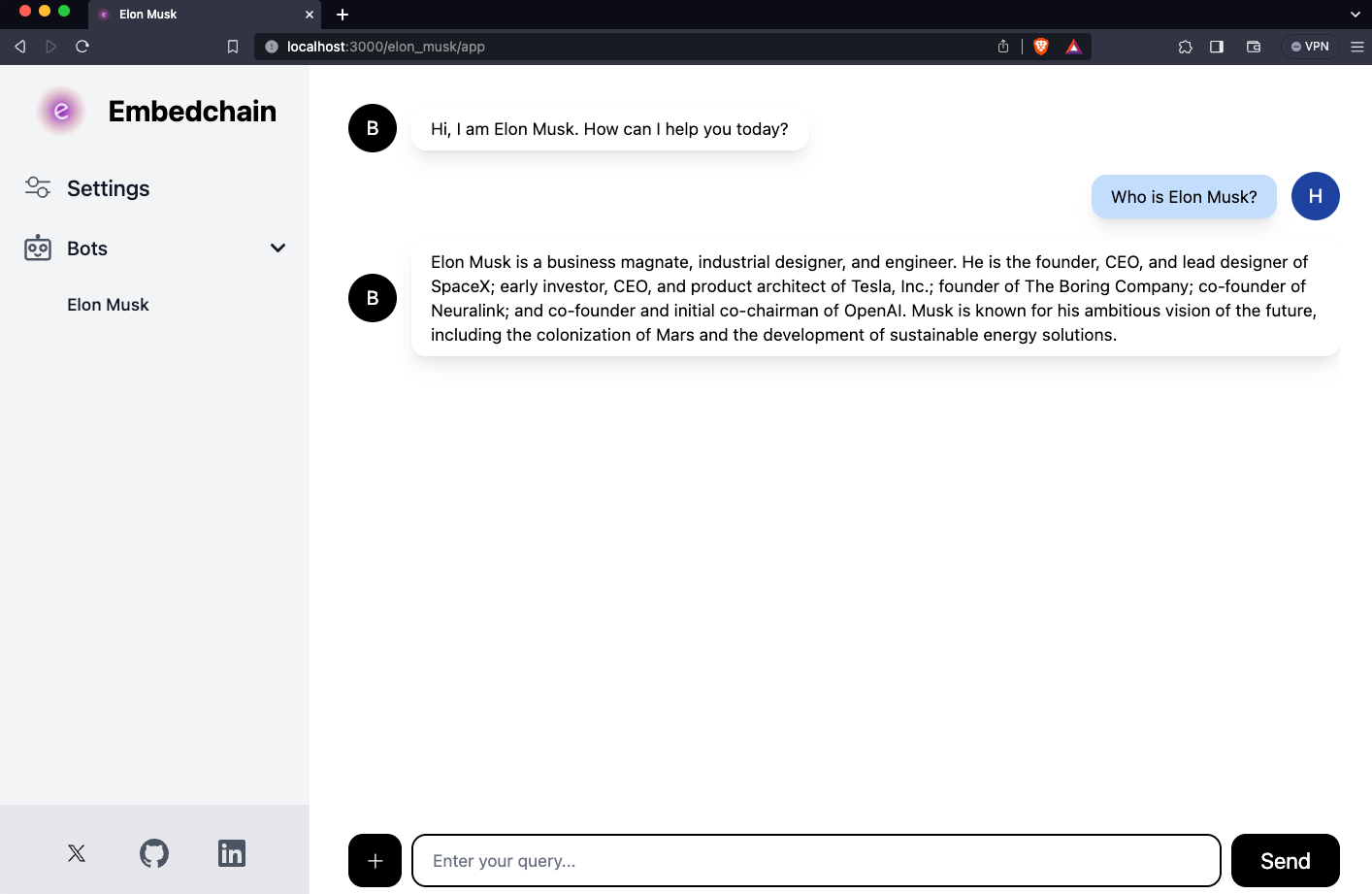
|
||||
|
||||
### 🚀 Usage Instructions
|
||||
|
||||
- Go to [http://localhost:3000/](http://localhost:3000/) in your browser to view the dashboard.
|
||||
- Add your `OpenAI API key` 🔑 in the Settings.
|
||||
- Create a new bot and you'll be navigated to its page.
|
||||
- Here you can add your data sources and then chat with the bot.
|
||||
|
||||
🎉 Happy Chatting! 🎉
|
||||
@@ -182,6 +182,7 @@
|
||||
"examples/rest-api/check-status"
|
||||
]
|
||||
},
|
||||
"examples/full_stack",
|
||||
"examples/openai-assistant",
|
||||
"examples/opensource-assistant",
|
||||
"examples/nextjs-assistant",
|
||||
|
||||
@@ -17,6 +17,9 @@ Chatbots, especially those powered by Large Language Models (LLMs), have a wide
|
||||
Embedchain provides the right set of tools to create chatbots for the above use cases. Refer to the following examples of chatbots on and you can built on top of these examples:
|
||||
|
||||
<CardGroup cols={2}>
|
||||
<Card title="Full Stack Chatbot" href="/examples/full_stack" icon="link">
|
||||
Learn to integrate a chatbot within a full-stack application.
|
||||
</Card>
|
||||
<Card title="Custom GPT Creation" href="https://app.embedchain.ai/create-your-gpt/" target="_blank" icon="link">
|
||||
Build a tailored GPT chatbot suited for your specific needs.
|
||||
</Card>
|
||||
|
||||
@@ -1,2 +1,2 @@
|
||||
gradio>=4.14.0
|
||||
gradio==4.11.0
|
||||
embedchain
|
||||
|
||||
@@ -1,2 +1,2 @@
|
||||
chainlit==0.7.700
|
||||
embedchain==0.1.57
|
||||
embedchain==0.1.31
|
||||
|
||||
@@ -1,3 +1,3 @@
|
||||
discord==2.3.1
|
||||
embedchain==0.1.57
|
||||
embedchain==0.0.58
|
||||
python-dotenv==1.0.0
|
||||
@@ -0,0 +1 @@
|
||||
.git
|
||||
@@ -0,0 +1,18 @@
|
||||
## 🐳 Docker Setup
|
||||
|
||||
- To setup full stack app using docker, run the following command inside this folder using your terminal.
|
||||
|
||||
```bash
|
||||
docker-compose up --build
|
||||
```
|
||||
|
||||
📝 Note: The build command might take a while to install all the packages depending on your system resources.
|
||||
|
||||
## 🚀 Usage Instructions
|
||||
|
||||
- Go to [http://localhost:3000/](http://localhost:3000/) in your browser to view the dashboard.
|
||||
- Add your `OpenAI API key` 🔑 in the Settings.
|
||||
- Create a new bot and you'll be navigated to its page.
|
||||
- Here you can add your data sources and then chat with the bot.
|
||||
|
||||
🎉 Happy Chatting! 🎉
|
||||
@@ -0,0 +1,7 @@
|
||||
__pycache__/
|
||||
database
|
||||
pyenv
|
||||
venv
|
||||
.env
|
||||
.git
|
||||
trash_files/
|
||||
@@ -0,0 +1,6 @@
|
||||
__pycache__
|
||||
database
|
||||
pyenv
|
||||
venv
|
||||
.env
|
||||
trash_files/
|
||||
Some files were not shown because too many files have changed in this diff Show More
Reference in New Issue
Block a user