 Saket Aryan
@mem0/openclaw-mem0
Long-term memory for OpenClaw agents, powered by Mem0.
Your agent forgets everything between sessions. This plugin fixes that. It watches conversations, extracts what matters, and brings it back when relevant — automatically.
How it works
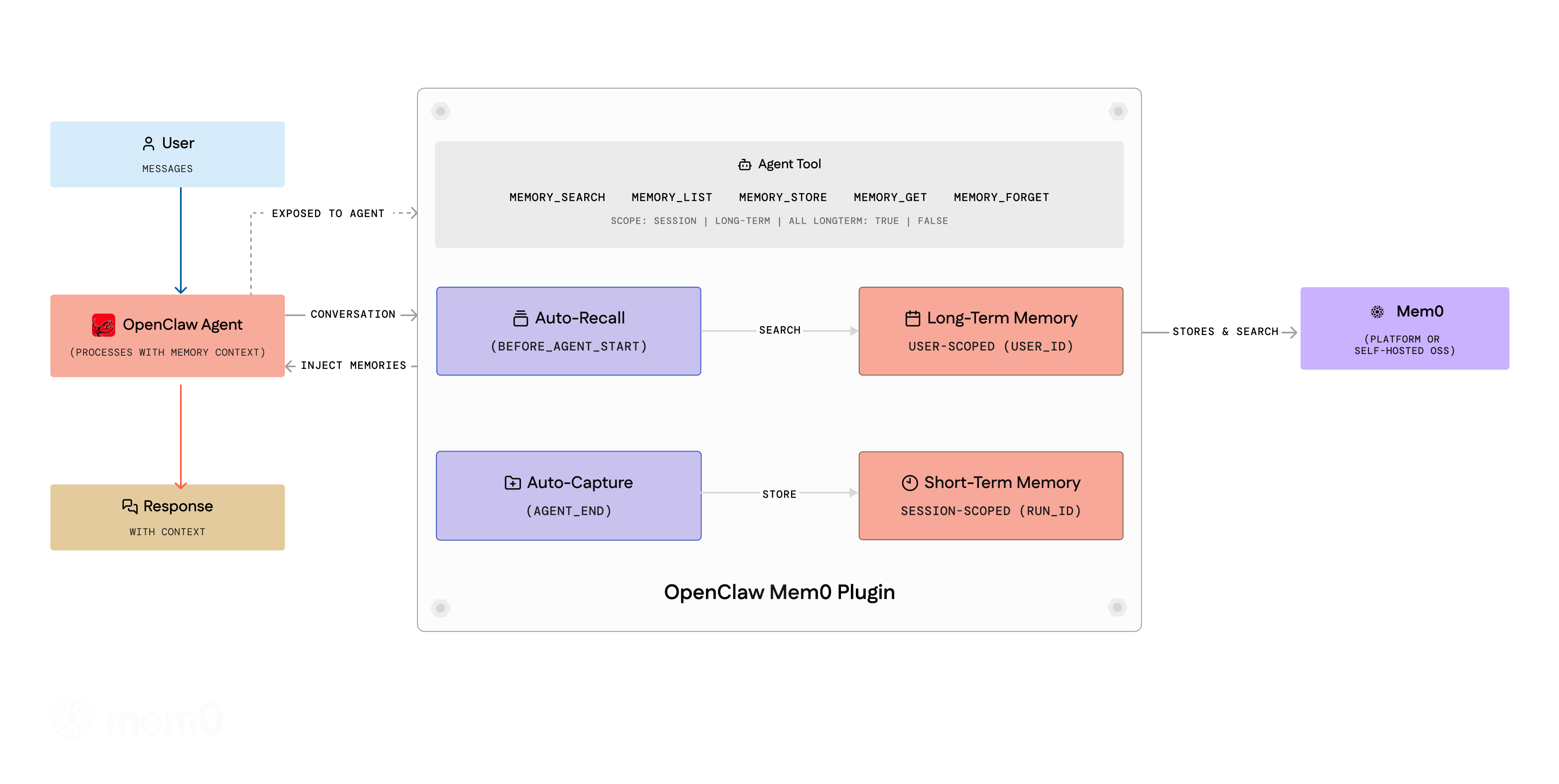
Auto-Recall — Before the agent responds, the plugin searches Mem0 for memories that match the current message and injects them into context.
Auto-Capture — After the agent responds, the plugin sends the exchange to Mem0. Mem0 decides what's worth keeping — new facts get stored, stale ones updated, duplicates merged.
Both run silently. No prompting, no configuration, no manual calls.
Short-term vs long-term memory
Memories are organized into two scopes:
-
Session (short-term) — Auto-capture stores memories scoped to the current session via Mem0's
run_id/runIdparameter. These are contextual to the ongoing conversation and automatically recalled alongside long-term memories. -
User (long-term) — The agent can explicitly store long-term memories using the
memory_storetool (withlongTerm: true, the default). These persist across all sessions for the user.
During auto-recall, the plugin searches both scopes and presents them separately — long-term memories first, then session memories — so the agent has full context.
The agent tools (memory_search, memory_list) accept a scope parameter ("session", "long-term", or "all") to control which memories are queried. The memory_store tool accepts a longTerm boolean (default: true) to choose where to store.
All new parameters are optional and backward-compatible — existing configurations work without changes.
Per-agent memory isolation
In multi-agent setups, each agent automatically gets its own memory namespace. Session keys following the pattern agent:<agentId>:<uuid> are parsed to derive isolated namespaces (${userId}:agent:${agentId}). Single-agent deployments are unaffected — plain session keys and agent:main:* keys resolve to the configured userId.
How it works:
- The agent's session key is inspected on every recall/capture cycle
- If the key matches
agent:<name>:<uuid>, memories are stored underuserId:agent:<name> - Different agents never see each other's memories unless explicitly queried
Explicit cross-agent queries:
All memory tools (memory_search, memory_store, memory_list, memory_forget) accept an optional agentId parameter to query another agent's namespace:
memory_search({ query: "user's tech stack", agentId: "researcher" })
Resolution priority: explicit agentId > explicit userId > session-derived > configured default.
Setup
openclaw plugins install @mem0/openclaw-mem0
Understanding userId
The userId field is a string you choose to uniquely identify the user whose memories are being stored. It is not something you look up in the Mem0 dashboard — you define it yourself.
Pick any stable, unique identifier for the user. Common choices:
- Your application's internal user ID (e.g.
"user_123","alice@example.com") - A UUID (e.g.
"550e8400-e29b-41d4-a716-446655440000") - A simple username (e.g.
"alice")
All memories are scoped to this userId — different values create separate memory namespaces. If you don't set it, it defaults to "default", which means all users share the same memory space.
Tip: In a multi-user application, set
userIddynamically per user (e.g. from your auth system) rather than hardcoding a single value.
Platform (Mem0 Cloud)
Get an API key from app.mem0.ai, then add to your openclaw.json:
// plugins.entries
"openclaw-mem0": {
  "enabled": true,
  "config": {
    "apiKey": "${MEM0_API_KEY}",
    "userId": "alice"  // any unique identifier you choose for this user
  }
}
Open-Source (Self-hosted)
No Mem0 key needed. Requires OPENAI_API_KEY for default embeddings/LLM.
"openclaw-mem0": {
  "enabled": true,
  "config": {
    "mode": "open-source",
    "userId": "alice"  // any unique identifier you choose for this user
  }
}
Sensible defaults out of the box. To customize the embedder, vector store, or LLM:
"config": {
  "mode": "open-source",
  "userId": "your-user-id",
  "oss": {
    "embedder": { "provider": "openai", "config": { "model": "text-embedding-3-small" } },
    "vectorStore": { "provider": "qdrant", "config": { "host": "localhost", "port": 6333 } },
    "llm": { "provider": "openai", "config": { "model": "gpt-4o" } }
  }
}
All oss fields are optional. See Mem0 OSS docs for providers.
Agent tools
The agent gets five tools it can call during conversations:
| Tool | Description |
|---|---|
memory_search |
Search memories by natural language. Optional agentId to scope to a specific agent. |
memory_list |
List all stored memories for a user. Optional agentId to scope to a specific agent. |
memory_store |
Explicitly save a fact. Optional agentId to store under a specific agent's namespace. |
memory_get |
Retrieve a memory by ID |
memory_forget |
Delete by ID or by query. Optional agentId to scope deletion to a specific agent. |
CLI
# Search all memories (long-term + session)
openclaw mem0 search "what languages does the user know"

# Search only long-term memories
openclaw mem0 search "what languages does the user know" --scope long-term

# Search only session/short-term memories
openclaw mem0 search "what languages does the user know" --scope session

# Stats
openclaw mem0 stats

# Search a specific agent's memories
openclaw mem0 search "user preferences" --agent researcher

# Stats for a specific agent
openclaw mem0 stats --agent researcher
Options
General
| Key | Type | Default | |
|---|---|---|---|
mode |
"platform" | "open-source" |
"platform" |
Which backend to use |
userId |
string |
"default" |
Any unique identifier you choose for the user (e.g. "alice", "user_123"). All memories are scoped to this value. Not found in any dashboard — you define it yourself. |
autoRecall |
boolean |
true |
Inject memories before each turn |
autoCapture |
boolean |
true |
Store facts after each turn |
topK |
number |
5 |
Max memories per recall |
searchThreshold |
number |
0.3 |
Min similarity (0–1) |
Platform mode
| Key | Type | Default | |
|---|---|---|---|
apiKey |
string |
— | Required. Mem0 API key (supports ${MEM0_API_KEY}) |
orgId |
string |
— | Organization ID |
projectId |
string |
— | Project ID |
enableGraph |
boolean |
false |
Entity graph for relationships |
customInstructions |
string |
(built-in) | Extraction rules — what to store, how to format |
customCategories |
object |
(12 defaults) | Category name → description map for tagging |
Open-source mode
Works with zero extra config. The oss block lets you swap out any component:
| Key | Type | Default | |
|---|---|---|---|
customPrompt |
string |
(built-in) | Extraction prompt for memory processing |
oss.embedder.provider |
string |
"openai" |
Embedding provider ("openai", "ollama", etc.) |
oss.embedder.config |
object |
— | Provider config: apiKey, model, baseURL |
oss.vectorStore.provider |
string |
"memory" |
Vector store ("memory", "qdrant", "chroma", etc.) |
oss.vectorStore.config |
object |
— | Provider config: host, port, collectionName, dimension |
oss.llm.provider |
string |
"openai" |
LLM provider ("openai", "anthropic", "ollama", etc.) |
oss.llm.config |
object |
— | Provider config: apiKey, model, baseURL, temperature |
oss.historyDbPath |
string |
— | SQLite path for memory edit history |
Everything inside oss is optional — defaults use OpenAI embeddings (text-embedding-3-small), in-memory vector store, and OpenAI LLM. Override only what you need.
License
Apache 2.0